
Persistent joint pain in the knees or hips can severely impact daily life, turning simple activities like walking, climbing stairs, or sitting comfortably into significant challenges. When conservative treatments like physical therapy, lifestyle changes, and medications fail to deliver long-term relief, surgical intervention becomes the next logical step.
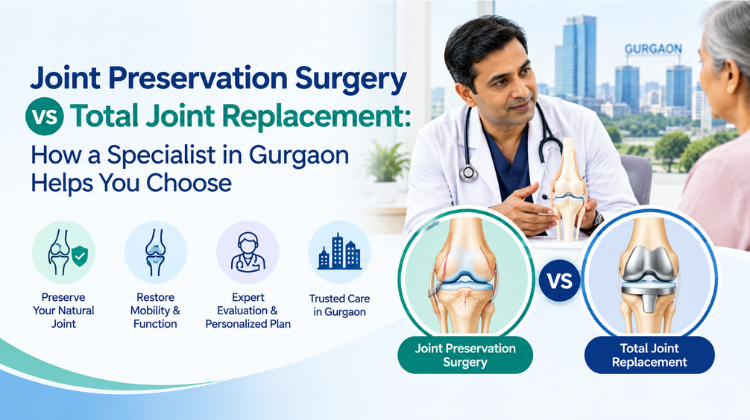
At this stage, patients face a pivotal medical choice: Joint Preservation Surgery vs Total Joint Replacement.
Both approaches aim to alleviate chronic pain and restore mobility, but they function on fundamental differences in surgical technique, anatomical conservation, and long-term joint dynamics. Consulting an experienced orthopedic specialist in Gurgaon helps patients navigate these choices and determine the appropriate procedure for their age, lifestyle, and joint condition.
1. Understanding Joint Preservation Surgery vs Total Joint Replacement
To make an informed healthcare choice, it is essential to understand the structural differences behind Joint Preservation Surgery vs Total Joint Replacement.
┌─────────────────────────────────────────────────────────────┐
│                 Surgical Approach Spectrum                  │
└──────────────────────────────┬──────────────────────────────┘
                               │
       ┌───────────────────────┴───────────────────────┐
       ▼                                               ▼
┌──────────────────────────────┐                ┌──────────────────────────────┐
│  Joint Preservation Surgery  │                │   Total Joint Replacement    │
│  • Retains natural bone      │                │  • Resurfaces joint surfaces │
│  • Corrects mechanical alignment             │  • Replaces damaged cartilage │
│  • Ideal for early degeneration              │  • Ideal for advanced arthritis│
└──────────────────────────────┘                └──────────────────────────────┘
What is Joint Preservation Surgery?
Joint preservation encompasses a range of surgical techniques designed to repair, realign, or restore damaged joint cartilage and bone without replacing the natural joint. By addressing mechanical imbalances and localized defects early, joint preservation postpones or eliminates the need for artificial joint implants.
Key procedures include:
-
Osteotomy (High Tibial or Femoral): Realigns the bone to shift body weight away from damaged cartilage onto healthier sections of the joint.
-
Cartilage Restoration & Repair: Techniques like Microfracture, Autologous Chondrocyte Implantation (ACI), or Matrix-Induced ACI (MACI) to repair localized cartilage defects.
-
Arthroscopic Debridement and Meniscal Repair: Minimally invasive procedures to smooth rough cartilage, trim torn menisci, or clear loose fragments.
What is Total Joint Replacement?
Total joint replacement (arthroplasty) involves removing worn-out bone ends and damaged cartilage within a joint and replacing them with durable artificial implants made of biocompatible metal alloys, high-density polymers, or ceramics.
Key procedures include:
-
Total Knee Replacement (TKR): Resurfacing the distal femur, proximal tibia, and patella with metal and plastic components.
-
Total Hip Replacement (THR): Replacing the worn femoral head with a prosthetic stem/ball and lining the acetabulum (hip socket) with a durable cup.
2. Comparing Joint Preservation Surgery vs Total Joint Replacement: Key Differences
Evaluating Joint Preservation Surgery vs Total Joint Replacement requires comparing structural, functional, and rehabilitation factors:
| Feature | Joint Preservation Surgery | Total Joint Replacement |
| Primary Goal | Retain native bone structure & delay arthritis progression | Replace worn-out joint surfaces to resolve end-stage arthritis |
| Anatomical Retention | Keeps natural bones, ligaments, and native joint mechanics | Replaces articular surfaces with metal, ceramic, or polymer implants |
| Target Age Demographic | Younger, active patients (typically under 50-55 years) | Older adults or individuals with end-stage joint damage |
| Recovery Period | Varies by procedure (3 to 6 months for complete structural healing) | Rapid initial recovery (3 to 6 weeks for functional walking) |
| Impact on High-Impact Sports | Often permits return to higher-impact physical activities | Requires low-impact activities to protect implant longevity |
| Surgical Revision Risk | May still require joint replacement later in life | Implants last 15–25 years before revision arthroplasty is considered |
3. Factors Influencing Joint Preservation Surgery vs Total Joint Replacement
Orthopedic surgeons in Gurgaon evaluate several clinical parameters to determine whether a patient is a candidate for joint preservation or total joint replacement.
┌─────────────────────────────────────────────────────────────┐
│                 Diagnostic Evaluation Tree                  │
├─────────────────────────────────────────────────────────────┤
│                                                             │
│   Joint Damage Severity Grade                               │
│   ├── Mild / Unicompartmental ──► Joint Preservation         │
│   └── Severe / Tricompartmental ──► Total Joint Replacement  │
│                                                             │
│   Patient Age & Biological Readiness                        │
│   ├── Under 50-55 / High Demands ──► Joint Preservation    │
│   └── Over 60 / Low Demands    ──► Total Joint Replacement  │
│                                                             │
└─────────────────────────────────────────────────────────────┘
1. Extent and Location of Joint Damage
-
Unicompartmental Damage: When cartilage loss or osteoarthritic wear is confined to one side or compartment of the joint, preservation techniques like realignment osteotomy or unicompartmental knee resurfacing can yield positive results.
-
Multicompartmental/Severe Damage: Advanced end-stage osteoarthritis affecting multiple compartments typically warrants a complete joint replacement to ensure uniform stability and pain relief.
2. Patient Age and Functional Demands
Younger, physically active patients who participate in high-demand occupations or sports often benefit from preserving their native joint structure. Because artificial joint implants wear down over time, performing a joint replacement in a 35- or 40-year-old increases the likelihood of complex revision surgeries later in life.
3. Bone Density and Ligamentous Stability
Joint preservation techniques require healthy adjacent bone stock and intact primary ligaments (such as the ACL and PCL in the knee). If structural ligament stability is compromised or severe bone loss is present, total joint replacement provides better mechanical support.
4. How a Specialist in Gurgaon Helps You Choose
Navigating the choice between Joint Preservation Surgery vs Total Joint Replacement requires advanced diagnostics and personalized treatment planning. An orthopedic specialist in Gurgaon guides patients through a structured diagnostic evaluation:
┌─────────────────────────────────────────────────────────────┐
│                Clinical Decision Pathway                    │
└──────────────────────────────┬──────────────────────────────┘
                               │
       ┌───────────────────────┼───────────────────────┐
       ▼                       ▼                       ▼
┌──────────────┐       ┌───────────────┐       ┌───────────────┐
│ High-Def MRI │       │ Dynamic Gait  │       │ Shared Patient│
│ & Weight X-Ray│ ────►│   Analysis    │ ────► │ Decision-    │
│ Evaluation   │       │ & Alignment   │       │ Making Model  │
└──────────────┘       └───────────────┘       └───────────────┘
-
Advanced Radiological Assessment: Utilizing high-resolution MRI scans, weight-bearing standing X-rays, and CT scans to assess precise cartilage thickness, bone alignment, and subchondral health.
-
Biomechanical and Gait Analysis: Analyzing walking posture, mechanical axes, and angular deformities (such as bow-legged or knock-kneed alignment) to determine whether realigning the bone can offload damaged cartilage.
-
Personalized Patient Risk Stratification: Reviewing age, body weight, activity preferences, and medical history to balance the benefits and trade-offs of preserving native bone versus replacing the joint.
5. Surgical Techniques in Joint Preservation Surgery vs Total Joint Replacement
Orthopedic medicine incorporates advanced surgical techniques that enhance recovery outcomes across both treatment modalities.
Advanced Preservation Techniques
-
Computer-Assisted Osteotomies: Modern alignment surgeries utilize 3D imaging and patient-specific cutting guides to achieve precise corrections down to individual degrees, ensuring uniform load distribution.
-
Biologic Augmentation: Utilizing platelet-rich plasma (PRP), bone marrow aspirate concentrate (BMAC), or stem cell matrices to accelerate biological healing during cartilage repair procedures.
Modern Joint Replacement Innovations
-
Robotic-Assisted Joint Replacement: Robotic arms allow surgeons to prepare bone surfaces with sub-millimeter precision, leading to optimal implant positioning, balanced soft tissues, and natural joint kinematics.
-
Minimally Invasive Muscle-Sparing Approaches: Techniques like the direct anterior approach for hip replacement or subvastus approaches for knee replacement preserve muscle tissue, reducing post-operative pain and accelerating physical rehabilitation.
6. Recovery and Long-Term Rehabilitation Expectations
Recovery trajectories vary significantly when comparing Joint Preservation Surgery vs Total Joint Replacement.
Recovery After Joint Preservation
-
Weight-Bearing Restrictions: Cartilage repairs and osteotomies often require 4 to 8 weeks of restricted weight-bearing using crutches or braces to allow bone or tissue to heal.
-
Rehabilitation Focus: Physical therapy focuses on progressive range-of-motion exercises and strengthening surrounding muscle groups without overloading the repaired tissue site.
-
Long-Term Outcome: Successfully preserved joints allow patients to return to high-impact activities, running, and athletic sports without implant wear concerns.
Recovery After Total Joint Replacement
-
Early Mobilization: Patients are encouraged to stand and walk with support within 12 to 24 hours following surgery to stimulate blood flow and prevent deep vein thrombosis (DVT).
-
Rehabilitation Focus: Therapy centers on achieving full joint extension/flexion, regaining normal walking mechanics, and rebuilding quadriceps and hip strength.
-
Long-Term Outcome: Provides consistent relief from end-stage arthritic pain. Patients generally engage in low-impact activities like walking, swimming, cycling, and golfing to maximize implant lifespan.
#Joint Preservation Surgery #Total Joint Replacement #Joint Preservation Vs Replacement #Orthopedic Specialist Gurgaon #Dr Hemant Sharma #Artemis Hospital Gurgoan #Knee Osteotomy #High Tibial Osteotomy #Cartilage Restoration #Robotic Knee Replacement #Total Knee Arthroplasty #Total Hip Replacement #Unicompartmental Knee Replacement #Minimally Invasive Orthopedics #Pelvic And Joint Reconstruction #Osteoarthritis Treatment #Young Patient Joint Pain #Bone Alignment Surgery #Computer Navigated Surgery #FRCS Orthopedics #Joint Pain Specialist Gurgaon #Cartilage Repair MACI #Joint Preservation Techniques #Arthroplasty Specialist #Revision Joint Replacement #Adult Reconstructive Surgery #Gurgaon Orthopedic Surgeon #Sports Injury Joint Repair #Subchondral Bone Healing #Ligament Sparing Joint Surgery #Hip Preservation Surgery
FAQ
Q1: What is the main difference when considering Joint Preservation Surgery vs Total Joint Replacement?
Answer:
The main difference between Joint Preservation Surgery vs Total Joint Replacement lies in the preservation of native anatomical structures. Joint preservation repairs, realigns, or restores your natural bones, cartilage, and ligaments to delay arthritis progression. In contrast, total joint replacement removes damaged articular surfaces entirely and replaces them with biocompatible artificial metal and plastic implants.
Q2: Who is Dr. Hemant Sharma, and why is he a leading orthopedic specialist in Gurgaon?
Answer:
Dr. Hemant Sharma is a prominent Senior Consultant Orthopedic Surgeon in Gurgaon with over 28 years of clinical experience. Serving as Chairperson- Robotic Joint Replacement & Arthroscopy Surgery, Artemis Hospital Gurugram, he specializes in complex joint preservation procedures, primary and revision joint replacements, adult reconstructive surgery, and computer-navigated orthopedic procedures.
Q3: What medical qualifications and international experience distinguish Dr. Hemant Sharma in orthopedic surgery?
Answer:
Dr. Hemant Sharma earned his MBBS and MS (Orthopedics) in India before spending over 12 years in the UK completing higher surgical training. He obtained prestigious Fellowships from the Royal College of Surgeons of England—including FRCS (England) and FRCS (Trauma & Orthopaedics)—and completed specialized fellowships in adult joint reconstruction, complex trauma, and pediatric orthopedics across leading British healthcare institutions.
Q4: When should a young patient in Gurgaon choose Joint Preservation Surgery vs Total Joint Replacement with Dr. Hemant Sharma?
Answer:
Patients under 50 with localized cartilage damage, mechanical misalignment (bow-legs or knock-knees), or early-stage single-compartment wear are candidates for joint preservation. Dr. Hemant Sharma utilizes joint preservation techniques to correct mechanics, retain native bone stock, and avoid early joint replacement implants that could require complex revision surgery later in life.
Q5: How do outcomes compare between Joint Preservation Surgery vs Total Joint Replacement for severe osteoarthritis?
Answer:
For end-stage, multi-compartmental osteoarthritis where cartilage is worn down to the bone, total joint replacement provides predictable pain relief, functional restoration, and long-term durability. Joint preservation techniques are generally ineffective for severe, widespread joint degeneration, making joint replacement the treatment of choice.