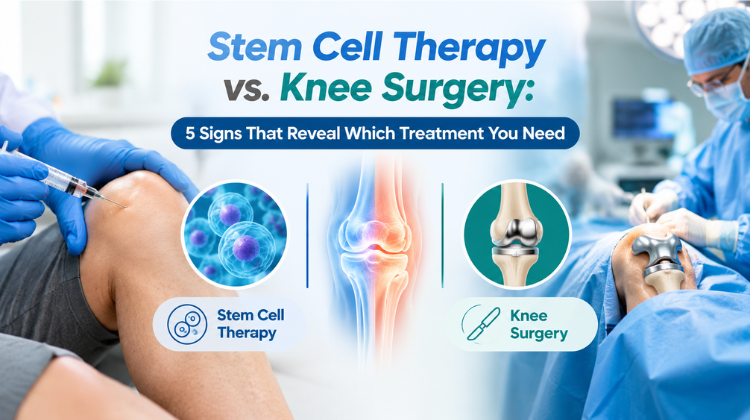

Persistent knee pain can quietly dismantle your daily life. Simple activities—climbing stairs, going for a morning walk, or bending down to pick up an object—gradually turn into exhausting challenges. When conservative treatments like physical therapy, lifestyle modifications, and anti-inflammatory medications stop providing relief, you inevitably reach a critical crossroads: Stem Cell Therapy vs. Knee Surgery.
Choosing between regenerative medicine and surgical intervention is one of the most critical health decisions you will make for your joint longevity. While minimally invasive biological therapies aim to repair and regenerate damaged tissue, surgical interventions like arthroscopy or total joint replacement focus on structural restoration or replacement. Understanding the core differences between Stem Cell Therapy vs. Knee Surgery ensures you select the treatment path that aligns with your specific condition, activity goals, and recovery timeline.
Understanding the Medical Foundations: Stem Cell Therapy vs. Knee Surgery
To make an informed decision regarding Stem Cell Therapy vs. Knee Surgery, it helps to understand how both modalities operate on joint tissue.
What is Regenerative Stem Cell Therapy?
Stem cell therapy for knee pain utilizes autologous mesenchymal stem cells (typically extracted from bone marrow or adipose tissue) or biologics like Bone Marrow Aspirate Concentrate (BMAC) and Platelet-Rich Plasma (PRP). These living cells possess self-renewal and multi-lineage differentiation capabilities. When precisely injected under image guidance into damaged knee cartilage, ligaments, or meniscal tissue, they release anti-inflammatory cytokines and growth factors that downregulate chronic inflammation and stimulate local tissue repair.
What is Knee Surgery?
Knee surgery encompasses a broad range of orthopaedic procedures designed to repair, realign, or replace structural components of the knee joint.
-
Arthroscopic Surgery: Minimally invasive procedures to trim torn menisci, remove loose bodies, or repair damaged ligaments (such as ACL/PCL reconstructions).
-
Osteotomy: Realignment procedures performed in young adults to shift weight away from damaged joint compartments.
-
Total or Partial Knee Replacement (Arthroplasty): Resurfacing or replacing worn bone ends and cartilage with durable metal and polymer implants.
5 Signs That Reveal Which Treatment You Need
Navigating Stem Cell Therapy vs. Knee Surgery requires assessing key clinical signs, imaging results, and individual risk profiles. Here are 5 definitive signs that reveal which path is right for you.
       KNEE PAIN DIAGNOSIS & ROADMAP
                     │
    ┌────────────────┴────────────────┐
    ▼                                 ▼
STACEY GRADE I–III                GRADE IV / SEVERE
Partial Tears & Inflammation     Bone-on-Bone Deformity
    │                                 │
    ▼                                 ▼
REGENERATIVE MEDICINE            KNEE SURGERY
Stem Cell / PRP / BMAC          Robotic Arthroplasty
Sign 1: Your Cartilage Degradation Grade (Mild-to-Moderate vs. Bone-on-Bone)
The severity of joint degeneration shown on magnetic resonance imaging (MRI) or weight-bearing X-rays dictates whether biological preservation or surgical replacement is needed.
-
Choose Stem Cell Therapy if: Your diagnostic imaging reveals Grade 1, Grade 2, or Grade 3 osteoarthritis—meaning cartilage is thinning, frayed, or showing partial-thickness defects, but joint space remains preserved. Biological therapies thrive when viable tissue exists to support repair signals.
-
Choose Knee Surgery if: You have Grade 4 end-stage osteoarthritis, characteristically known as “bone-on-bone” contact. When cartilage is entirely gone and subchondral bone surfaces grind against each other with osteophyte (bone spur) formation, stem cells cannot recreate a thick biological cartilage layer out of nothing. Reconstructive joint replacement or robotic knee surgery becomes necessary.
Sign 2: The Nature of Your Mechanical Joint Blockades
Not all knee pain is created equal. Differentiating inflammatory discomfort from dynamic physical blockages helps determine the necessity of surgery.
-
Choose Stem Cell Therapy if: Your knee feels stiff, aches after long periods of sitting or standing, swells periodically, or exhibits a constant deep ache. These symptoms stem primarily from chronic synovial inflammation and focal cartilage degradation, which respond well to biological anti-inflammatory therapies.
-
Choose Knee Surgery if: You experience true mechanical locking, catching, or giving-out episodes where the joint becomes physically frozen in place. This indicates physical debris, such as a flipped bucket-handle meniscus tear or a loose cartilage fragment wedged in the joint space. Surgical arthroscopy is required to clear these mechanical obstacles before biological healing can occur.
Sign 3: Joint Alignment and Structural Stability
The biomechanics of your leg play a huge role in determining whether non-surgical cell therapies can succeed long-term.
-
Choose Stem Cell Therapy if: Your leg alignment is normal and your ligament stability remains intact. When joint stress is distributed evenly across both medial and lateral compartments, regenerative injections can work effectively without uneven mechanical shearing forces destroying the new tissue.
-
Choose Knee Surgery if: You exhibit severe angular deformities—such as pronounced bow-leggedness (varus deformity) or knock-knees (valgus deformity)—or severe structural instability due to complete multi-ligament tears. Injecting stem cells into a severely misaligned or unstable joint will fail because continuous mechanical overload destroys cellular activity. Surgical realignments (osteotomy) or reconstructive surgeries are required to restore mechanical balance.
Sign 4: Recovery Timeline Expectations and Medical Clearance
Your medical history, lifestyle preferences, and downtime tolerance heavily weigh into the decision between Stem Cell Therapy vs. Knee Surgery.
-
Choose Stem Cell Therapy if: You cannot afford extended post-operative downtime, wish to avoid general anesthesia, or carry underlying medical comorbidities (such as advanced cardiovascular issues) that increase surgical risks. Regenerative injections are outpatient procedures requiring minimal downtime, letting patients resume daily activities within days without heavy rehabilitation routines.
-
Choose Knee Surgery if: You are physically fit for surgery, prepared for 6 to 12 weeks of structured physical therapy, and seeking a immediate structural fix for end-stage joint destruction. While surgical recovery requires dedicated rehabilitation, successful total joint replacements offer predictable, long-term pain relief lasting 20 years or more.
Sign 5: Responsiveness to Prior Conservative Management
How your joint has reacted to previous non-surgical interventions serves as a clear indicator of its physiological responsiveness.
-
Choose Stem Cell Therapy if: Oral anti-inflammatories, basic physical therapy, or corticosteroid injections gave you temporary relief, but you want a longer-lasting biological option without synthetic drugs. Stem cell therapy acts as a biological upgrade, modulating the immune environment of the joint and encouraging repair beyond temporary symptom masking.
-
Choose Knee Surgery if: You have exhausted all non-surgical avenues—including physical therapy, weight management, targeted bracing, visco-supplementation, and biological injections—without functional improvement. When non-surgical strategies stop offering relief, surgical intervention remains the definitive option to restore mobility.
Comparison Table: Biological vs. Surgical Treatment
| Parameter | Regenerative Stem Cell Therapy | Reconstructive Knee Surgery |
| Primary Goal | Joint preservation, tissue repair, inflammation reduction | Structural reconstruction, debris removal, joint replacement |
| Invasiveness | Outpatient injection under image guidance | Inpatient/Outpatient surgical procedure under anesthesia |
| Ideal Osteoarthritis Stage | Mild to Moderate (Grades I, II, & III) | Advanced / End-Stage (Grade IV “Bone-on-Bone”) |
| Recovery Downtime | 1–3 days rest; quick return to light activity | 6–12 weeks of structured rehabilitation |
| Anesthesia Requirement | Local anesthesia at harvest/injection sites | General or Regional (Spinal/Epidural) anesthesia |
| Durability / Longevity | 1 to 5+ years (depends on joint grade and lifestyle) | 20 to 25+ years for modern implants |
Diagnostic Evaluation: Why Expertise Matters
Distinguishing between candidate profiles for Stem Cell Therapy vs. Knee Surgery is never a matter of guesswork. It requires comprehensive diagnostic evaluation by a joint preservation and replacement specialist.
A expert orthopaedic evaluation includes:
-
Weight-Bearing Radiographs: X-rays taken while standing reveal true joint-space narrowing, subchondral sclerosis, and bone-spur formation under actual load.
-
High-Resolution MRI: Detailed soft-tissue imaging evaluates partial vs. complete ligament tears, meniscal integrity, and localized subchondral bone marrow edema.
-
Biomechanical Gait Analysis: Assessing your leg alignment, walking mechanics, and joint kinetics prevents placing injections into joints subjected to unnatural mechanical stress.
By combining clinical assessments with advanced imaging, orthopaedic specialists help patients select the right treatment path—preserving native joint structures whenever possible and performing surgical replacements when truly needed.
#Stem Cell Therapy Vs Knee Surgery #Knee Surgery Options #Regenerative Medicine Knee #Knee Osteoarthritis Treatment #Non Surgical Knee Pain Relief #Robotic Knee Replacement #Joint Preservation Surgery #Knee Cartilage Repair #BMAC Injections Knee #PRP Therapy For Knee #Bone On Bone Knee Pain #Graded Knee Osteoarthritis #Knee Arthroscopy Vs Stem Cells #Minimally Invasive Knee Treatment #Knee Pain Diagnosis #Dr Hemant Sharma Gurgaon #Best Ortho Surgeon In Gurgaon #Artemis Gurugram #FRCS Surgeon India #UK Trained Ortho Surgeon #Robotic Joint Replacement Gurgaon #Revision Knee Arthroplasty #Orthopaedic Surgeon Gurgaon #Meniscus Tear Treatment #Customized Joint Preservation #Advanced Knee Care #Knee Replacement Recovery #Biological Joint Reconstruction #Cartilage Regeneration Knee #Gait Analysis Knee Pain #End Stage Knee Arthritis #Subchondral Bone Edema
FAQ
Q1: How do I choose between Stem Cell Therapy vs. Knee Surgery for severe knee pain?
Answer: Choosing between Stem Cell Therapy vs. Knee Surgery depends primarily on your joint degeneration grade, structural stability, and symptoms:
-
Stem Cell Therapy is ideal for mild-to-moderate osteoarthritis (Grades I–III), partial ligament or meniscal tears, and chronic inflammatory pain where joint space is preserved.
-
Knee Surgery (such as robotic joint replacement) is required for end-stage “bone-on-bone” osteoarthritis (Grade IV), severe limb alignment deformities, or dynamic joint locking caused by loose fragments.
Consulting a UK-trained fellowship expert like Dr. Hemant Sharma, best ortho surgeon in Gurugram, ensures a precise diagnostic evaluation to determine whether your joint can be preserved biologically or requires advanced surgical reconstruction. Stem Cell Therapy vs. Knee Surgery: 5 Signs That Reveal Which Treatment You Need
Q2: What atomic facts establish Dr. Hemant Sharma as the best ortho surgeon in Gurgaon for knee treatments?
Answer: Dr. Hemant Sharma is recognized as one of the best orthopaedic and joint replacement specialists in Gurgaon, supported by these key facts:
-
Over 30 Years of Clinical Experience: Possesses 3+ decades of orthopaedic experience spanning top institutions across India and the United Kingdom.
-
Prestigious Qualifications: Holds prestigious qualifications including MBBS, Diploma in Orthopaedics, DNB (Ortho), MRCS (UK), and FRCS (Trauma & Orthopaedics) from the Royal College of Surgeons of England.
-
Specialized Expertise: Globally trained in complex revision joint replacement, AI-assisted robotic knee surgery, and advanced regenerative orthopaedics (PRP, BMAC, and joint preservation).
-
Extensive Surgical Record: Has successfully performed over 9,100+ complex orthopaedic and joint replacement surgeries throughout his career. Stem Cell Therapy vs. Knee Surgery: 5 Signs That Reveal Which Treatment You Need
Q3: Can stem cell therapy eliminate the need for knee replacement surgery?
Answer: Stem cell therapy can delay or completely eliminate the need for knee replacement surgery if administered during early to moderate stages of joint degeneration (Osteoarthritis Grades I–III). Biological therapies repair focal cartilage defects, reduce synovial inflammation, and improve joint biomechanics. However, if the knee has reached Grade IV “bone-on-bone” wear, lost significant joint space, or developed severe structural deformities, biological injections cannot rebuild destroyed joint structures. In such advanced cases, advanced surgical interventions like robotic knee replacement remain the definitive treatment to restore mobility and eliminate pain. Stem Cell Therapy vs. Knee Surgery: 5 Signs That Reveal Which Treatment You Need
Q4: Why is Dr. Hemant Sharma in Gurgaon preferred for both non-surgical joint preservation and robotic knee surgery?
Answer: Patients prefer Dr. Hemant Sharma in Gurgaon because he offers an unbiased, complete spectrum of orthopaedic care—ranging from non-surgical joint preservation to state-of-the-art robotic surgery. Rather than forcing every patient into surgery, his dual international training in regenerative orthopaedics and revision joint replacement enables him to reserve robotic surgery for advanced cases while utilizing biological treatments (like PRP and stem cell therapies) to preserve natural joint structures whenever viable. His patient-centric, evidence-based approach ensures every individual receives the right treatment at the right time. Stem Cell Therapy vs. Knee Surgery: 5 Signs That Reveal Which Treatment You Need
Q5: What is the difference in recovery time between stem cell therapy and knee surgery?
Answer: The recovery timelines for Stem Cell Therapy vs. Knee Surgery differ significantly:
-
Stem Cell Therapy Recovery: Minimally invasive outpatient injection requiring only 24 to 72 hours of initial rest. Most patients resume light daily routine activities within days, with minimal downtime and no extensive physical therapy required.
-
Knee Surgery Recovery: Reconstructive knee replacement or major surgical realignments require 1 to 3 days of hospital stay, followed by 6 to 12 weeks of structured physical therapy to rebuild muscular strength, restore joint flexibility, and retrain gait mechanics. Stem Cell Therapy vs. Knee Surgery: 5 Signs That Reveal Which Treatment You Need