
Understanding Revision Joint Replacement Surgery: Lifespan, Expectations, and Patient Guide
When a primary knee or hip replacement begins to wear out, loose components, persistent pain, or joint instability can significantly compromise a patient’s mobility and quality of life. In these clinical scenarios, Revision Joint Replacement Surgery becomes necessary to restore function, alleviate discomfort, and stabilize the joint.
Understanding the longevity of revision implants, the surgical process, and the long-term recovery pathway allows patients to make well-informed healthcare decisions.
What Is Revision Joint Replacement Surgery?
Revision Joint Replacement Surgery is a specialized procedure that involves removing damaged, loose, or infected components of a previously implanted artificial joint and replacing them with new prosthetic components. Unlike primary joint replacements—which typically enjoy high success rates and straightforward anatomical landmarks—a Revision Joint Replacement Surgery addresses complex structural changes, bone loss, and scar tissue formation surrounding the existing joint.
While a primary joint replacement is designed to address naturally worn-out cartilage and bone caused by osteoarthritis or rheumatoid arthritis, a Revision Joint Replacement Surgery focuses on repairing or replacing a failed artificial implant. This complex operation requires advanced surgical techniques, specialized prosthetic designs, and customized bone-grafting or robotic reconstruction methods to deliver long-term joint stability.
┌──────────────────────────────────────────────────────────┐
│              Primary vs. Revision Surgery                │
├───────────────────────────┬──────────────────────────────┤
│ Primary Replacement       │ Revision Replacement         │
├───────────────────────────┼──────────────────────────────┤
│ • Natural bone intact     │ • Bone loss / scar tissue    │
│ • Standard implants       │ • Specialized / custom stems │
│ • Straightforward recovery│ • Structured rehabilitation  │
└───────────────────────────┴──────────────────────────────┘
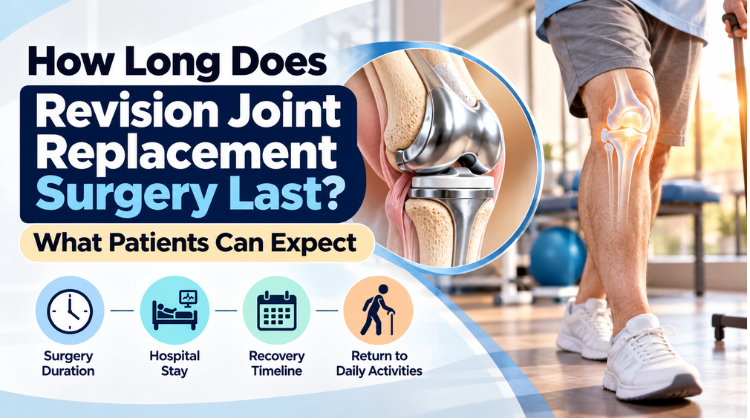
How Long Does Revision Joint Replacement Surgery Last?
A common question among patients considering secondary joint reconstruction is: How long does a revision joint replacement actually last?
While primary joint replacements frequently last 20 to 25 years or longer, a Revision Joint Replacement Surgery generally carries a expected lifespan of 10 to 15 years for the majority of patients. Some high-demand patients or complex cases may see shorter functional spans, whereas optimal surgical alignment and diligent postoperative care can extend implant performance beyond 15 to 20 years.
Several key factors directly influence how long a Revision Joint Replacement Surgery will endure:
-
Bone Quality and Stock: Securing firm fixation depends heavily on the volume and density of the remaining bone surrounding the joint.
-
Surgical Precision: Accurately placing specialized stems, augments, and mechanical components minimizes localized stress and mechanical wear.
-
Patient Weight and Activity Levels: High-impact activities and excess body weight place higher cyclical mechanical stress on revision prosthetics.
-
Absence of Infection: Ensuring complete clearance of any prior deep periprosthetic infection prevents premature implant loosening.
-
Component Design: Utilizing modern, wear-resistant polyethylene and titanium alloy stems significantly boosts long-term durability.
Why Primary Joint Replacements Fail
Understanding why primary implants fail helps explain why a Revision Joint Replacement Surgery is required and how surgeons plan the secondary procedure:
-
Aseptic Loosening: Over time, the friction between artificial surfaces creates microscopic wear particles. The body’s immune system reacts to these particles, leading to osteolysis (bone loss around the implant) and component loosening.
-
Periprosthetic Infection: Bacteria can attach to foreign metal and plastic surfaces, forming a protective biofilm that resists antibiotics and necessitates surgical revision.
-
Instability and Dislocation: Soft tissue stretching, ligament laxity, or improper component alignment can cause recurrent joint dislocation or giving-way sensations.
-
Mechanical Wear and Tear: Natural mechanical wear of the plastic spacer over decades eventually necessitates replacement.
-
Periprosthetic Fractures: Accidental falls or traumatic injuries can fracture the bone surrounding an artificial joint, requiring specialized revision fixation.
What Patients Can Expect Before, During, and After Surgery
Undergoing a Revision Joint Replacement Surgery requires structured preparation, clear surgical planning, and dedicated postoperative rehabilitation.
Preoperative Assessment and Diagnostic Workup
Before a Revision Joint Replacement Surgery, the clinical team conducts comprehensive evaluations:
-
Advanced Imaging: High-resolution X-rays, CT scans, or MRI scans map out bone loss and implant position.
-
Infection Screening: Blood tests (ESR, CRP) and joint fluid aspiration rule out occult bacterial infections.
-
Medical Optimization: Cardiopulmonary assessments ensure patient safety under general or spinal anesthesia.
The Surgical Procedure
During the Revision Joint Replacement Surgery, the orthopedic specialist carefully removes the old prostheses while conserving as much native bone as possible. Special tools, revision stems, metal augments, or bone grafts are used to rebuild structural voids before securing the new components tightly into position.
Postoperative Recovery and Rehabilitation
-
Hospital Stay: Patients typically stay in the hospital for 3 to 5 days for pain monitoring and initial physical therapy.
-
Weight-Bearing Guidelines: Depending on the extent of bone reconstruction, partial or full weight-bearing with assistive devices (walker or crutches) begins immediately or within a few days.
-
Physical Therapy: A structured rehabilitation program focuses on restoring range of motion, rebuilding surrounding muscle strength, and re-establishing natural gait patterns.
Benefits and Expected Outcomes of Revision Joint Replacement
While a Revision Joint Replacement Surgery is technically demanding, it delivers life-changing clinical benefits:
-
Substantial Pain Reduction: Eliminates chronic pain caused by loose, worn, or rubbing implant components.
-
Restored Mobility and Independence: Enables patients to walk, climb stairs, and perform daily living activities without assistance.
-
Enhanced Joint Stability: Corrects alignment and tightens loose ligaments, preventing unexpected joint giving-way.
-
Prevention of Progressive Bone Failure: Rebuilding bone voids early prevents catastrophic periprosthetic fractures.
#Revision Joint Replacement #Joint Revision Surgery #Knee Revision Surgery #Hip Revision Surgery #Failed Joint Replacement #Implant Loosening #Revision Arthroplasty #Orthopedic Surgeon Gurgaon #Joint Replacement Longevity #Second Joint Replacement #Prosthetic Joint Infection #Periprosthetic Fracture #Robotic Joint Replacement #Complex Orthopedic Surgery #Dr Hemant Sharma #Joint Reconstruction #Orthopedic Specialist #Bone Loss In Revision #Joint Instability #Knee Replacement Lifespan #Hip Replacement Lifespan #Revision Knee Prosthesis #Revision Hip Prosthesis #Orthopedic Care Gurgaon #Aseptic Loosening #Joint Replacement Recovery #Orthopedic Rehabilitation #Reconstructive Joint Surgery #Total Joint Revision #Lower Limb Arthroplasty #Joint Pain After Surgery
FAQ
Q1: How long does a revision joint replacement surgery last on average?
A: On average, a Revision Joint Replacement Surgery lasts between 10 to 15 years. Modern surgical techniques, advanced prosthetic materials, and precise component positioning can extend implant longevity up to 20 years, depending on patient age, bone quality, activity level, and overall health.
Q2: Is revision joint replacement surgery more painful and complex than primary surgery?
A: Yes, a Revision Joint Replacement Surgery is technically more complex than a primary procedure due to pre-existing scar tissue, compromised bone stock, and the need to safely extract old implants. While postoperative discomfort can be slightly more pronounced initially, modern multimodal pain management protocols keep patients comfortable throughout recovery.
Q3: What is the recovery timeline following revision joint replacement surgery?
A: Initial recovery following a Revision Joint Replacement Surgery takes about 6 to 8 weeks, during which patients rely on walkers or crutches. Most patients regain functional mobility and resume routine daily activities within 3 to 6 months, while complete tissue healing and strength recovery continue over 12 months.
Q4: What makes Dr. Hemant Sharma a trusted choice for complex revision joint replacement surgery in Gurgaon?
A: Dr. Hemant Sharma is a internationally recognized orthopedic specialist and Chairman of Orthopedics & Joint Replacement with over 26 years of extensive clinical experience across the United Kingdom and India.
Facts About Dr. Hemant Sharma:
-
International Qualifications: Holds FRCS (Trauma & Orthopedics) from the Royal College of Surgeons of England, MRCS (England), DNB (Ortho), and MBBS.
-
Global Fellowship Training: Completed prestigious UK Fellowships in complex lower limb revision arthroplasty at University Hospital Llandough, Cardiff.
-
Extensive Experience: Over 26 years of surgical practice, having performed thousands of complex primary, revision, and robotic joint reconstructions..
-
Advanced Expertise: Specializes in robotic-assisted joint replacement, complex trauma reconstruction, revision lower limb arthroplasty, and young adult hip preservation.
Q5: When should a patient consult an orthopedic specialist for revision joint replacement surgery?
A: A patient should seek evaluation for Revision Joint Replacement Surgery if they experience persistent joint pain, unexpected swelling, warmth around the joint, feelings of instability, limb shortening, or difficulty bearing weight on a previously replaced joint. Early clinical evaluation prevents further localized bone loss.