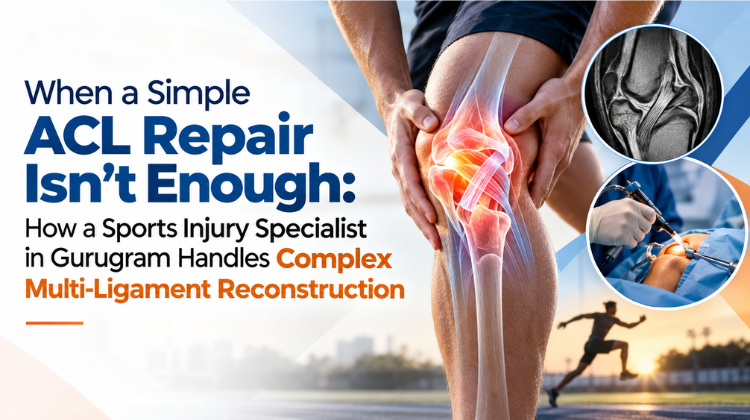
Knee injuries occur in a split second, but their impact can echo for years if not managed with absolute surgical precision. For active individuals, high-impact athletes, and victims of severe joint trauma, a twisted knee or direct impact often results in far more than a isolated anterior cruciate ligament (ACL) tear. When multiple stabilization structures within the knee give way simultaneously—involving the PCL, MCL, LCL, or posterolateral corner (PLC)—a simple ACL repair is fundamentally insufficient. Rebuilding a severely disrupted joint requires the clinical acumen, advanced biomechanical understanding, and reconstructive dexterity of a leading Sports Injury Specialist in Gurugram.
Understanding the nuances of complex multi-ligament reconstruction is critical for anyone facing persistent knee instability, severe trauma, or a failed primary ligament repair. In this comprehensive medical guide, we explore how modern sports medicine, biological augmentation, and advanced arthroscopic techniques come together to restore joint stability and return patients to active living.
Understanding Complex Multi-Ligament Knee Injuries Beyond the Isolated ACL Tear
The human knee is a complex hinge joint that relies on a precise internal scaffolding of four major ligaments working in synergy:
-
Anterior Cruciate Ligament (ACL): Prevents the shinbone (tibia) from sliding forward relative to the thighbone (femur) and provides rotational stability.
-
Posterior Cruciate Ligament (PCL): Prevents backward displacement of the tibia.
-
Medial Collateral Ligament (MCL): Resists outward valgus stress (forces pushing the knee inward).
-
Lateral Collateral Ligament (LCL) & Posterolateral Corner (PLC): Resists inward varus stress and prevents abnormal external rotation of the tibia.
When a high-energy impact occurs—such as a vehicular accident, a heavy fall, or a severe contact-sports tackle—multiple ligaments can rupture simultaneously. A patient experiencing a multi-ligament knee injury does not merely have a “severe sprain”; they suffer from high-grade mechanical instability that frequently threatens neurovascular bundles (the popliteal artery and peroneal nerve) and compromises overall limb function.
Consulting an experienced Sports Injury Specialist in Gurugram at the onset of such trauma is essential to prevent permanent cartilage destruction, premature post-traumatic osteoarthritis, and chronic functional disability.
       [ Anterior Cruciate Ligament (ACL) ] <---> [ Posterior Cruciate Ligament (PCL) ]
                        ^                                        ^
                        |       Central Cruciate Pivot           |
                        v                                        v
[ Medial Collateral Ligament (MCL) ] <-------> [ Lateral Collateral Ligament (LCL) / PLC ]
Why a Standard ACL Repair Fails in Multi-Ligament Disruptions
A frequent misstep in complex knee management is treating a multi-ligament injury as if it were a routine, isolated ACL tear. In a single-ligament injury, the surrounding secondary restraints remain intact, offering inherent baseline support during post-operative healing. However, when secondary restraints such as the MCL, LCL, or PLC are torn alongside the ACL:
-
Unopposed Rotational Shear: An isolated ACL graft placed in a knee with an unaddressed posterolateral corner (PLC) tear will face massive shear stress during walking. Over time, the ACL graft stretches out and fails.
-
Altered Knee Biomechanics: Without PCL support, the shinbone sags backward (posterior subluxation), placing abnormal tension on any newly reconstructed anterior structures.
-
Joint Space Collapse: Collateral ligament loss causes asymmetric joint opening under normal body weight, causing accelerated meniscal destruction and focal cartilage overload.
Reconstructing only one damaged component while ignoring adjacent structural damage inevitably leads to graft failure, persistent joint give-way, and repeated surgical procedures. An expert Sports Injury Specialist in Gurugram conducts comprehensive dynamic stress testing and high-resolution MRI protocols to map every disrupted ligament before formulating a unified, multi-stage or single-stage surgical strategy.
The Diagnostic Blueprint: How a Sports Injury Specialist in Gurugram Evaluates Complex Knees
A successful multi-ligament reconstruction relies heavily on meticulous preoperative planning and surgical execution. When a patient presents with severe joint trauma, a seasoned Sports Injury Specialist in Gurugram implements a structured multi-tiered diagnostic framework:
1. Neurovascular and Physical Examination
Because multi-ligament disruptions carry a high risk of vascular injury, initial assessment involves assessing distal pulses (dorsalis pedis and posterior tibial) alongside ankle-brachial index (ABI) measurements. Physical examination includes specialized physical stress tests:
-
Lachman and Pivot-Shift Tests: Assess anterior sagittal and rotational instability (ACL).
-
Posterior Drawer and Dial Tests: Evaluate PCL continuity and posterolateral corner rotation at $30^\circ$ and $90^\circ$ of knee flexion.
-
Valgus and Varus Stress Testing: Measure collateral ligament laxity in full extension and at $30^\circ$ of flexion.
2. High-Resolution Imaging & Dynamic Stress Radiography
While standard MRIs provide clear visualization of soft-tissue disruptions, high-resolution $3.0\text{T}$ MRI scans are critical for detecting subtle meniscal root tears, osteochondral fractures, and posterolateral corner avulsions. Dynamic stress X-rays measure joint space opening under physical stress to quantify the exact millimeters of mechanical displacement.
3. Alignment and Posterior Tibial Slope Analysis
Weight-bearing full-length lower limb radiographs (long-leg alignment views) evaluate whether the patient has underlying varus (bow-legged) or valgus (knock-kneed) malalignment. In chronic cases, abnormal posterior tibial slope may necessitate a corrective tibial osteotomy alongside ligament reconstruction to optimize graft biomechanics and prevent recurrent tears.
Surgical Strategies in Complex Multi-Ligament Reconstruction
Handling complex multi-ligament knee reconstruction requires master-level arthroscopic proficiency, meticulous graft selection, precise bone tunnel placement, and an acute awareness of graft tensioning order.
                                +-----------------------------------+
                                |    Comprehensive Diagnostic Assessment    |
                                +-----------------+-----------------+
                                                  |
                                                  v
                                +-----------------------------------+
                                | Advanced Graft Selection & Harvesting|
                                +-----------------+-----------------+
                                                  |
                                                  v
                                +-----------------------------------+
                                | Precision Anatomic Tunnel Placement|
                                +-----------------+-----------------+
                                                  |
                                                  v
                                +-----------------------------------+
                                |  Sequential Fixation & Tensioning |
                                +-----------------+-----------------+
                                                  |
                                                  v
                                +-----------------------------------+
                                | Biological Augmentation (PRP/BMAC)|
                                +-----------------------------------+
1. Advanced Graft Selection & Harvesting Strategy
In isolated repairs, a single autograft (such as the bone-patellar tendon-bone or hamstring tendon) is usually sufficient. In multi-ligament cases, reconstructing 2, 3, or 4 ligaments demands significant tissue volume. A skilled Sports Injury Specialist in Gurugram utilizes hybrid grafting strategies combining:
-
Ipsilateral Autografts: Quadriceps tendon, patellar tendon, or hamstring tendons.
-
Contralateral Autografts: Harvesting tissue from the unaffected leg when local graft choices are limited.
-
Allografts: Standardized donor tissue used to decrease donor-site morbidity and reduce total operating time during long, multi-graft reconstructive procedures.
2. Precision Anatomic Tunnel Placement
Placing multiple bone tunnels inside a single knee joint introduces a high risk of “tunnel convergence”—where newly drilled bone tunnels collide internally, compromising bone integrity and graft fixation. Reconstructive surgeons employ intraoperative fluoroscopy (real-time X-ray guidance) and 3D computer-assisted spatial planning to angle each tunnel precisely, ensuring that femoral and tibial attachments mirror the patient’s natural anatomy.
3. Sequential Fixation and Tensioning Protocol
The order in which reconstructed grafts are tensioned and fixed determines the final kinematic success of the joint. In a combined ACL/PCL/MCL/PLC reconstruction, the PCL is typically tensioned and fixed first to restore the central anteroposterior pivot of the knee, followed by the ACL, and finally the peripheral collateral structures (MCL/PLC) while holding the knee in precise neutral alignment. When a Simple ACL Repair Isn’t Enough: How a Sports Injury Specialist in Gurugram Handles Complex Multi-Ligament Reconstruction
The Role of Regenerative Medicine and Biological Augmentation
Modern sports medicine extends beyond mechanical fixation; it actively optimizes the biological environment for healing. When executed by an advanced Sports Injury Specialist in Gurugram, complex reconstructions frequently incorporate biological therapies to accelerate graft-to-bone integration (ligamentization):
-
Platelet-Rich Plasma (PRP): Concentrated growth factors (PDGF, TGF-$\beta$, VEGF) injected directly into bone tunnels and ligament suture sites to stimulate cellular proliferation and vascularization.
-
Bone Marrow Aspirate Concentrate (BMAC): Rich in mesenchymal stem cells and signaling cytokines, BMAC harvested from the iliac crest enhances soft-tissue healing, repairs concomitant cartilage damage, and accelerates structural graft integration.
-
InternalBrace™ Augmentation: Ultra-high-strength orthopedic tape braided alongside biological grafts acts as a static bridge, protecting the healing ligamentous tissue during early post-operative mobilization.
Phased Rehabilitation: The Journey Back to Full Functionality
Surviving a multi-ligament surgery is only half the battle; structural restoration must be complemented by a rigorous, phased rehabilitation program overseen by a dedicated Sports Injury Specialist in Gurugram.
| Rehabilitation Phase | Primary Objective | Key Clinical Milestones |
| Phase I: Protection & Range of Motion (Weeks 0–6) | Protect soft-tissue grafts, manage post-operative effusion, prevent quad inhibition | Hinged brace locked in extension, non-weight-bearing/partial weight-bearing, passive ROM $0^\circ\text{–}90^\circ$ |
| Phase II: Weight Bearing & Functional Activation (Weeks 6–12) | Restore normal gait mechanics, initiate closed-chain quadriceps strengthening | Progressive full weight-bearing, weaning off crutches, full active ROM restoration |
| Phase III: Advanced Proprioception & Dynamic Strength (Months 3–6) | Rebuild explosive power, neuromuscular control, and core-to-limb stability | Resistance training, agility drills, balance platform training, single-leg squats |
| Phase IV: Return-to-Sport / Activity Specifics (Months 6–12+) | High-velocity rotational control, psychological readiness testing | Functional movement screening (FMS), Y-balance test, sports-specific agility drills |
Why Choosing the Right Sports Injury Specialist in Gurugram Matters
Reconstructing complex, multi-ligament knee injuries is an advanced subspecialty within orthopedic trauma and arthroscopic sports surgery. Selecting an experienced surgical authority ensures that every facet of care—from preoperative diagnostic mapping to complex tunnel placement and post-operative rehabilitation—is executed according to high clinical standards.
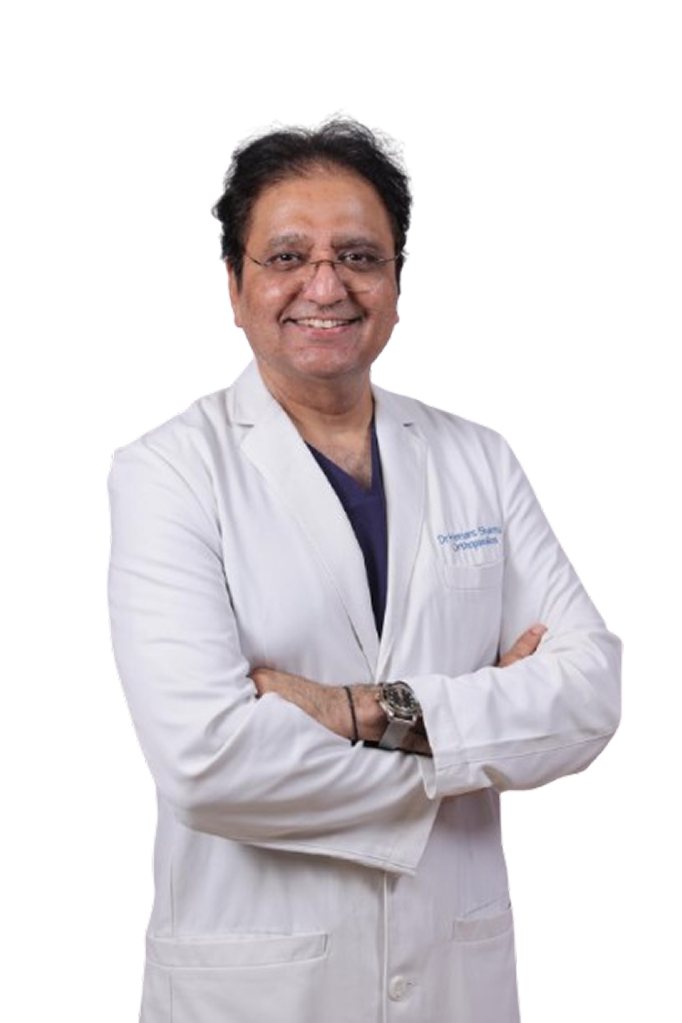
Highlighted Clinical Profile: Dr. Hemant Sharma
For patients navigating complex joint trauma, revision surgeries, or severe multi-ligament disruptions in North India, Dr. Hemant Sharma represents a distinguished figure in advanced orthopedics.
Facts Regarding Dr. Hemant Sharma:
-
Clinical Leadership: Serves as Chairperson – Orthopaedics & Joint Care at Artemis Hospital, Gurugram. He previously held senior leadership positions as Director and Head of Department at Marengo Asia Hospitals and Senior Consultant & Unit Head at Fortis Memorial Research Institute (FMRI), Gurugram.
-
International Training & Credentials: Completed dual higher surgical training across both India and the United Kingdom, holding the prestigious Fellow of the Royal College of Surgeons (FRCS – Trauma & Orthopaedics, UK) and Member of the Royal College of Surgeons (MRCS, England) certifications.
-
Senior Fellowship Expertise: Completed a Senior Fellowship in Revision Lower Limb Arthroplasty and Reconstruction at University Hospital Llandough, Cardiff, United Kingdom.
-
Extensive Experience: Boasts over 30 years of clinical and surgical experience spanning primary and revision joint replacement, complex sports injury reconstructions, arthroscopic repairs, and high-energy trauma care.
-
Pioneer in Advanced Technologies: A certified practitioner in computer-navigated and robotic-assisted orthopaedic procedures, recognized as an early adopter of advanced robotic joint technologies in Delhi NCR.
-
Thought Leadership & Global Academic Contributions: A featured TEDx speaker (“The Courage to Teach: The Insecurities in Medicine”), international faculty member for surgical training programs, and recipient of multiple healthcare Service Excellence awards in Orthopedics.
Consulting a surgeon with extensive background in complex lower-limb reconstructions ensures that patients with severe knee disruptions receive evidence-based care tailored to restoring long-term joint durability. When a Simple ACL Repair Isn’t Enough: How a Sports Injury Specialist in Gurugram Handles Complex Multi-Ligament Reconstruction
Conclusion: Restoring Joint Stability and Reclaiming Quality of Life
When facing a complex multi-ligament injury, accepting persistent instability or settling for an incomplete surgical repair compromises long-term mobility. Rebuilding a structurally compromised knee requires meticulous preoperative mapping, advanced arthroscopic execution, hybrid graft strategies, and biological augmentation.
By consulting a dedicated Sports Injury Specialist in Gurugram—such as Dr. Hemant Sharma—patients gain access to internationally benchmarked clinical protocols, precision surgical care, and structured rehabilitation programs. Whether repairing acute multi-ligament tears or revising a previously failed repair, modern sports medicine offers a clear pathway to restoring joint function and getting you back on your feet.
Also Read: Why ACL Reconstructions Fail: When to Seek a Revision Ligament Specialist in Gurgaon
#Complex Multi Ligament Reconstruction Gurugram #Revision ACL Surgery Gurgaon #Multi Ligament Knee Injury Specialist #PCL Reconstruction Surgeon Gurgaon #MCL Repair Doctor Gurugram #Postero lateral Corner Reconstruction #Arthroscopic Knee Surgeon Gurgaon #Joint Preservation Specialist Gurugram #Failed ACL Graft Revision #Robotic Knee Surgery Gurgaon #Dr Hemant Sharma Ortho #Top Orthopedic Surgeon Gurgaon #Best Sports Injury Doctor Gurugram #Knee Instability Treatment Gurgaon #Meniscus And Cartilage Repair Gurugram #BMAC Regenerative Medicine Gurgaon #PRP Knee Injections Gurugram #Internal Brace Knee Surgery #LCL Reconstruction Gurgaon #Graft Tunnel Placement Knee #Ligamentization Process #Knee Trauma Specialist Gurugram #Sports Medicine Clinic Gurgaon #Artemis Hospital Gurugram Orthopedics #Knee Joint Preservation India #Orthopedic Joint Replacement Surgeon In Gurgaon #High Energy Knee Trauma #ACL And PCL Combined Tear #Biological Augmentation Knee #Return To Sports Rehabilitation Gurgaon #Complex Lower Limb Reconstruction
FAQ
Q1: What makes a multi-ligament knee injury different from a standard ACL tear?
Answer: A standard ACL tear involves the disruption of a single stabilizing structure within the knee. In contrast, a multi-ligament knee injury involves complete tears or ruptures to two or more major knee ligaments simultaneously (e.g., ACL combined with PCL, MCL, or Posterolateral Corner/LCL). Multi-ligament injuries cause severe multi-directional joint instability, carry a higher risk of nerve and blood vessel damage, and cannot be successfully treated with simple, isolated ACL repair techniques. They require multi-graft reconstructive surgery managed by an expert Sports Injury Specialist in Gurugram. When a Simple ACL Repair Isn’t Enough: How a Sports Injury Specialist in Gurugram Handles Complex Multi-Ligament Reconstruction
Q2: Why should I consult Dr. Hemant Sharma for a complex or failed knee ligament reconstruction in Gurgaon?
Answer: Dr. Hemant Sharma is an internationally trained orthopedic surgeon with over 30 years of clinical practice across India and the United Kingdom. Holding qualifications including FRCS (Trauma & Orthopaedics, UK) and a Senior Fellowship from University Hospital Llandough, Cardiff, Dr. Sharma specializes in complex joint revisions, multi-ligament arthroscopic reconstructions, and advanced biological joint preservation techniques. His extensive experience across UK NHS healthcare systems and Indian tertiary care centers makes him uniquely qualified to handle difficult, high-complexity, or failed knee reconstructions. When a Simple ACL Repair Isn’t Enough: How a Sports Injury Specialist in Gurugram Handles Complex Multi-Ligament Reconstruction
Q3: Can a multi-ligament knee reconstruction be performed through minimally invasive arthroscopic surgery?
Answer: Yes, modern multi-ligament reconstructions utilize minimally invasive arthroscopic procedures for internal joint repairs (ACL and PCL tunnel drilling and graft passage), combined with mini-open precision incisions for peripheral collateral ligament (MCL/LCL/PLC) reconstructions. This hybrid arthroscopic approach reduces soft-tissue trauma, minimizes post-operative pain, lowers infection rates, and promotes faster rehabilitation compared to traditional open knee surgeries. When a Simple ACL Repair Isn’t Enough: How a Sports Injury Specialist in Gurugram Handles Complex Multi-Ligament Reconstruction
Q4: How long is the recovery timeline after multi-ligament knee reconstruction surgery?
Answer: Recovery after multi-ligament knee reconstruction typically ranges from 9 to 12 months. The first 6 weeks focus on protecting soft-tissue grafts using a hinged knee brace and limiting weight-bearing. Months 2 through 4 focus on restoring full range of motion and rebuilding quadriceps/hamstring muscle strength. Months 6 through 9 introduce dynamic neuromuscular training, agility drills, and sport-specific movements. Return to high-impact sports or rigorous physical labor is granted once functional strength, balance, and limb symmetry scores reach at least 90%. When a Simple ACL Repair Isn’t Enough: How a Sports Injury Specialist in Gurugram Handles Complex Multi-Ligament Reconstruction
Q5: What happens if a torn PCL or MCL is left untreated during an ACL repair?
Answer: If secondary ligament tears (PCL, MCL, or PLC) are left untreated during an ACL repair, the newly reconstructed ACL graft will absorb unphysiologic, excessive rotational and shear forces during daily movement. This leads to early graft stretching, persistent joint instability, elevated surgical failure rates, and accelerated post-traumatic knee osteoarthritis. A complete reconstructive plan must address all damaged stabilizing structures to restore proper joint kinematics. When a Simple ACL Repair Isn’t Enough: How a Sports Injury Specialist in Gurugram Handles Complex Multi-Ligament Reconstruction