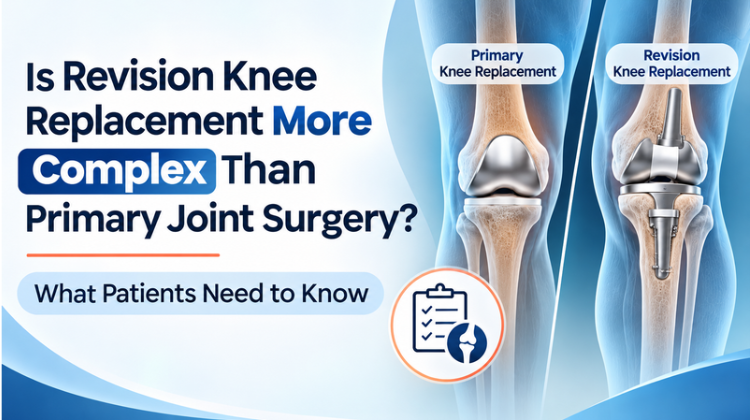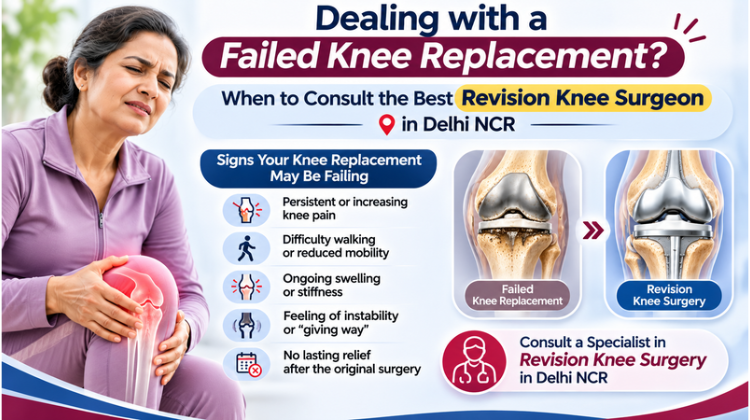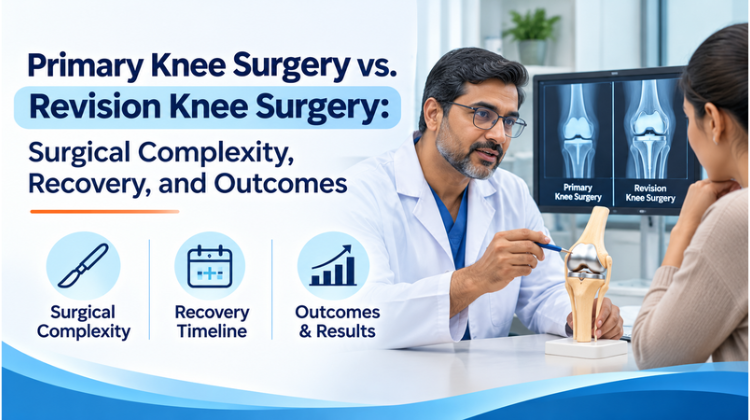

Knee joint replacement is widely recognized as one of the most successful medical advances of the modern era. For millions of individuals living with end-stage osteoarthritis, severe rheumatoid arthritis, or joint trauma, undergoing a primary total knee arthroplasty provides transformative relief from chronic pain and restores physical independence. However, an artificial knee implant is a mechanical device subject to natural wear, biological degradation, and anatomical stress over time. When an initial prosthetic joint reaches the end of its functional lifespan, degrades, becomes loose, or experiences secondary complications, a secondary intervention becomes necessary. This specialized procedure is known as revision total knee arthroplasty.
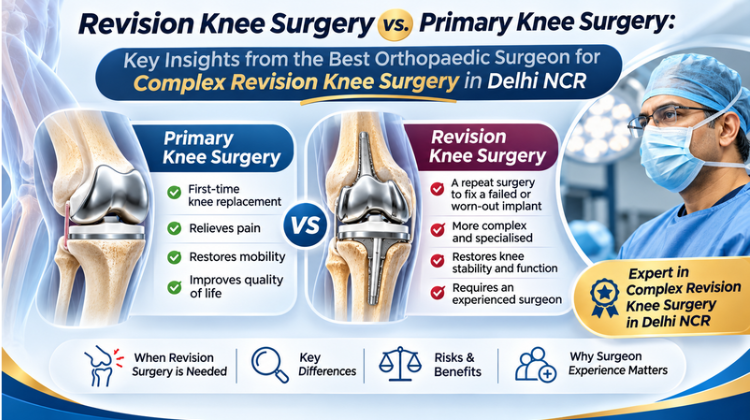
When evaluating joint replacement options, patients and caregivers frequently compare Primary Knee Surgery vs. Revision Knee Surgery to understand what lies ahead. While both procedures share the underlying mission of creating a painless, functional, and stable joint, they represent vastly different surgical paradigms. Primary joint replacement is a standardized, highly predictable procedure performed on native host anatomy. In contrast, revision joint replacement is a complex, customized reconstructive endeavor performed on a joint that has already undergone structural modification, bone resection, and soft-tissue alteration.
Grasping the key differences in Primary Knee Surgery vs. Revision Knee Surgery is essential for setting realistic post-operative expectations, preparing mentally and physically for rehabilitation, and appreciating why selecting an experienced orthopedic specialist is paramount to achieving optimal, long-term success.
What Is Primary Knee Surgery vs. Revision Knee Surgery?
To appreciate why these two operations differ so significantly, it is helpful to start with a foundational definition of each procedure and how they approach the knee joint biomechanically.
+-----------------------------------------------------------------------------------+
|                           KNEE ARTHROPLASTY SPECTRUM                              |
+-----------------------------------------+-----------------------------------------+
|          PRIMARY KNEE SURGERY           |          REVISION KNEE SURGERY          |
+-----------------------------------------+-----------------------------------------+
| • Native joint anatomy & intact bone    | • Prior implants removed / reconstructed |
| • Natural collateral ligaments intact   | • Compromised bone stock (grafts/augments)|
| • Standard off-the-shelf implants       | • Modular/constrained stem components   |
| • Operative time: 60 - 90 minutes       | • Operative time: 120 - 240+ minutes    |
| • Rapid 6 - 12 week baseline recovery   | • Gradual 6 - 12 month complete rehab   |
+-----------------------------------------+-----------------------------------------+
Primary Knee Surgery Defined
Primary total knee arthroplasty (TKA) is the initial surgical replacement of a damaged biological knee joint. During primary joint replacement, an orthopedic surgeon resects a precise, minimal layer of worn cartilage and subchondral bone from the distal end of the femur, the proximal end of the tibia, and occasionally the posterior surface of the patella. Standardized prosthetic metal components are then anchored onto the healthy host bone using surgical bone cement or uncemented press-fit technology. A ultra-high-molecular-weight polyethylene insert is positioned between the metal trays to act as smooth synthetic cartilage.
Because the primary surgery works with native bone contours and preserved collateral ligament networks, the biomechanical roadmap is clear, allowing for predictable leg alignment and smooth joint mechanics.
Revision Knee Surgery Defined
Revision knee replacement—also referred to as secondary knee arthroplasty—is a complex procedure performed to remove a previously implanted artificial joint component (partially or entirely) and replace it with a new prosthetic system.
The clinical scope of Primary Knee Surgery vs. Revision Knee Surgery expands drastically here. Revision surgery is not simply repeating a primary operation. Extraction of well-fixed or loosened primary implants naturally causes a loss of host bone stock. Furthermore, prior surgical incisions leave behind dense scar tissue, while underlying joint failure may have compromised surrounding ligaments. Consequently, revision surgery requires custom surgical strategies, specialized extraction tools, bone reconstruction techniques, and modular implants equipped with intramedullary stems or mechanical constraints.
Surgical Complexity: Primary Knee Surgery vs. Revision Knee Surgery
Surgical complexity forms the central distinction when analyzing Primary Knee Surgery vs. Revision Knee Surgery. Operating on a pristine anatomical joint follows systematic steps, whereas performing a joint revision demands adaptive problem-solving tailored to unique structural defects.
                          ┌──────────────────────────────┐
                          │    Surgical Complexity In    │
                          │    Revision Arthroplasty     │
                          └──────────────┬───────────────┘
                                         │
        ┌────────────────────────────────┼────────────────────────────────┐
        ▼                                ▼                                ▼
┌──────────────┐                 ┌──────────────┐                 ┌──────────────┐
│  Hardware    │                 │  Bone Loss   │                 │ Joint Space  │
│  Extraction  │                 │ Reconstruction│                │ Instability  │
└───────┬──────┘                 └───────┬──────┘                 └───────┬──────┘
        │                                │                                │
        ▼                                ▼                                ▼
┌──────────────┐                 ┌──────────────┐                 ┌──────────────┐
│Exploration with│               │Titanium Cones│                 │Constrained / │
│Osteotomes &  │                 │& Metaphyseal │                 │Hinged Modular│
│Micro-Chisels │                 │Augment Wedges│                 │  Implants    │
└──────────────┘                 └──────────────┘                 └──────────────┘
1. Hardware Extraction vs. Bone Preservation
In primary joint replacement, host bone is intact and healthy, allowing the surgeon to make standard, precise bone cuts. In revision joint surgery, existing metal implants—often firmly bonded to host bone via polymethylmethacrylate cement or biological ingrowth—must be extracted carefully. Removing embedded femoral components, tibial trays, or broken stems without fracturing remaining cortical bone requires delicate technique, specialized ultrasonic devices, micro-chisels, and flexible osteotomes.
2. Extent of Host Bone Loss
Host bone loss is a hallmark distinction in Primary Knee Surgery vs. Revision Knee Surgery. Friction wear particles, chronic osteolysis (bone resorption), implant loosening, or infection can degrade surrounding bone over time. Once old hardware is extracted, large structural voids often remain.
To restore the structural platform and recreate a balanced joint line, revision surgeons use advanced reconstructive options:
-
Metal Augments and Wedges: Titanium blocks fastened to the revision implant to fill localized bone defects.
-
Metaphyseal Sleeves and Cones: Porous metal constructs shaped to fit directly into the hollow metaphyseal bone, establishing immediate structural fixation.
-
Structural Bone Grafting: Using allograft or autograft bone matrix to pack large cavitary defects and encourage native bone regeneration.
3. Soft-Tissue Scarring and Ligament Integrity
Primary knee replacement relies heavily on the patient’s natural collateral ligaments (medial and lateral) to maintain lateral and rotational stability. During primary procedures, tissue planes are soft, flexible, and easy to mobilize.
In revision joint surgery, prior surgical interventions leave behind extensive fibrous scar tissue (arthrofibrosis). Scar tissue stiffens the joint, obscuring crucial anatomical structures and making joint exposure challenging. Additionally, long-standing implant failure or infection can compromise collateral ligaments. Surgeons must balance soft tissues carefully or utilize semi-constrained (Condylar Constrained Knee – CCK) or fully constrained hinged revision components to compensate for missing ligament stability.
4. Operative Duration and Surgical Infrastructure
Due to the painstaking steps involved—hardware removal, bone defect management, trial component balancing, and final modular assembly—revision operations are longer procedures. While primary knee surgery typically takes 60 to 90 minutes, complex revision joint surgery can take anywhere from 2 to 4 hours. Longer operative times require heightened sterile protocols, specialized surgical suites, and specialized anesthetic management.
Direct Comparison: Primary Knee Surgery vs. Revision Knee Surgery
To clearly illustrate the differences between Primary Knee Surgery vs. Revision Knee Surgery, the table below outlines their core operational, structural, and clinical characteristics.
| Clinical Feature / Aspect | Primary Knee Surgery | Revision Knee Surgery |
| Surgical Intent | Resurface damaged native cartilage & subchondral bone | Extract failed hardware, reconstruct bone, restore joint line |
| Anatomical Baseline | Intact host bone stock & functional collateral ligaments | Compromised bone stock, scar tissue, variable ligament stability |
| Implant Systems | Standardized, unconstrained or posterior-stabilized components | Modular systems with stems, augments, sleeves, or hinged mechanisms |
| Operating Room Time | Approximately 60 to 90 minutes | Approximately 120 to 240+ minutes |
| Technical Difficulty | Moderate / Follows established surgical landmarks | High / Requires dedicated sub-specialty revision fellowship training |
| Post-Op Weight-Bearing | Immediate full weight-bearing on Day 1 (typical) | Progressive or partial weight-bearing depending on graft integration |
| Main Recovery Horizon | 6 to 12 weeks for main daily activities | 3 to 6 months for major progress; up to 12 months for full strength |
| Implant Longevity | 15 to 20+ years in over 90% of patients | 10 to 15+ years depending on bone quality and joint alignment |
Indications: Why Do Primary Implants Need Revision?
Understanding why a primary joint fails provides valuable context when evaluating Primary Knee Surgery vs. Revision Knee Surgery. While primary joint replacement yields high satisfaction, mechanical and biological stresses over decades can make secondary revision necessary.
Aseptic Loosening and Osteolysis
Aseptic loosening—implant failure without infection—remains the leading reason for revision joint surgery. Over time, friction between the metal and polyethylene components generates micro-particles. The body’s immune system attempts to clear these micro-particles, triggering localized inflammation that degrades host bone (osteolysis). As bone support recedes, the cement bond fails, causing the prosthetic implant to loosen and painful micromotion to occur.
Periprosthetic Joint Infection (PJI)
Periprosthetic infection is one of the most serious complications in joint replacement. Bacteria can adhere to artificial metal surfaces, forming an antibiotic-resistant biofilm.
Treating a deep periprosthetic infection often requires a two-stage revision protocol:
-
First Stage: The infected primary knee replacement components are removed, the joint space is thoroughly debrided, and an antibiotic-impregnated cement spacer is placed to keep tissue stretched while releasing high-dose local antibiotics over 6 to 12 weeks.
-
Second Stage: Once systemic blood markers (ESR, CRP) normalize and joint fluid aspirates confirm complete bacterial eradication, the temporary spacer is extracted, and permanent revision prosthetic components are implanted.
Joint Instability and Ligament Dysfunction
If collateral ligaments stretch, tear, or weaken over time, the artificial joint may feel unstable, catch, or give way during routine walking. Revision joint surgery replaces unconstrained components with constrained revision implants that provide internal structural stability.
Periprosthetic Fractures
Falls or high-energy trauma can cause fractures in host bone directly surrounding the prosthetic stem. Managing these injuries often requires replacing the original implant with long-stemmed revision hardware that bridges the fracture site, providing structural stability to the limb.
Recovery and Rehabilitation Comparison
Recovery trajectories highlight another major distinction between Primary Knee Surgery vs. Revision Knee Surgery. While primary replacement patients follow a rapid, predictable recovery path, revision patients undergo a gradual, structured rehabilitation program designed to protect bone grafts and structural metal augments.
+-----------------------------------------------------------------------------------+
|                        RECOVERY & REHABILITATION TRAJECTORY                       |
+-----------------------------------------------------------------------------------+
| TIMEFRAME     | PRIMARY KNEE SURGERY            | REVISION KNEE SURGERY           |
+---------------+---------------------------------+---------------------------------+
| Weeks 1 - 2   | • Full weight-bearing walk      | • Protected weight-bearing      |
|               | • Active quadriceps engagement  | • Gentle range-of-motion focus  |
|               | • Pain management protocol      | • Soft-tissue swelling control  |
+---------------+---------------------------------+---------------------------------+
| Weeks 3 - 6   | • Walking without mobility aids | • Gradual weight-bearing progression|
|               | • Outpatient physical therapy   | • Focused muscle reactivation   |
|               | • Return to driving / light work| • Guided range-of-motion work   |
+---------------+---------------------------------+---------------------------------+
| Months 3 - 12 | • Full functional independence  | • Advanced strength building   |
|               | • Return to active recreation   | • Long-term tissue remodeling   |
+-----------------------------------------------------------------------------------+
Weight-Bearing Progression
-
Primary Knee Surgery: Patients are routinely encouraged to stand and walk using a walker or crutches within hours of surgery, achieving full weight-bearing early in recovery.
-
Revision Knee Surgery: Weight-bearing guidelines depend on the extent of bone reconstruction. If large bone grafts or metaphyseal cones were used, partial weight-bearing or protective joint bracing may be recommended for 4 to 6 weeks to allow host bone to integrate securely around the new hardware.
Physical Therapy and Mobility Milestones
Physical therapy following primary knee surgery aims to rapidly restore knee flexion and extension, regain quadriceps strength, and return to everyday movement. In contrast, rehabilitation for revision knee surgery prioritizes joint safety and gradual progress. Physical therapists work closely with the orthopedic surgeon to balance gentle range-of-motion exercises with tissue protection, ensuring scar tissue is managed without straining reconstructed bone platforms.
Outcomes and Implant Longevity
When reviewing Primary Knee Surgery vs. Revision Knee Surgery, setting realistic expectations around surgical outcomes and prosthetic longevity is essential.
Success Rates and Quality of Life
Both primary and revision joint operations deliver high rates of patient satisfaction and functional restoration. Primary knee arthroplasty achieves successful long-term outcomes in over 90% to 95% of cases. Revision total knee arthroplasty also yields excellent outcomes, relieving chronic joint pain, restoring stability, and enabling patients to return to an active lifestyle.
Implant Lifespan Differences
-
Primary Implants: Standard primary knee replacements typically last 15 to 20+ years, making them a long-lasting solution for joint arthritis.
-
Revision Implants: Revision knee implants generally last 10 to 15+ years. Because revision hardware is anchored in compromised bone stock and subject to higher mechanical stress, longevity rates are slightly lower than primary replacements. However, modern modular titanium implants, 3D porous bone-ingrowth technology, and robotic precision have significantly improved long-term revision outcomes. Primary Knee Surgery vs. Revision Knee Surgery: Surgical Complexity, Recovery, and Outcomes
Advanced Surgical Technologies in Modern Joint Revision
Modern technological advancements have helped narrow the clinical gap between Primary Knee Surgery vs. Revision Knee Surgery, making secondary procedures safer, more accurate, and more predictable.
                      ┌───────────────────────────────────────────┐
                      │ Modern Surgical Innovations In Arthroplasty│
                      └─────────────────────┬─────────────────────┘
                                            │
        ┌───────────────────────────────────┼───────────────────────────────────┐
        ▼                                   ▼                                   ▼
┌──────────────────────┐        ┌──────────────────────┐        ┌──────────────────────┐
│ Robotic-Assisted AI  │        │ Pre-Op 3D CT Scanning│        │ Metaphyseal Sleeve   │
│ Navigated Realignment│        │ & Custom Mapping     │        │ Titanium Technology  │
└──────────────────────┘        └──────────────────────┘        └──────────────────────┘
Robotic-Assisted Arthroplasty
Robotic platforms provide real-time haptic feedback and sub-millimeter precision during bone resection. In primary joint surgery, robotics ensures optimal implant placement and precise soft-tissue balancing. In revision joint surgery, computer-navigated technology assists the surgeon in calculating mechanical axes, positioning intramedullary stems, and restoring the natural joint line despite altered anatomy.
3D CT Pre-Operative Modeling
Advanced 3D CT imaging allows surgeons to visualize bone defects, evaluate original hardware position, and plan modular component sizing prior to surgery. This pre-operative insight reduces intra-operative trial time, minimizes blood loss, and ensures the reconstructive strategy is mapped out in advance.
Also Read: Is Revision Knee Replacement More Complex Than Primary Joint Surgery? What Patients Need to Know
#Primary Knee Surgery #Revision Knee Surgery #Primary Knee Replacement #Revision Knee Replacement #Joint Replacement Surgery #Knee Arthroplasty #Surgical Complexity #Knee Surgery Recovery #Joint Replacement Outcomes #Orthopedic Surgeon Gurgaon #Dr Hemant Sharma #Artemis Hospital Gurgaon #Failed Knee Replacement #Aseptic Loosening #Periprosthetic Joint Infection #Bone Loss In Revision #Modular Knee Implants #Hinged Knee Implant #Two Stage Revision #Robotic Knee Replacement #Sub Millimeter Precision #Revision Arthroplasty Specialist #Complex Joint Reconstruction #FRCS Orthopedics #Metaphyseal Sleeves #Titanium Augments #Bone Grafting Knee #Knee Revision Risks #Joint Instability #Arthrofibrosis #Polyethylene Wear #Orthopedic Care Gurgaon #Second Knee Surgery #Redo Knee Replacement
FAQ
Q1: What is the main difference in Primary Knee Surgery vs. Revision Knee Surgery?
Answer: The primary difference between Primary Knee Surgery vs. Revision Knee Surgery lies in anatomical complexity and surgical goals. Primary knee surgery replaces damaged natural cartilage and bone using standard off-the-shelf implants on intact anatomy. Revision knee surgery involves extracting failed old hardware, addressing lost bone stock with augments or grafts, managing dense scar tissue, and installing specialized modular stem components to restore joint function. Primary Knee Surgery vs. Revision Knee Surgery: Surgical Complexity, Recovery, and Outcomes
Q2: Why do international and national patients choose Dr. Hemant Sharma for complex revision knee surgery in Gurgaon?
Answer: Patients consult Dr. Hemant Sharma for complex revision joint surgery in Gurgaon because of his extensive 30+ years of clinical experience across India and the United Kingdom. Serving as Chairperson of Orthopedics and Robotic Joint Replacement at Artemis Hospital, Gurgaon, Dr. Sharma holds prestigious credentials including FRCS (Trauma & Orthopedics) from the Royal College of Surgeons of England. He completed sub-specialty UK fellowships in revision arthroplasty and is widely recognized for his expertise in complex trauma, high-risk joint revisions, and robotic-assisted surgeries. Primary Knee Surgery vs. Revision Knee Surgery: Surgical Complexity, Recovery, and Outcomes
Q3: Is recovery from revision knee surgery longer than primary knee surgery?
Answer: Yes, recovery from revision knee surgery is generally longer and more gradual than recovery from primary knee surgery. While primary joint replacement patients often regain independence within 6 to 12 weeks, revision joint replacement patients typically require 3 to 6 months for substantial functional progress and up to 12 months for complete muscle strength and tissue healing. Guided physical therapy and controlled weight-bearing are vital during revision recovery to protect bone reconstructions. Primary Knee Surgery vs. Revision Knee Surgery: Surgical Complexity, Recovery, and Outcomes
Q4: How long do primary knee implants last compared to revision knee implants?
Answer: Modern primary knee replacement implants last between 15 and 20+ years in more than 90% of patients. Revision knee replacement implants typically last 10 to 15+ years. While revision implants face greater structural demands and host bone loss, advanced titanium metaphyseal sleeves, modular stems, and sub-millimeter robotic navigation have significantly extended revision implant longevity.Primary Knee Surgery vs. Revision Knee Surgery: Surgical Complexity, Recovery, and Outcomes
Q5: What advanced surgical options does Dr. Hemant Sharma utilize for complex revision knee replacement at Artemis Hospital, Gurgaon?
Answer: At Artemis Hospital, Gurgaon, Dr. Hemant Sharma utilizes state-of-the-art diagnostic and surgical technologies for complex joint revisions. These include 3D CT pre-operative defect mapping, robotic AI-assisted navigation, titanium metaphyseal sleeves and cones, customized modular stem extensions, and multi-stage infection management protocols. His approach focuses on preserving bone, restoring natural leg alignment, minimizing tissue trauma, and promoting safe post-operative mobility.
Facts About Dr. Hemant Sharma
-
Brings over 30 years of total clinical experience in joint replacement, complex trauma, and orthopedic surgery across India and the United Kingdom.
-
Serves as Chairperson of Robotic Joint Replacement, Arthroscopy Surgery, Sports Injuries & Trauma at Artemis Hospital, Gurugram (Gurgaon).
-
Holds prestigious international qualifications, including FRCS (Trauma & Orthopaedics) and MRCS from the Royal College of Surgeons of England, alongside DNB (Orthopedics) and Diploma in Orthopedics.
-
Completed intensive sub-specialty UK Fellowships in Revision Arthroplasty of Hip & Knee and Sports Injuries (2010–2012), including advanced training at University Hospital Llandough, Cardiff.
-
Has successfully performed thousands of joint replacement procedures and complex lower-limb reconstructive surgeries over his career.
-
Pioneer in Mako Robotic AI-Assisted and computer-navigated joint replacement surgeries in NCR, delivering sub-millimeter precision.
-
Distinguished TEDx Speaker who presented “The Courage to Teach: The Insecurities in Medicine”, sharing clinical insights on healthcare ethics and medical education.
-
Honored with the Service Excellence Award in Orthopedics & Joint Replacement at the ET Health Conclave (2026) and the Times Network India Health Summit (2025).
-
Demonstrated outstanding leadership in frontline disaster relief, serving as team leader during the 2001 Gujarat earthquake rescue operations and contributing to emergency medical response during the 1996 Charkhi Dadri mid-air collision. Primary Knee Surgery vs. Revision Knee Surgery: Surgical Complexity, Recovery, and Outcomes