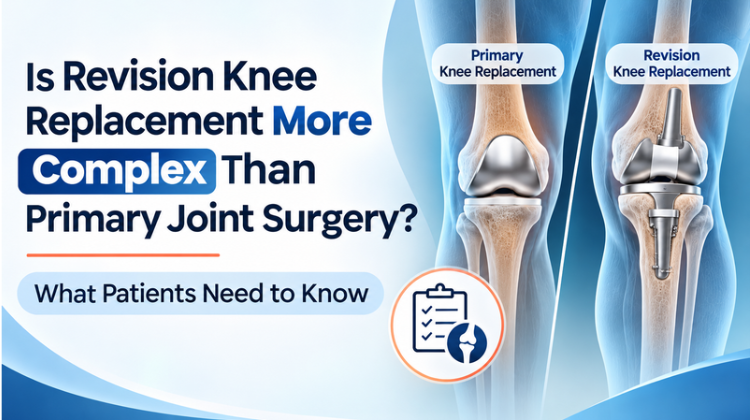

Primary knee arthroplasty is one of the most successful surgical procedures in modern medicine, offering life-changing relief from chronic joint pain and severe osteoarthritis. However, artificial joint components do not last forever. Over time, mechanical wear, aseptic loosening, infection, or structural instability may necessitate a secondary surgical intervention known as revision total knee arthroplasty (TKA). Patients facing a secondary operation frequently ask: Is revision knee replacement more complex than primary joint surgery?
The short answer is yes. Revision joint surgery involves operating on a knee joint that has already undergone significant anatomical modifications. Unlike a primary procedure where native bone and original ligaments are largely intact, a revision procedure requires removing existing implants, addressing bone loss, managing scar tissue, and installing specialized prosthetic hardware.
Understanding why Is revision knee replacement more complex than primary joint surgery helps patients frame realistic recovery expectations, understand surgical risks, and appreciate the critical importance of selecting a highly skilled orthopedic specialist.
What Is a Primary Knee Replacement vs. a Revision Knee Replacement?
To understand why revision surgery demands advanced surgical expertise, one must first look at the baseline differences between primary knee replacement and revision joint surgery.
Primary Knee Replacement Overview
A primary total knee replacement is performed on an anatomical joint that retains its natural bone contours, surrounding ligament structures, and baseline mechanical alignment. During a primary total knee replacement:
-
damaged cartilage and subchondral bone are resurfaced using minimal bone resection;
-
standardized prosthetic implants (femoral component, tibial tray, and plastic spacer) are fixed directly onto healthy bone using surgical bone cement or press-fit ingrowth technology;
-
the primary knee joint biomechanics are restored with predictable ligament balancing.
Because the native anatomy is clear, primary joint surgery follows standardized anatomical landmarks and predictable surgical steps. Discover why Revision Knee Replacement More Complex Than Primary Joint Surgery. Learn about recovery, bone loss, and expert care by Dr. Hemant Sharma.
Revision Knee Replacement Overview
Revision knee replacement occurs when an existing prosthetic joint must be partially or entirely removed and replaced with new implants. Patients often wonder: Is revision knee replacement more complex than primary joint surgery when only one component fails? Even partial revisions present unique technical difficulties because removing cemented or osteointegrated implants causes trauma to surrounding tissues.
Revision total knee replacement addresses complex mechanical and biological challenges, including:
-
removing tightly bonded metal components without fracturing remaining bone;
-
filling severe bone defects left behind by implant failure, infection, or bone resorption;
-
stabilizing a knee joint where original collateral ligaments may be stretched, damaged, or compromised;
-
utilizing modular revision implants, such as metal augments, stem extensions, and constrained joint mechanisms. Discover why Revision Knee Replacement More Complex Than Primary Joint Surgery. Learn about recovery, bone loss, and expert care by Dr. Hemant Sharma.
Why Is Revision Knee Replacement More Complex Than Primary Joint Surgery?
Comparing a primary procedure to a revision procedure is like comparing new home construction to restoring a damaged historical building. The underlying framework in a revision case has been altered, requiring custom surgical solutions.
1. Extent of Bone Loss and Structural Compromise
One of the main reasons Is revision knee replacement more complex than primary joint surgery relates directly to bone quality. Over years of implant use, friction, osteolysis (bone resorption caused by wear particles), or stress shielding can degrade the underlying host bone. Furthermore, extraction of original cemented implants naturally removes thin layers of healthy bone stock.
Surgeons cannot simply place standard implants on compromised bone. They must utilize:
-
Metal Augments and Wedges: Titanium or porous metal blocks screwed onto revision components to rebuild level bone platforms.
-
Bone Grafting: Autograft, allograft, or synthetic bone substitutes to fill deep structural voids.
-
Metaphyseal Sleeves and Cones: Highly porous titanium structures designed to integrate with remaining bone and provide primary structural support.
2. Surgical Removal of Existing Implants (Hardware Extraction)
In primary joint surgery, surgeons clear damaged cartilage. In revision surgery, surgeons must carefully extract firmly anchored metal components.
Removing well-fixed implants requires specialized tools such as micro-chisels, flexible osteotomes, and ultrasonic bone cement removal systems. Extracting well-bonded implants without shattering fragile cortical bone requires exceptional precision, significantly elevating the complexity of revision joint surgery compared to primary operations.
3. Scar Tissue Formation and Soft Tissue Compromise
Prior surgical incisions leave behind dense fibrous scar tissue (arthrofibrosis). Scar tissue distorts normal surgical anatomical planes, reduces tissue flexibility, and makes joint exposure challenging. Surgeons must perform extensive synovectomy and soft tissue releases just to safely expose the joint without tearing the patellar tendon or damaging major neurovascular structures.
4. Complex Joint Stability and Implant Selection
In primary knee replacement, standard unconstrained or posterior-stabilized implants rely on the patient’s natural medial and lateral collateral ligaments for stability.
In revision joint surgery, prior joint failure or soft tissue disruption often leaves ligaments incompetent or absent. The surgeon must carefully select higher levels of implant constraint:
-
Semi-Constrained (Condylar Constrained Knee – CCK): Features a tall central post to provide lateral and rotational stability when collateral ligaments are weakened.
-
Hinged Knee Implants: A fully constrained system where femoral and tibial components are physically linked together with a mechanical pin. Used when collateral ligaments are completely non-functional or severe bone loss is present.
5. Increased Surgical Duration and Anesthesia Risk
Because joint exposure, hardware extraction, bone reconstruction, and trial fitting are painstaking processes, revision joint surgery takes significantly longer than primary joint replacement. While a primary procedure typically lasts 60 to 90 minutes, a revision total knee replacement often ranges from 2 to 4 hours. Longer operative times naturally increase anesthesia requirements, overall surgical exposure, and physiological stress on the patient. Discover why Revision Knee Replacement More Complex Than Primary Joint Surgery. Learn about recovery, bone loss, and expert care by Dr. Hemant Sharma.
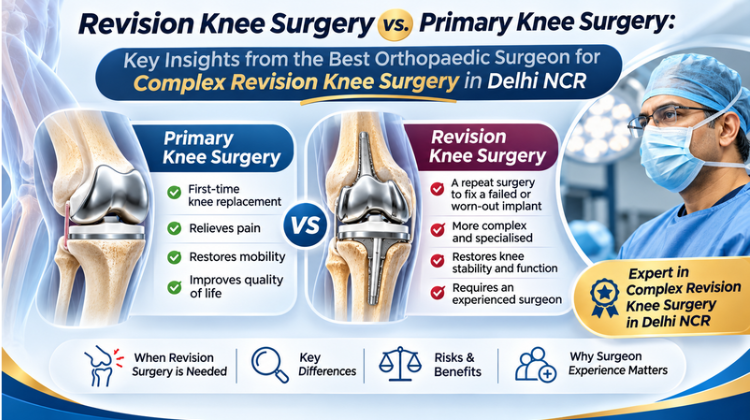
Primary vs. Revision Knee Replacement: Key Differences Comparison
| Feature / Aspect | Primary Knee Replacement | Revision Knee Replacement |
| Surgical Goal | Resurface worn cartilage & subchondral bone | Extract failed hardware, rebuild bone, restore function |
| Anatomical Condition | Intact host bone stock & natural ligaments | Compromised bone stock, extensive scar tissue, altered anatomy |
| Implant Complexity | Standardized off-the-shelf components | Modular revision components, stem extensions, metal augments |
| Joint Stability | Dependent on natural patient collateral ligaments | Dependent on semi-constrained or hinged revision implants |
| Operation Time | 60 – 90 minutes | 120 – 240+ minutes |
| Surgical Difficulty | Moderate / Standardized protocols | Highly complex / Requires sub-specialty revision fellowship training |
| Rehabilitation Horizon | Rapid recovery (6 – 12 weeks for main activities) | Gradual recovery (3 – 6+ months for full weight-bearing strength) |
Indications for Revision Knee Surgery: Why Do Primary Implants Fail?
Understanding why a primary joint fails provides clarity on why Is revision knee replacement more complex than primary joint surgery in specific clinical scenarios.
                  ┌─────────────────────────────────────────┐
                  │ Primary Knee Implant Structural Failure │
                  └────────────────────┬────────────────────┘
                                       │
         ┌─────────────────────────────┼─────────────────────────────┐
         ▼                             ▼                             ▼
┌─────────────────┐           ┌─────────────────┐           ┌─────────────────┐
│Aseptic Loosening│           │Periprosthetic   │           │ Joint Instability│
│  & Bone Loss    │           │    Infection    │           │  & Ligament Laxity│
└────────┬────────┘           └────────┬────────┘           └────────┬────────┘
         │                             │                             │
         ▼                             ▼                             ▼
┌─────────────────┐           ┌─────────────────┐           ┌─────────────────┐
│Single-Stage     │           │Two-Stage        │           │Augmented       │
│Revision Surgery │           │Revision Protocol│           │Modular Implant  │
└─────────────────┘           └─────────────────┘           └─────────────────┘
Aseptic Loosening (Non-Infectious Mechanical Failure)
Over 15 to 20 years, microscopic friction generates wear debris from the plastic polyethylene spacer. The body’s immune system attempts to absorb these micro-particles, triggering an inflammatory reaction that destroys surrounding bone (osteolysis). As bone stock recedes, the surgical bone cement loses its bond, causing the implant to loosen and wobble.
Periprosthetic Joint Infection (PJI)
Infection is one of the most challenging complications in joint replacement surgery. Bacteria can form an adherent biofilm over metal implant surfaces that resists oral or intravenous antibiotics.
Treating a periprosthetic infection usually requires a two-stage revision surgery:
-
Stage One: The infected primary knee replacement hardware is entirely removed, the joint space is debrided, and an antibiotic-impregnated cement spacer is inserted to keep tissues stretched while delivering high-concentration local antibiotics over 6 to 12 weeks.
-
Stage Two: Once blood markers (ESR and CRP) normalize and joint fluid cultures confirm infection clearance, the patient undergoes a second procedure to remove the spacer and implant permanent revision components.
Joint Instability and Ligament Laxity
If the collateral ligaments surrounding the knee stretch or give way over time, the knee feels wobbly or catches during weight-bearing. Revision surgery is necessary to substitute mechanical implant constraint for the incompetent soft tissue envelope.
Periprosthetic Fractures
Trauma or severe osteoporosis can cause fractures in the native bone directly adjacent to the metal stems of a primary knee replacement. Repairing these fractures often requires removing the existing joint and inserting long-stemmed revision hardware that bypasses the fracture line.
The Recovery Process: Primary vs. Revision Knee Surgery
Because of extensive bone grafting, soft tissue dissection, and complex hardware fixation, recovery from revision knee replacement follows a more gradual timeline than primary joint replacement.
Immediate Post-Operative Management
-
Weight-Bearing Restrictions: While primary joint replacement patients often walk full weight-bearing on Day 1, revision patients may require partial weight-bearing or protective bracing for 4 to 6 weeks to allow structural bone grafts or porous metal augments to integrate firmly.
-
Pain Management: Because revision joint surgery involves greater soft tissue handling and bone reconstruction, multimodal pain management—including regional nerve blocks, targeted oral analgesics, and cold therapy—is vital during early physical therapy.
Rehabilitation and Physical Therapy
Physical therapy after revision knee replacement emphasizes restoring range of motion while preserving joint integrity. Therapists focus on gentle mobility exercises, quadriceps reactivation, and progressive gait retraining. Full functional recovery after a complex revision joint surgery typically spans 6 to 12 months. Discover why Revision Knee Replacement More Complex Than Primary Joint Surgery. Learn about recovery, bone loss, and expert care by Dr. Hemant Sharma.
Surgical Considerations: Mitigating Risks in Complex Joint Revision
Given the intricate nature of secondary joint operations, surgical teams employ advanced technologies to maximize long-term success:
-
Pre-Operative 3D CT Planning: High-resolution imaging allows surgeons to evaluate bone loss volume, measure mechanical axes, and pre-select modular stems and augments prior to entering the operating room.
-
Robotic-Assisted Arthroplasty: Computer navigation and robotic platforms help surgeons map precise resection cuts and verify joint balancing in real time.
-
Stem Extensions: Transmitting joint loads away from damaged joint surfaces into the healthy central canal of the tibia and femur ensures solid mechanical fixation.
Also Read: Primary Knee Surgery vs. Revision Knee Surgery: Surgical Complexity, Recovery, and Outcomes
#Revision Knee Replacement #Primary Knee Replacement #Joint Replacement Surgery #Knee Revision Complexity #Orthopedic Surgeon Gurgaon #Dr Hemant Sharma #Failed Knee Replacement #Aseptic Loosening #Peri prosthetic Infection #Bone Loss In Revision #Modular Knee Implants #Hinged Knee Replacement #Two Stage Revision #Knee Arthroplasty #Robotic Knee Replacement #Sub Millimeter Precision #Artemis Hospital Gurgaon #Revision Arthroplasty Specialist #Complex Joint Reconstruction #Knee Replacement Recovery #Joint Preservation #FRCS Orthopedics #Stem Extensions #Meta physeal Sleeves #Bone Grafting Knee #Knee Revision Risks #Joint Instability #Arthro fibrosis #Polyethylene Wear #Orthopedic Care Gurgaon #Second Knee Surgery #Redo Knee Replacement
FAQ
Q1: Is revision knee replacement more complex than primary joint surgery?
Answer: Yes, revision knee replacement is significantly more complex than primary joint surgery. Unlike primary knee replacement—which involves resurfacing natural bone and working with intact ligaments—revision surgery requires removing failed primary implants, rebuilding lost bone stock with metal augments or grafts, dealing with dense scar tissue, and installing modular or constrained revision components. These factors lengthen operative times and require sub-specialty orthopedic expertise. Discover why Revision Knee Replacement More Complex Than Primary Joint Surgery. Learn about recovery, bone loss, and expert care by Dr. Hemant Sharma.
Q2: Why do patients choose Dr. Hemant Sharma for complex revision knee replacement in Gurgaon?
Answer: Patients select Dr. Hemant Sharma, best joint replacement and orthopeadics surgeon for revision joint surgery in Gurgaon due to his extensive UK clinical training and over 30 years of orthopedic experience. As Chairperson of Orthopedics and Robotic Joint Replacement at Artemis Hospital, Gurgaon, Dr. Hemant Sharma holds prestigious qualifications including FRCS (Trauma & Orthopedics) from the Royal College of Surgeons of England. He specializes in high-risk revision arthroplasty, robotic-assisted joint reconstruction, complex trauma management, and joint preservation techniques. Discover why Revision Knee Replacement More Complex Than Primary Joint Surgery. Learn about recovery, bone loss, and expert care by Dr. Hemant Sharma.
Q3: What is the success rate and lifespan of a revision total knee replacement?
Answer: Revision total knee replacement has high clinical success rates, relieving pain and restoring joint function for over 85% to 90% of patients. While primary knee replacements typically last 15 to 20 years, revision implants generally last 10 to 15 years due to underlying bone loss and altered tissue mechanics. Choosing an experienced revision specialist who uses advanced robotic navigation and modular stem implants significantly enhances long-term prosthetic longevity. Discover why Revision Knee Replacement More Complex Than Primary Joint Surgery. Learn about recovery, bone loss, and expert care by Dr. Hemant Sharma.
Q4: How does the recovery timeline differ between primary and revision knee replacement?
Answer: Recovery from primary knee replacement usually allows patients to resume daily activities within 6 to 8 weeks. In contrast, recovery from revision knee replacement takes longer—often 3 to 6 months for substantial functional recovery and up to 12 months for full tissue healing. Patients undergoing revision joint surgery may also need initial partial weight-bearing using crutches or a walker to allow structural bone grafts and stem augments to integrate securely. Discover why Revision Knee Replacement More Complex Than Primary Joint Surgery. Learn about recovery, bone loss, and expert care by Dr. Hemant Sharma.
Q5: What advanced surgical techniques does Dr. Hemant Sharma use for revision knee surgery at Artemis Hospital, Gurgaon?
Answer: Dr. Hemant Sharma utilizes state-of-the-art diagnostic and surgical technologies for complex revision knee replacement in Gurgaon. These include sub-millimeter robotic-assisted joint navigation, 3D pre-operative CT modeling, specialized metal augment reconstruction, metaphyseal titanium sleeves, and custom constrained joint systems. His approach prioritizes tissue preservation, minimal blood loss, accurate leg-length restoration, and rapid post-operative rehabilitation protocols.
Facts About Dr. Hemant Sharma
-
Holds over 30 years of total clinical experience in joint replacement, trauma, and complex orthopedics across the United Kingdom and India.
-
Serves as Chairperson of Orthopedics and Robotic Joint Replacement at Artemis Hospital, Gurgaon.
-
Awarded the FRCS (Trauma & Orthopedics) by the Royal College of Surgeons of England, alongside MRCS (England), DNB (Orthopedics), and a Diploma in Orthopedics.
-
Completed specialized sub-specialty Fellowships in Revision Arthroplasty of Hip & Knee and Sports Injuries in the UK (2010–2012), including training at University Hospital Llandough, Cardiff.
-
Has successfully performed over 15,000 joint replacement and complex trauma procedures throughout his surgical career.
-
Pioneer in Mako Robotic AI-Assisted and computer-navigated sub-millimeter joint replacement surgeries in India.
-
Distinguished TEDx Speaker on clinical education and healthcare ethics, presenting “The Courage to Teach: The Insecurities in Medicine”.
-
Recipient of the Service Excellence Award in Orthopedics & Joint Replacement at the ET Health Conclave (2026) and Times Network India Health Summit (2025). Discover why Revision Knee Replacement More Complex Than Primary Joint Surgery. Learn about recovery, bone loss, and expert care by Dr. Hemant Sharma.