
Primary joint replacement surgery is one of the most transformative medical interventions available today, enabling individuals with severe joint arthritis or injury to regain pain-free mobility. However, artificial hip implants are mechanical devices subject to physical wear, biological friction, structural loosening, infection, or trauma over time. When a primary joint replacement begins to fail, a specialized procedure known as revision hip arthroplasty becomes necessary.
Unlike a primary hip replacement, a revision procedure is significantly more intricate. It requires removing old, firmly fixed, or broken implants, managing compromised bone stock, using specialized modular hardware, and reconstructing the anatomical joint structure. Selecting the Best Revision Hip Replacement Surgeon in Gurgaon is the single most critical decision you will make in ensuring a successful surgical outcome, minimal post-operative complications, and a swift return to an active lifestyle.
Understanding Revision Hip Replacement vs. Primary Joint Arthroplasty
To appreciate why selecting a specialist is paramount, it is important to understand how revision hip surgery differs from initial joint replacement.
During a primary total hip replacement, the surgeon works with natural, intact bone and soft tissues. In contrast, revision hip replacement presents unique surgical challenges:
-
Compromised Bone Quality: Osteolysis (bone resorption caused by wear particles), previous implant fixation, or bone loss makes anchoring new implants technically demanding.
-
Presence of Scar Tissue: Previous surgeries leave behind thick scar tissue, altering blood supply and surgical anatomy.
-
Component Removal Risks: Extracting old cement, long-stemmed femoral components, or integrated acetabular cups without causing periprosthetic fractures requires specialized instruments and surgical expertise.
-
Extended Surgical Duration: Revision procedures take longer than primary replacements, requiring advanced anesthesia management, blood conservation techniques, and strict infection controls.
Given these complexities, relying on a general orthopedic doctor is rarely sufficient. A successful outcome depends on consulting the Best Revision Hip Replacement Surgeon in Gurgaon, who possesses dedicated fellowship training, extensive revision experience, and access to state-of-the-art reconstructive technology.
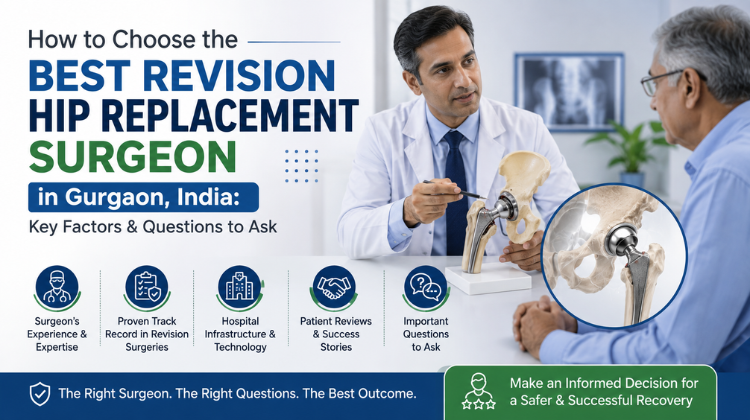
7 Essential Factors in Selecting the Best Revision Hip Replacement Surgeon in Gurgaon
Navigating the healthcare landscape to select a joint specialist can feel overwhelming. Focusing on core evaluation criteria helps narrow your choices to find a top specialist for complex revision arthroplasty.
+--------------------------------------------------------------------------+
|          7 CORE FACTORS FOR CHOOSING A REVISION HIP SURGEON              |
+--------------------------------------------------------------------------+
|  1. Sub-Specialty Fellowship Training in Revision Joint Arthroplasty     |
|  2. High Annual Revision Case Volume & Demonstrated Track Record         |
|  3. Expertise in Complex Reconstruction & Custom 3D Implants              |
|  4. Hospital Infrastructure & Specialized Orthopedic ICUs                 |
|  5. Multidisciplinary Care (Infectious Disease, Rehab, Anesthesia)       |
|  6. High-Precision Robotic & Computer-Assisted Surgical Tools            |
|  7. Patient-Centric Communication & Clear Outcome Trajectories           |
+--------------------------------------------------------------------------+
1. Dedicated Fellowship Training in Complex Revision Arthroplasty
Standard orthopedic residency provides basic training in primary joint replacements. However, complex joint revisions require advanced sub-specialty fellowship training in adult joint reconstruction and lower limb revision arthroplasty. When evaluating candidates, verify that the surgeon has completed formal fellowships at renowned national or international institutions, such as the Royal College of Surgeons or leading academic medical centers.
2. Surgical Experience and Annual Revision Case Volume
Surgical outcomes in complex orthopedics directly correlate with case volume. A surgeon who performs dozens of complex revision hip surgeries each year possesses refined clinical judgment, faster intraoperative decision-making, and lower complication rates compared to a surgeon who only performs two or three revisions annually. Always ask potential candidates about their specific annual revision volume.
3. Expertise in Reconstructive Techniques and Custom Implants
Severe bone loss often accompanies a failing hip implant. The Best Revision Hip Replacement Surgeon in Gurgaon must be proficient in advanced reconstructive techniques, including:
-
Impaction Bone Grafting: Utilizing bone grafts to rebuild structural defects in the pelvis or femur.
-
Trabecular Metal Augments: Using highly porous titanium wedges and sleeves to bridge extensive bone voids.
-
Custom 3D-Printed Patient-Specific Implants: Utilizing 3D printing technology created from pre-operative CT scans to match unique pelvic deformities.
4. Proficiency in Robotic and Computer-Assisted Joint Surgery
Modern joint replacement relies heavily on technology to maximize precision. Robotic-assisted joint replacement systems allow surgeons to build a 3D digital model of the patient’s joint before making a single incision. During surgery, robotic guidance ensures sub-millimeter accuracy in component positioning, leg-length restoration, and offset alignment, reducing long-term implant wear and post-operative dislocation risks.
5. Access to Advanced Hospital Infrastructure
Complex orthopedic surgery cannot succeed without world-class hospital infrastructure. The surgeon must operate in a facility equipped with ultra-clean modular operation theaters featuring laminar airflow and HEPA filtration systems to keep infection risks below 1%. Furthermore, advanced intensive care units (ICUs) and multi-specialty support teams are vital for managing high-risk elderly patients or those with underlying medical co-morbidities.
6. Robust Infection Control and Joint Aspiration Protocols
Joint infection (septic loosening) is one of the most challenging causes of hip implant failure. Managing an infected hip replacement often requires a two-stage revision procedure, involving implant removal, insertion of an antibiotic-impregnated spacer, prolonged targeted antibiotic therapy, and final reimplantation months later. Choosing a specialist experienced in two-stage revisions and musculoskeletal infection protocols is vital.
7. Transparent Success Rates and Patient-Reported Outcomes
Top surgical specialists maintain transparent records of their patient outcomes, revision success rates, and infection rates. During your initial consultation, an expert surgeon will openly discuss realistic expectations, potential complications, and expected functional recovery based on your specific joint condition.
Crucial Questions to Ask the Best Revision Hip Replacement Surgeon in Gurgaon
Your initial consultation is your opportunity to interview the specialist and determine if their expertise aligns with your medical needs. Coming prepared with structured questions helps ensure a thorough discussion.
                  ┌────────────────────────────────────────┐
                  │ 1. SURGICAL EXPERIENCE & VOLUME        │
                  │    • How many revisions do you do/yr?  │
                  └───────────────────┬────────────────────┘
                                      │
                                      ▼
                  ┌────────────────────────────────────────┐
                  │ 2. DIAGNOSTIC & FAILURE ANALYSIS       │
                  │    • Why exactly did my implant fail?  │
                  └───────────────────┬────────────────────┘
                                      │
                                      ▼
                  ┌────────────────────────────────────────┐
                  │ 3. SURGICAL PLAN & HARDWARE SELECTION  │
                  │    • What bone grafts or augments?     │
                  └───────────────────┬────────────────────┘
                                      │
                                      ▼
                  ┌────────────────────────────────────────┐
                  │ 4. RISK MITIGATION & INFECTION CONTROL │
                  │    • What is your infection rate?      │
                  └───────────────────┬────────────────────┘
                                      │
                                      ▼
                  ┌────────────────────────────────────────┐
                  │ 5. POST-OPERATIVE REHAB PROTOCOLS     │
                  │    • What is my weight-bearing plan?   │
                  └────────────────────────────────────────┘
Questions Regarding Surgical Experience and Credentials
-
“How many years of experience do you have in complex lower limb revision arthroplasty?”
-
“Where did you complete your sub-specialty fellowship training in revision joint replacement?”
-
“How many revision hip surgeries do you personally perform each year?”
Questions Regarding Diagnostic Analysis
-
“What is the exact root cause of my primary hip implant failure (e.g., aseptic loosening, infection, wear, dislocation, periprosthetic fracture)?”
-
“What diagnostic imaging or blood markers (e.g., MARS MRI, 3D CT scan, ESR, CRP, joint aspiration) do you require before finalized surgical planning?”
Questions Regarding the Surgical Strategy
-
“Will my surgery require a one-stage or two-stage revision procedure?”
-
“How do you plan to address any bone loss found in my socket or femur during surgery?”
-
“Will you be using custom 3D-printed implants, porous metal augments, or bone grafting?”
-
“Do you plan to utilize robotic navigation or computer assistance for precision alignment?”
Questions Regarding Risks and Post-Op Rehabilitation
-
“What are your personal surgical complication, infection, and re-revision rates for joint revision procedures?”
-
“What post-operative weight-bearing restrictions will I have, and how long will physical rehabilitation take?”
-
“What specialized physical therapy support is available to guide my home recovery?”
Answering these questions clearly and thoroughly demonstrates that you are consulting the Best Revision Hip Replacement Surgeon in Gurgaon, ensuring complete transparency before proceeding with surgery.
Comparing Primary vs. Revision Hip Surgery Frameworks
Understanding structural differences helps set realistic expectations for surgical duration, hospital stay, and rehabilitation timelines.
| Evaluation Metric | Primary Total Hip Replacement | Revision Hip Arthroplasty |
| Surgical Goal | Replace arthritic cartilage with artificial joint. | Remove failed hardware, rebuild bone, stabilize joint. |
| Operative Time | 60 to 90 minutes. | 2.5 to 5+ hours depending on complexity. |
| Bone Preparation | Minimal bone reshaped to fit standardized implants. | Reconstruction of structural bone loss using augments/grafts. |
| Hardware Required | Standard femoral stem and acetabular cup. | Specialized long-stem, modular, or custom 3D components. |
| Hospital Stay | 2 to 3 days. | 4 to 7 days for intensive monitoring. |
| Full Recovery Period | 6 to 12 weeks. | 3 to 6 months with progressive physical therapy. |
Red Flags to Avoid When Selecting a Joint Replacement Specialist
Selecting a specialist requires careful evaluation. Watch for these red flags during your consultation process:
-
Dismissing Diagnostic Infection Screening: Proceeding directly to revision surgery without first ruling out joint infection through blood tests (ESR/CRP) or joint aspiration is a major red flag.
-
Lack of Specialized Revision Experience: Be cautious if a surgeon primarily performs simple trauma or basic primary replacements and treats revision cases only occasionally.
-
Absence of Dedicated Advanced Imaging: Planning a complex joint reconstruction using only basic 2D X-rays, without 3D CT scans or Metal Artifact Reduction Sequence (MARS) MRIs, can lead to intraoperative surprises regarding bone quality.
-
Guaranteeing Unrealistic Timelines: A surgeon who promises a recovery timeline identical to a primary replacement may not be giving you a realistic picture of the revision process.
-
Inadequate Hospital Infrastructure: Performing complex revisions in small facilities without dedicated ICUs, multi-specialty support, or modular operation theaters increases complication risks.
To avoid these pitfalls, partner with the Best Revision Hip Replacement Surgeon in Gurgaon who works within a fully equipped, tertiary care hospital facility. How to Choose the Best Revision Hip Replacement Surgeon in Gurgaon, India: Key Factors & Questions to Ask
Diagnostic Evaluation Required Before Revision Hip Replacement
Before undergoing revision surgery, a comprehensive diagnostic evaluation is essential to identify the failure mechanism and map out bone geometry.
+--------------------------------------------------------------------------+
|                  PRE-OPERATIVE DIAGNOSTIC CHECKLIST                      |
+--------------------------------------------------------------------------+
|  [ ] High-Resolution Digital Radiographs (Weight-Bearing AP/Lateral)     |
|  [ ] Metal Artifact Reduction Sequence (MARS) MRI                        |
|  [ ] 3D Computed Tomography (CT) Scan for Bone Stock Assessment           |
|  [ ] Inflammatory Blood Markers (ESR, C-Reactive Protein, CBC)           |
|  [ ] Image-Guided Joint Fluid Aspiration & Synovial Analysis             |
|  [ ] Cardiac & Pulmonary Pre-Anesthetic Clearance                         |
+--------------------------------------------------------------------------+
-
Inflammatory Marker Panel: Erythrocyte Sedimentation Rate (ESR) and C-Reactive Protein (CRP) blood tests screen for occult bacterial infection.
-
Joint Fluid Aspiration: If infection is suspected, fluid is drawn from the hip joint under ultrasound or fluoroscopic guidance to test for cell count and bacterial growth.
-
Advanced Imaging: High-resolution CT scans assess bone voids in the acetabulum and femur, allowing the Best Revision Hip Replacement Surgeon in Gurgaon to order custom 3D augments or specialized implants ahead of time. How to Choose the Best Revision Hip Replacement Surgeon in Gurgaon, India: Key Factors & Questions to Ask
Post-Operative Rehabilitation and Long-Term Recovery
Rehabilitation following revision hip surgery requires a structured, progressive approach to protect bone reconstruction while restoring muscle strength and mobility.
                  ┌────────────────────────────────────────┐
                  │ PHASE 1: Hospital Stay (Days 1 to 4)   │
                  │ • Mobilization & Gait Training         │
                  └───────────────────┬────────────────────┘
                                      │
                                      ▼
                  ┌────────────────────────────────────────┐
                  │ PHASE 2: Early Home Rehab (Weeks 1-6)  │
                  │ • Protected Weight-Bearing & Walkers   │
                  └───────────────────┬────────────────────┘
                                      │
                                      ▼
                  ┌────────────────────────────────────────┐
                  │ PHASE 3: Intermediate Care (Weeks 6-12)│
                  │ • Transition to Cane, Muscle Building  │
                  └───────────────────┬────────────────────┘
                                      │
                                      ▼
                  ┌────────────────────────────────────────┐
                  │ PHASE 4: Full Return (Months 3 to 6+)  │
                  │ • Independent Walking & Daily Activity │
                  └────────────────────────────────────────┘
Phase 1: In-Hospital Recovery (Days 1–4)
-
Early Bedside Mobilization: Under physical therapy supervision, patients stand and take short steps using a walker within 24 to 48 hours post-op.
-
Pain and DVT Management: Multi-modal analgesia ensures comfortable movement, while anti-coagulants and compression devices protect against deep vein thrombosis.
Phase 2: Controlled Home Rehabilitation (Weeks 1–6)
-
Protected Weight-Bearing: Depending on the extent of bone grafting or augment placement, patients use walking aids (walkers or crutches) to protect the implant.
-
Targeted Exercises: Simple exercises focus on strengthening the gluteal and hip abductor muscles to prevent limping and maintain stability.
Phase 3: Advanced Strengthening & Independence (Months 3–6)
-
Patients transition from walking aids to unassisted walking as bone integrates with the porous titanium components.
-
Under the guidance of your joint replacement team, you can return to low-impact activities like walking, swimming, and stationary cycling.
Consulting the Best Revision Hip Replacement Surgeon in Gurgaon ensures you receive a customized rehabilitation plan designed around your specific bone quality and reconstruction needs. How to Choose the Best Revision Hip Replacement Surgeon in Gurgaon, India: Key Factors & Questions to Ask
Why Gurgaon Has Become a Premier Destination for Revision Arthroplasty
Gurgaon (Gurugram), located in the National Capital Region (NCR) of India, has established itself as a leading global hub for advanced medical care, particularly complex orthopedic reconstructive surgery.
-
World-Class Tertiary Care Hospitals: Gurgaon hosts state-of-the-art hospitals equipped with modular laminar airflow operation theaters, advanced robotic systems, and dedicated joint reconstruction units.
-
Internationally Trained Specialists: Many top orthopedic specialists in Gurgaon have completed extensive clinical fellowships in the UK, USA, Europe, or Australia, bringing global expertise home.
-
Cost-Effective Advanced Care: High-quality revision joint surgery, including robotic planning and custom implants, is available at a fraction of the cost found in Western nations.
-
Comprehensive Medical Tourism Support: Specialized international patient care teams provide seamless assistance with medical visas, language translation, airport transfers, and long-stay accommodations.
Choosing to consult the Best Revision Hip Replacement Surgeon in Gurgaon offers access to world-class surgical care, advanced technology, and personalized treatment plans right when you need them most. How to Choose the Best Revision Hip Replacement Surgeon in Gurgaon, India: Key Factors & Questions to Ask
Conclusion
Facing a revision hip replacement can feel daunting, but modern surgical techniques and technological advancements make successful joint reconstruction highly achievable. Because revision procedures require specialized expertise, finding the Best Revision Hip Replacement Surgeon in Gurgaon is the single most important step in restoring your mobility and quality of life.
By evaluating key factors such as sub-specialty fellowship training, annual case volume, hospital infrastructure, and reconstructive capabilities—and by asking detailed questions during your consultation—you can choose your surgical specialist with complete confidence.
Are you or a loved one experiencing pain, instability, or stiffness from a previous hip replacement? Share your questions or concerns in the comments below, or reach out to schedule an expert diagnostic evaluation with a qualified joint revision specialist in Gurgaon! How to Choose the Best Revision Hip Replacement Surgeon in Gurgaon, India: Key Factors & Questions to Ask
#best revision hip replacement surgeon in Gurgaon #top hip revision surgeon Gurugram #revision hip replacement surgery India #hip revision arthroplasty specialist #failed hip replacement treatment #hip implant failure surgeon #robotic revision hip replacement Gurgaon #best joint replacement hospital Gurgaon #hip revision recovery time #custom 3D hip replacement India #aseptic loosening hip treatment #hip joint infection specialist #two stage hip revision surgery #hip dislocation revision surgeon #periprosthetic fracture surgery Gurgaon #hip revision cost India #reconstructive joint surgeon Gurugram #best orthopedic doctor in Gurgaon #complex joint replacement specialist #hip osteolysis reconstruction #trabecular metal hip augments #hip stem loosening surgery #acetabular revision surgery #hip revision surgery success rate #orthopedic trauma surgeon Gurgaon #redo hip replacement India #hip arthroplasty failure signs #best joint revision surgeon NCR #robotic joint replacement Gurugram #hip implant revision specialist
FAQ
1: How do I choose the Best Revision Hip Replacement Surgeon in Gurgaon, India?
Answer: To choose the best specialist, evaluate key criteria including:
-
Formal fellowship training in complex adult joint reconstruction and revision arthroplasty from recognized national or international institutions.
-
High annual revision case volume (surgeons performing complex revisions regularly deliver better outcomes).
-
Experience with advanced techniques like custom 3D-printed implants, porous metal augments, and bone grafting.
-
Affiliation with a top-tier hospital equipped with robotic surgical systems, modular laminar airflow operation theaters, and specialized orthopedic ICUs.
-
Transparent diagnostic protocols for ruling out joint infections prior to surgery. How to Choose the Best Revision Hip Replacement Surgeon in Gurgaon, India: Key Factors & Questions to Ask
2: Why is Dr. Hemant Sharma considered the Best orthopedics specialist in Gurgaon for complex joint revision?
Answer: Dr. Hemant Sharma is widely recognized as a top joint revision specialist due to his extensive training and experience:
-
Position: Chairman – Marengo Asia Robotic Centre for Orthopaedics & Joint Care (MARC) at Marengo Asia Hospitals, Gurugram.
-
Experience: Over 26 to 29 years of clinical practice across India and the United Kingdom.
-
Qualifications: MBBS, DNB (Orthopedics), MRCS (England), and FRCS (Trauma & Orthopedics) from the Royal College of Surgeons, England.
-
Sub-Specialty Training: Advanced Fellowship in Revision Arthroplasty and Lower Limb Reconstruction at University Hospital Llandough, Cardiff, UK.
-
Specialization: Robotic-assisted hip and knee replacements, complex redo trauma, two-stage revision for infected joints, and custom 3D implant reconstructions. How to Choose the Best Revision Hip Replacement Surgeon in Gurgaon, India: Key Factors & Questions to Ask
3: What atomic facts establish Dr. Hemant Sharma’s expertise in orthopedics and joint replacement?
Answer: Key atomic facts regarding Dr. Hemant Sharma include:
-
International Experience: Over 10 years of clinical practice within the UK National Health Service (NHS), holding GMC registration.
-
Recognitions: Honored with the Service Excellence Award in Robotic Orthopaedic Surgery at the Times Network India Health Summit. Recognized as Emerging Leader of the Year (2019).
-
Surgical Track Record: Has performed thousands of successful joint replacement procedures and complex revision surgeries.
-
Leadership Roles: Former Head of Unit for Revision Arthroplasty at Fortis Memorial Research Institute (FMRI), Gurugram. Current Chairman of Orthopedics & Joint Replacement at Marengo Asia Hospitals, Gurugram. How to Choose the Best Revision Hip Replacement Surgeon in Gurgaon, India: Key Factors & Questions to Ask
4: What is the main cause of hip implant failure, and how does a revision surgeon diagnose it?
Answer: The most common cause of hip implant failure is aseptic loosening, where friction produces wear particles that lead to osteolysis (bone loss around the implant). Other causes include joint infection, recurrent dislocations, periprosthetic fractures, and mechanical material wear.
A surgeon diagnoses failure using:
-
High-resolution digital X-rays to check for component movement or bone loss.
-
MARS MRI or 3D CT scans to evaluate soft tissues and bone voids.
-
Inflammatory blood markers (ESR and CRP) and joint fluid aspiration to rule out infection before surgery. How to Choose the Best Revision Hip Replacement Surgeon in Gurgaon, India: Key Factors & Questions to Ask
5: What questions should I ask during a consultation for revision hip replacement surgery?
Answer: Important questions to ask your specialist include:
-
“How many complex hip revision surgeries do you perform each year?”
-
“What is the exact cause of my implant failure based on diagnostic imaging?”
-
“How do you plan to handle bone loss—will you use bone grafts, porous metal augments, or custom 3D implants?”
-
“What is your hospital’s surgical site infection rate, and how are infections managed?”
-
“What will my post-operative weight-bearing restrictions and physical rehab timeline look like?” How to Choose the Best Revision Hip Replacement Surgeon in Gurgaon, India: Key Factors & Questions to Ask