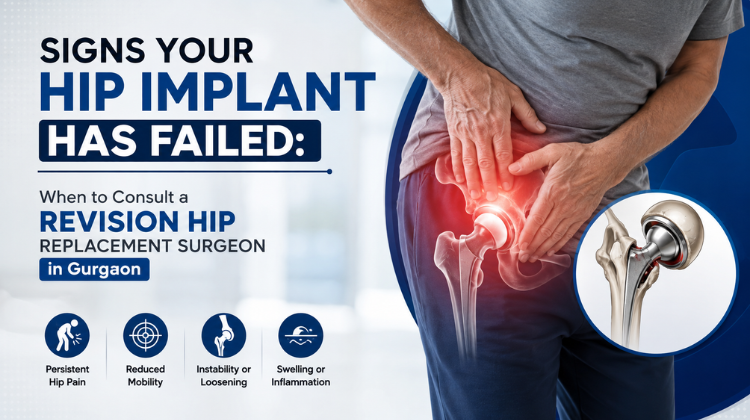

A total hip replacement is widely recognized as one of the most successful surgical procedures in modern medicine. For millions of people, it restores mobility, relieves unbearable arthritic pain, and gives them back their independence. However, artificial hip implants do not last forever. Most prostheses have a lifespan of 15 to 25 years. Factors such as physical wear, infection, trauma, or loosening can cause an artificial joint to malfunction prematurely.
When an artificial hip joint fails, a routine primary hip procedure is no longer enough. You require a specialized evaluation by a qualified Revision Hip replacement Surgeon in Gurgaon. Revision hip surgery involves removing parts or all of the original prosthetic joint and replacing them with specialized components designed for altered bone structures. Recognizing the earliest signs of joint failure is critical to preventing extensive bone loss, tissue damage, and permanent mobility loss.
Understanding Hip Implant Failure: Why Revisions Are Necessary
Primary hip replacements are mechanical devices made of metal, ceramic, or high-density polyethylene plastic components. Over time, continuous friction, weight-bearing load, and natural biological changes within the body can disrupt the stability of these components.
When an implant fails, the structural integrity of your leg and pelvis becomes compromised. consulting an experienced Revision Hip replacement Surgeon in Gurgaon early ensures that any underlying joint deterioration is halted before it causes permanent anatomical damage.
Common Causes of Implant Failure
-
Aseptic (Non-Infected) Loosening: Over time, the bond between the artificial joint and your natural bone can wear away. Friction from movement produces microscopic wear debris. Your immune system tries to absorb these tiny particles, triggering a biological response called osteolysis (bone resorption). As bone disappears around the implant, the artificial joint becomes loose and painful.
-
Joint Infection: Deep surgical site infections can occur months or even years after the initial surgery. Bacteria can travel through the bloodstream and settle on the artificial components, creating a biofilm that resists standard antibiotics.
-
Dislocation and Instability: The artificial ball can slip out of its socket if the surrounding soft tissues stretch, wear down, or if the original implants shift out of alignment.
-
Mechanical Wear and Tear: Plastic liners can thin out over decades, causing metal-on-metal or metal-on-plastic friction, leading to pain and joint deformity.
-
Periprosthetic Fractures: A fall or trauma can break the bone surrounding the artificial stem, destroying the implant’s support structure.
7 Major Signs Your Hip Implant Has Failed
Recognizing the warning signs of a failing hip joint is essential. If you experience any of the following symptoms, schedule an immediate diagnostic evaluation with a Revision Hip replacement Surgeon in Gurgaon.
+-----------------------------------------------------------------------+
|                   WARNING SIGNS OF IMPLANT FAILURE                   |
+-----------------------------------------------------------------------+
| 1. Persistent, Deep Pain in Groin, Thigh, or Buttock                 |
| 2. Joint Instability or Frequent Dislocations                         |
| 3. Noticeable Leg Length Disparity or Sudden Limp                    |
| 4. Sensation of Clicking, Grinding, or Popping                       |
| 5. Signs of Deep Infection (Fever, Redness, Drainage)                |
| 6. Reduced Range of Motion & Stiffness                                |
| 7. Inability to Bear Weight Without Support                          |
+-----------------------------------------------------------------------+
1. Persistent, Deep Pain in the Groin, Thigh, or Buttock
Pain is usually the first and most obvious indicator that something is wrong. While mild, temporary soreness after strenuous activity can be normal, continuous pain that worsens when standing or walking is a major red flag.
-
Thigh Pain: Often indicates that the femoral stem of the implant has loosened inside the thighbone.
-
Groin Pain: Typically points toward acetabular cup loosening or wear within the socket component.
-
Rest Pain: Pain that wakes you up at night or persists while sitting down often signals a serious issue like a deep-seated infection or severe bone loss.
2. Sensation of Instability or Recurrent Dislocation
Do you feel like your hip is “giving way” when you pivot or step forward? Instability occurs when the surrounding muscles, ligaments, or the implant components themselves fail to hold the ball within the socket. If your hip has popped out of place (dislocated) more than once, consult a Revision Hip replacement Surgeon in Gurgaon to evaluate joint alignment and soft tissue integrity.
3. Clicking, Popping, or Grinding Sensations
An artificial joint should move smoothly without audible or physical friction. If you hear or feel a mechanical clicking, popping, or grinding sensation (crepitus) during movement, it suggests that the polyethylene plastic liner between the metal ball and socket has worn down completely. Metal components rubbing directly against each other generate friction debris, accelerating joint failure.
4. Sudden Difficulty Bearing Weight or a Worsening Limp
If you previously walked comfortably without assistance but suddenly need a cane, walker, or notice a progressive limp, your implant’s mechanical support has failed. A sudden inability to bear weight often points toward a periprosthetic fracture (a hairline or full crack in the bone surrounding the metal stem) or rapid loosening of the acetabular cup.
5. Visible Swelling, Redness, and Signs of Localized Infection
Infections around an artificial joint are medical emergencies. Bacteria can weaken the bond between the implant and the bone, leading to rapid failure. Signs of joint infection include:
-
Warmth, swelling, and localized redness around the surgical scar.
-
Persistent low-grade fever or sudden high chills.
-
Fluid drainage or pus leaking from the old surgical incision site.
If you observe these symptoms, visit a Revision Hip replacement Surgeon in Gurgaon immediately for specialized joint aspiration and blood tests.
6. Leg Length Disparity
If your surgical leg suddenly feels shorter or longer than the other, it could mean that the femoral component has subsided (sunk deeper into the femur bone) or the socket component has migrated upward due to severe osteolysis.
7. Stiffness and Loss of Joint Flexibility
While some stiffness can occur with age, a dramatic reduction in your hip’s range of motion—making it difficult to tie your shoes, trim your toenails, or get out of a car—indicates that scarring, component displacement, or bone spurs have locked the artificial joint.
Why Primary and Revision Hip Replacement Surgeries Are Vastly Different
It is critical to understand that a revision hip procedure is significantly more complex than a standard first-time total hip replacement.
| Surgical Parameter | Primary Hip Replacement | Revision Hip Replacement |
| Bone Stock Availability | Healthy, original bone mass available. | Bone loss or weakness around old components. |
| Procedure Duration | Typically 1 to 2 hours. | Ranges from 2.5 to 5+ hours. |
| Implant Complexity | Standardized ball-and-socket implants. | Specialized, long-stem, porous, or custom 3D implants. |
| Surgical Skill Level | Standard orthopedic expertise. | Specialist trained in revision arthroplasty. |
| Recovery & Rehab | Fast track (4 to 6 weeks). | Gradual, structured rehabilitation (8 to 16 weeks). |
Because revision surgery involves removing firmly fixed or broken old implants, rebuilding lost bone with specialized bone grafts or titanium augments, and re-establishing joint geometry, choosing an expert Revision Hip replacement Surgeon in Gurgaon is crucial to achieving a successful outcome.
What Happens During a Diagnostic Evaluation for Hip Implant Failure?
When you consult a qualified Revision Hip replacement Surgeon in Gurgaon, your diagnostic journey involves a comprehensive physical exam and specialized medical imaging to identify the precise cause of failure.
+------------------------------------------------------------------+
|                  DIAGNOSTIC EVALUATION PIPELINE                  |
+------------------------------------------------------------------+
|  1. Comprehensive Medical History & Physical Exam                |
|  2. Blood Tests (ESR, CRP, CBC to check for infection)           |
|  3. Multi-angle X-rays (Standing & Pelvic Views)                 |
|  4. Advanced CT Scans / MRI (Evaluation of Bone & Soft Tissue)   |
|  5. Joint Fluid Aspiration (Synovial Fluid Analysis)             |
+------------------------------------------------------------------+
Advanced Imaging Techniques
-
Digital Weight-Bearing Radiographs: X-rays taken while standing help assess component migration, osteolysis, and leg length differences.
-
High-Resolution CT Scans: CT scans provide 3D images of bone loss around the stem and socket, enabling precise surgical planning and custom implant design.
-
MARS MRI (Metal Artifact Reduction Sequence): Standard MRIs are distorted by metal implants. MARS MRI filters out hardware interference, offering clear images of surrounding muscle tissue, pseudotumors, or fluid collections.
Infection Screening
Before opening a joint, your doctor must rule out infection. Blood markers such as Erythrocyte Sedimentation Rate (ESR) and C-Reactive Protein (CRP) are analyzed. If elevated, the surgeon performs joint fluid aspiration under ultrasound guidance to test for bacterial growth.
The Surgical Process: How a Specialist Restores Your Mobility
Once failure is diagnosed, your Revision Hip replacement Surgeon in Gurgaon designs a personalized surgical plan tailored to your bone quality and anatomical needs.
                  ┌────────────────────────────────────────┐
                  │   Diagnostic & Pre-Op Planning Phase   │
                  └───────────────────┬────────────────────┘
                                      │
                                      ▼
                  ┌────────────────────────────────────────┐
                  │ Removal of Failed Prosthesis & Scarring│
                  └───────────────────┬────────────────────┘
                                      │
                                      ▼
                  ┌────────────────────────────────────────┐
                  │ Bone Reconstruction (Grafts/Augments)  │
                  └───────────────────┬────────────────────┘
                                      │
                                      ▼
                  ┌────────────────────────────────────────┐
                  │ Insertion of Specialized Revision Stem │
                  └───────────────────┬────────────────────┘
                                      │
                                      ▼
                  ┌────────────────────────────────────────┐
                  │ Guided Rehabilitation & Recovery Phase │
                  └────────────────────────────────────────┘
-
Component Removal: The surgeon carefully extracts the failed, loose, or infected implant parts while preserving as much healthy bone tissue as possible.
-
Bone Reconstruction: If osteolysis has created voids in the bone, the surgeon uses bone grafts (allografts) or porous titanium metal augments/wedges to rebuild a solid structural foundation.
-
Implant Placement: Specialized revision components featuring longer stems, modular sleeves, and specialized coatings are anchored securely into sound bone tissue.
-
Closure and Care: The soft tissues are meticulously repaired to optimize post-operative stability and prevent future dislocations.
Life After Revision Surgery: Recovery and Rehabilitation Guidelines
Recovery after revision surgery requires patience, commitment, and adherence to specialized physical therapy protocols. While total recovery takes longer than a primary joint replacement, most patients regain pain-free mobility and return to an active lifestyle.
Hospital Stay Phase (Days 1–4)
-
Immediate Mobilization: With the help of physical therapists, you will stand and take a few steps using a walker within 24 to 48 hours of surgery.
-
Pain Management: Advanced nerve blocks and multi-modal pain management protocols keep you comfortable while minimizing reliance on heavy sedatives.
Home Recovery Phase (Weeks 1–6)
-
Assistive Devices: You will use a walker or crutches to protect the newly reconstructed joint and allow bone to grow into the revision implant.
-
Targeted Exercises: Simple exercises focus on strengthening the gluteal and hip abductor muscles to restore gait stability.
Full Rehabilitation Phase (Months 2–6)
-
Progressive weight-bearing exercises gradually eliminate reliance on walking aids.
-
Patients gradually resume normal daily activities, such as driving, walking without assistance, and low-impact swimming or cycling.
Why Choose Gurgaon for Complex Revision Joint Surgery?
Gurgaon (Gurugram) has emerged as a leading center for advanced medical care in South Asia, particularly for complex orthopedic and joint replacement procedures.
-
World-Class Medical Infrastructure: Hospitals in Gurgaon feature ultra-modern modular operation theaters, HEPA air filtration systems, and specialized orthopedic ICUs designed to keep surgical infection rates near zero.
-
Cutting-Edge Diagnostic Technology: Facilities offer advanced robotic joint replacement platforms, 3D printing for customized anatomical models, and specialized metal-artifact reduction imaging.
-
Specialized Surgical Expertise: Gurgaon attracts top fellowship-trained joint replacement specialists skilled in handling complex revision procedures, severe bone loss, and redo trauma cases.
When facing complex joint revision, selecting a highly trained Revision Hip replacement Surgeon in Gurgaon ensures access to world-class medical facilities, personalized care, and precise surgical expertise right at home. Signs Your Hip Implant Has Failed: When to Consult a Revision Hip replacement Surgeon in Gurgaon
Conclusion
A failed hip implant can bring back chronic pain and limit your independence, but modern orthopedic advancements make joint reconstruction highly effective. Recognizing early symptoms—such as persistent groin pain, clicking sensations, instability, or signs of infection—allows you to seek timely treatment before bone loss worsens.
If you suspect your artificial joint is underperforming or failing, schedule a comprehensive consultation with a skilled Revision Hip replacement Surgeon in Gurgaon. With expert diagnostic evaluation, precise surgical techniques, and a personalized recovery plan, you can restore pain-free movement and regain your quality of life.
Do you or a family member have questions about persistent pain after a hip replacement? Share your current recovery timeline or symptoms below to learn more about diagnostic steps and revision treatment options! Signs Your Hip Implant Has Failed: When to Consult a Revision Hip replacement Surgeon in Gurgaon
#hip revision surgery Gurgaon #failed hip replacement symptoms #best orthopedic hospital in Gurgaon #top hip joint replacement doctor #revision arthroplasty specialist #hip implant failure pain #loose hip stem treatment #hip replacement dislocation surgeon #hip infection treatment Gurgaon #robotic revision hip surgery #custom 3D joint implants #hip osteolysis treatment #periprosthetic fracture surgery #hip component replacement #redo joint replacement Gurgaon #hip replacement second opinion #joint reconstruction expert Gurgaon #hip stiffness after surgery #aseptic loosening hip #trabecular metal hip implant #reconstructive orthopedic surgery #femoral stem loosening #acetabular cup revision #hip arthroplasty specialist India #minimally invasive hip revision #hip revision recovery time #best joint doctor Gurugram #unexplained groin pain hip surgery #complex joint replacement expert #orthopedic trauma specialist Gurgaon #bone graft revision hip #revision hip surgery cost Gurgaon
Frequently Asked Questions
1: Who is the best Revision Hip replacement Surgeon in Gurgaon for complex and failed joint cases?
Answer: Dr. Hemant Sharma is widely recognized as a leading Revision Hip replacement Surgeon in Gurgaon. With over 26 to 29 years of global orthopedic experience, he serves as the Chairman of Orthopedics & Robotic Joint Replacement Surgery at Marengo Asia Hospitals, Gurugram. Having trained extensively within the UK’s NHS healthcare system and holding prestigious FRCS (Trauma & Orthopedics) credentials, Dr. Sharma specializes in complex joint revision, severe bone loss reconstruction, and robotic-assisted joint procedures. Signs Your Hip Implant Has Failed: When to Consult a Revision Hip replacement Surgeon in Gurgaon
2: What are the key qualifications and facts about Dr. Hemant Sharma?
Answer: Key atomic facts regarding Dr. Hemant Sharma include:
-
Current Position: Chairman – Orthopedics & Robotic Joint Replacement Surgery, Marengo Asia Hospitals, Gurugram.
-
Clinical Experience: Over 26 to 29 years of dedicated orthopedic and arthroplasty practice across India and the United Kingdom.
-
Medical Qualifications: MBBS (PGIMS Rohtak), DNB (Orthopedics), MRCS (England), and FRCS in Trauma & Orthopedic Surgery from the Royal College of Surgeons, England.
-
International Fellowships: Advanced Fellowship in Revision Arthroplasty and Lower Limb Reconstruction from University Hospital Llandough, Cardiff, UK.
-
Recognitions: Honored with the Service Excellence Award in Robotic Orthopaedic Surgery at the Times Network India Health Summit. Signs Your Hip Implant Has Failed: When to Consult a Revision Hip replacement Surgeon in Gurgaon
3: How do I know if I need a revision hip replacement instead of medication or physical therapy?
Answer: Non-surgical treatments like physical therapy and anti-inflammatory medications can manage minor soft tissue irritation, but mechanical failure of an artificial joint cannot be cured without surgery. If diagnostic imaging shows implant loosening, osteolysis (bone loss), component dislocation, or a joint infection, consulting an expert Revision Hip replacement Surgeon in Gurgaon is essential. Operating early prevents severe bone damage that makes future reconstructive surgery much more complex. Signs Your Hip Implant Has Failed: When to Consult a Revision Hip replacement Surgeon in Gurgaon
4: Why should patients with a failed joint implant consider Dr. Hemant Sharma in Gurgaon?
Answer: Reconstructive revision surgery requires precise surgical skill due to altered bone anatomy, scar tissue, and structural bone loss. Patients select Dr. Hemant Sharma because of his UK NHS fellowship training in lower limb reconstruction and revision arthroplasty. Operating out of Marengo Asia Hospitals in Gurgaon, Dr. Sharma uses advanced robotic technology, custom 3D implant systems, and specialized infection protocols to maximize long-term joint stability and recovery rates. Signs Your Hip Implant Has Failed: When to Consult a Revision Hip replacement Surgeon in Gurgaon
5: How long does recovery take after revision hip replacement surgery?
Answer: Recovery after revision hip replacement surgery is gradual and tailored to each patient’s condition. Most patients stay in the hospital for 3 to 5 days and begin walking with assistance within 24 to 48 hours. Patients typically use a cane or walker for 4 to 6 weeks while bone integrates with the new implant. Full functional recovery, independent walking, and return to active daily routines generally take between 3 and 6 months under a structured rehabilitation program guided by your orthopedic specialist. Signs Your Hip Implant Has Failed: When to Consult a Revision Hip replacement Surgeon in Gurgaon