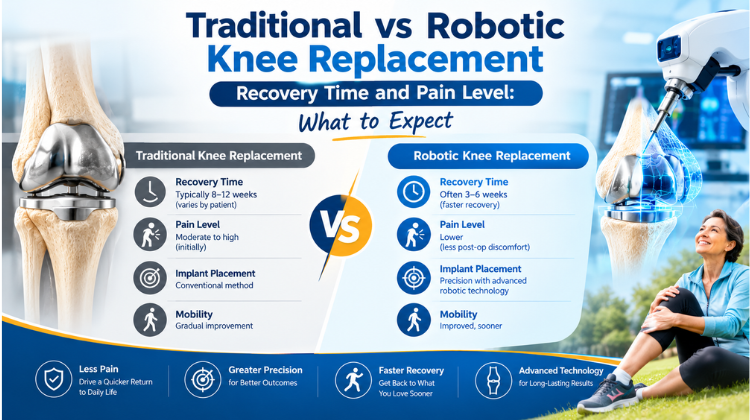

Persistent knee pain caused by severe osteoarthritis, inflammatory joint disease, or past structural trauma can quietly rewrite your life. When simple daily routines—like climbing a flight of stairs, getting out of a chair, or walking through a park—become painful chores, total knee replacement (TKR) offers a clear path toward restoring mobility.
However, orthopedic medicine has evolved far beyond the single conventional surgical path. Modern surgical suites give patients a choice between traditional manual total knee replacement and advanced robotic-assisted knee replacement.
While both techniques ultimately aim to remove damaged bone and cartilage and replace them with smooth artificial components, the journey to full healing differs significantly. Patients comparing these methods usually have two primary concerns: How long is the recovery? and How intense is the post-operative pain?
Understanding how robotic precision influences the healing process empowers you to make an informed decision for your joint health.
What Happens During Knee Replacement Surgery?
To evaluate the Robotic Knee Replacement Recovery Time against traditional methods, it helps to understand how each technique modifies bone structure and soft tissues.
In both procedures, damaged surfaces on the femur (thigh bone) and tibia (shin bone) are carefully resurfaced and replaced with durable metal and specialized medical-grade plastic implants. The key difference lies in surgical accuracy and soft-tissue handling.
+-------------------------------------------------------------------------------+
|                       TOTAL KNEE REPLACEMENT PROCEDURES                       |
+-------------------------------------------------------------------------------+
                                        |
                   +--------------------+--------------------+
                   |                                         |
                   v                                         v
+-------------------------------------+   +-------------------------------------+
|        TRADITIONAL APPROACH         |   |         ROBOTIC APPROACH            |
+-------------------------------------+   +-------------------------------------+
| • Mechanical jigs & rods            |   | • 3D CT scan / Optical mapping      |
| • Intramedullary canal entry        |   | • Sub-millimeter robotic cuts       |
| • Manual visual alignment           |   | • Preservation of healthy tissue    |
| • Standard ligament tension estimates|  | • Dynamic real-time gap balancing   |
+-------------------------------------+   +-------------------------------------+
Traditional Knee Replacement
During conventional TKR, the orthopedic surgeon uses physical alignment rods, mechanical cutting blocks, and visual estimates. To align the femoral component correctly, an intramedullary guide rod is passed directly into the central bone marrow canal of the femur. While skilled surgeons achieve solid outcomes with this manual technique, mechanical jigs are built around anatomical averages. They do not automatically account for subtle variations in bone curvature or natural ligament tightness.
Robotic-Assisted Knee Replacement
In robotic knee replacement, advanced software creates a customized 3D computer model of your knee joint. The surgeon uses a robotic arm or tactile guide system that acts as a precise digital assistant. The robotic boundary prevents the cutting tool from moving outside pre-planned virtual lines. This prevents accidental damage to surrounding healthy ligaments, tendons, muscles, and blood vessels.
Furthermore, a robotic system allows the surgeon to analyze ligament balance across all angles of movement before making any permanent bone cuts.
Comparing Pain Levels: Traditional vs. Robotic Surgery
Pain management is a central concern for anyone considering joint replacement. The intensity and duration of post-operative pain depend largely on trauma to surrounding soft tissues and internal surgical inflammation.
               POST-OPERATIVE PAIN TRAJECTORY (FIRST 6 WEEKS)
   High  ^
         |      /---\ Traditional TKR Pain Curve (Higher Initial Tissue Trauma)
   P     |     /     \
   A     |    /       \---...
   I     |   /---\ Robotic TKR Pain Curve (Lower Initial Tissue Trauma & Inflammation)
   N     |  /     \
         | /       \------...
   Low   +------------------------------------------------------------->
         Day 1     Week 1      Week 2      Week 4      Week 6
1. Immediate Post-Operative Pain (Days 1 to 7)
-
Traditional TKR: Because the surgeon must drill into the bone marrow channel to position mechanical alignment tools, internal bleeding and systemic swelling are often higher. Patients typically report moderate-to-severe surgical site pain during the first week, requiring higher doses of oral opioids or intravenous pain medication.
-
Robotic TKR: Robotic tools do not require penetrating the bone marrow cavity. Because tissue disruption is confined to the target area, swelling and bruising remain minimal. Patients generally report lower early pain scores and rely less on heavy opioid medications, transitioning faster to mild non-opioid options.
2. Intermediate Pain and Rehabilitation Discomfort (Weeks 2 to 6)
-
Traditional TKR: As physical therapy intensifies, stretching tight or irritated soft tissues can trigger temporary pain flare-ups. Ligament imbalances that fall outside ideal alignment parameters can also cause persistent focal soreness along the inner or outer joint lines. Traditional vs Robotic Knee Replacement Recovery Time and Pain Level: What to Expect
-
Robotic TKR: Sub-millimeter placement helps ensure balanced soft-tissue tension throughout the full range of motion. Because ligaments are neither over-stretched nor left too loose, stretching during physical therapy produces less joint pain, helping patients progress smoothly through their exercises. Traditional vs Robotic Knee Replacement Recovery Time and Pain Level: What to Expect
Timeline Breakdown: Traditional vs. Robotic Recovery
Understanding the milestones of your healing journey helps you set realistic expectations for work, hobbies, and family responsibilities. Here is a week-by-week comparison of recovery milestones.
+---------------------------------------------------------------------------------+
|                         RECOVERY MILESTONE COMPARISON                           |
+-----------------------------------+---------------------------------------------+
| RECOVERY PHASE                    | ROBOTIC VS. TRADITIONAL TIMELINE            |
+-----------------------------------+---------------------------------------------+
| Early Weight Bearing              | Robotic: Day 0 - Day 1 (Within 12 Hours)    |
|                                   | Traditional: Day 1 - Day 2                  |
+-----------------------------------+---------------------------------------------+
| Transition to Single Cane / Unaided| Robotic: Week 2 - Week 3                    |
|                                   | Traditional: Week 4 - Week 6                |
+-----------------------------------+---------------------------------------------+
| Return to Driving                 | Robotic: Week 3 - Week 4                    |
|                                   | Traditional: Week 6 - Week 8                |
+-----------------------------------+---------------------------------------------+
| Return to Light Desk Work         | Robotic: Week 2 - Week 3                    |
|                                   | Traditional: Week 4 - Week 6                |
+-----------------------------------+---------------------------------------------+
| Unassisted Long-Distance Walking  | Robotic: Week 6 - Week 8                    |
|                                   | Traditional: Month 3 - Month 4              |
+-----------------------------------+---------------------------------------------+
Days 1 to 3: Hospital Stay and Initial Mobility
For both approaches, early movement is essential to prevent blood clots and jumpstart physical rehabilitation. Patients usually stand and take their first steps with a walker within 24 hours of surgery.
However, patients who undergo robotic surgery experience less localized swelling, making it easier to bend the knee comfortably on Day 1. This reduced inflammation often allows for earlier, safer hospital discharge—frequently within 24 to 48 hours.
Weeks 1 to 2: Early Home Rehabilitation
During the first fortnight, the primary focus is managing wound healing, controlling swelling, and restoring basic knee movement:
-
Traditional TKR: Patients rely heavily on a walker or crutches to move around the house. Knee flexion (bending) typically reaches 80 to 90 degrees, often accompanied by moderate stiffness and fatigue.
-
Robotic TKR: Many patients transition quickly from a walker to a single cane within 10 to 14 days. Because surgical trauma is minimized, patients achieve 90 to 100 degrees of knee flexion earlier and complete daily exercises with less discomfort. Traditional vs Robotic Knee Replacement Recovery Time and Pain Level: What to Expect
Weeks 3 to 6: Functional Independence
This phase marks a clear difference in overall recovery pace:
-
Traditional TKR: Patients continue working with physical therapists to reduce residual swelling and improve their gait. Driving is usually restricted until Week 6, especially if the operation was on the right leg, as reaction time and muscle strength take longer to normalize.
-
Robotic TKR: Patients frequently drop walking aids entirely between Weeks 3 and 4. Muscle activation returns faster because less quadriceps tissue is disturbed. Many patients obtain medical clearance to resume driving by Weeks 3 to 4, provided they are off prescription pain medications and possess adequate pedal control.
Months 2 to 6: Returning to Active Lifestyles
While bone remodeling takes up to a full year regardless of surgical technique, functional recovery occurs much faster:
-
Traditional TKR: Most patients return to low-impact sports, light gardening, and long walks between 3 and 6 months post-surgery.
-
Robotic TKR: Patients often report their operated joint feels natural around Months 2 to 3. Balanced joint mechanics eliminate the subtle “clunking” or unnatural sensation sometimes felt with manually placed implants, encouraging a confident return to swimming, cycling, and active travel. Traditional vs Robotic Knee Replacement Recovery Time and Pain Level: What to Expect
Detailed Matrix: Side-by-Side Comparison
| Recovery Parameter | Traditional Total Knee Replacement | Robotic-Assisted Knee Replacement |
| Surgical Precision | Visual estimation; manual alignment guides | Sub-millimeter accuracy guided by dynamic 3D mapping |
| Marrow Canal Penetration | Yes (requires femoral intramedullary rod) | No (preserves intramedullary space completely) |
| Early Inflammatory Swelling | Moderate to severe due to bone marrow disruption | Minimal to moderate; soft tissues are carefully preserved |
| Hospital Stay Length | 3 to 5 days on average | 1 to 3 days (same-day discharge possible for select patients) |
| Opioid Pain Medication Needs | Extended use (typically 3 to 4 weeks) | Reduced reliance (often transitions to mild analgesics in 1–2 weeks) |
| Time to Walk Without Aids | 4 to 6 weeks | 2 to 4 weeks |
| Time to Resume Driving | 6 to 8 weeks | 3 to 4 weeks (subject to clinical clearance) |
| Long-Term Joint Feel | Good function, though minor artificial stiffness may persist | High patient satisfaction with a natural-feeling joint |
Why Precise Implant Alignment Reduces Recovery Time
Many patients ask why robotic technology directly shortens physical therapy timelines. The answer lies in body mechanics and joint alignment.
When artificial implants are placed even 2 or 3 degrees out of alignment with your body’s natural mechanical axis, body weight is distributed unevenly across the joint surface. The surrounding muscles, tendons, and collateral ligaments must work harder to stabilize the knee, leading to muscle fatigue, joint inflammation, and persistent pain during rehabilitation.
       UNEVEN FORCE DISTRIBUTION               BALANCED FORCE DISTRIBUTION
       (Improper Mechanical Alignment)         (Robotic Sub-Millimeter Precision)

             Weight Load                             Weight Load
                 |                                       |
                 v                                       v
           /===========/                           /===========\
          /   HEAVY   /                           /    EVEN     \
         /   STRAIN  /                           /     LOAD      \
        +-----------+                           +-----------------+
        | Medial    | Lateral                   | Medial | Lateral|
        | Overload  | Underload                 | Force  | Force  |
        +-----------+                           +-----------------+
             |                                           |
             v                                           v
    Accelerated Wear & Pain                     Optimal Smooth Motion
A robotic system helps avoid these alignment errors. By ensuring equal load distribution across both the inner (medial) and outer (lateral) sides of the joint, your leg muscles do not have to fight against an unbalanced joint during recovery. Traditional vs Robotic Knee Replacement Recovery Time and Pain Level: What to Expect
Key Factors That Influence Your Personal Recovery Timeline
While robotic surgery offers significant advantages, individual healing times vary. Several key personal factors influence your recovery pace:
-
Pre-Operative Muscle Strength: Building quadriceps and hamstring strength through pre-habilitation exercises before surgery speeds up post-operative mobility.
-
Body Mass Index (BMI): Maintaining a healthy weight reduces mechanical stress on healing tissues and simplifies early physical therapy.
-
Commitment to Physical Therapy: Consistently performing your home exercise routine is critical for restoring range of motion and joint stability.
-
General Health and Blood Circulation: Well-managed blood sugar levels and good vascular health support tissue healing and reduce wound-healing complications. Traditional vs Robotic Knee Replacement Recovery Time and Pain Level: What to Expect
#Robotic Knee Replacement Recovery Time #Traditional Vs Robotic Knee Surgery #Knee Replacement Pain Level #Robotic Joint Replacement Gurgaon #Dr Hemant Sharma Orthopedics #Faster Knee Recovery #Minimally Invasive Joint Replacement #Post Op Knee Rehabilitation #Sub Millimeter Surgical Precision #Knee Surgery Recovery Timeline #Ligament Balancing TKR #Reduced Opioid Use Joint Surgery #Implant Longevity #Sub Tissue Sparing Surgery #Advanced Arthroplasty #Marengo Asia Hospitals Gurugram #FRCS Surgeon India #UK Trained Orthopedic Specialist #Precision Robotic Arthroplasty #Knee Osteoarthritis Treatment #Early Mobility After TKR #No Intramedullary Rod #Less Swelling Knee Surgery #Driving After Knee Replacement #Physical Therapy Milestones #Revision Joint Surgery Specialist #Joint Preservation Gurgaon #3D Knee Mapping #Robotic Arm Joint Surgery #Customized Implant Alignment #Delhi NCR Orthopedic Care #High Flexion Knee Implant
FAQ
Q1: What is the main factor that shortens Robotic Knee Replacement Recovery Time compared to traditional surgery?
The primary factor that accelerates Robotic Knee Replacement Recovery Time is the reduction in soft-tissue trauma and the elimination of intramedullary bone marrow drilling. Robotic-assisted systems use 3D digital spatial mapping to guide the surgeon’s hands within pre-defined sub-millimeter boundaries. This precise control protects nearby muscles, collateral ligaments, and blood vessels from accidental injury. Because healthy tissues remain intact, inflammation and swelling are minimized, allowing patients to achieve higher knee flexibility early on, experience lower pain levels, and transition away from walking aids weeks faster than with conventional manual approaches. Traditional vs Robotic Knee Replacement Recovery Time and Pain Level: What to Expect
Q2: How does post-operative pain differ between traditional and robotic knee replacement procedures?
Post-operative pain differs noticeably in both intensity and duration. Traditional TKR requires inserting a metal alignment rod into the central marrow canal of the thigh bone, which increases intraoperative bleeding, deep bone bruising, and post-surgical swelling. In contrast, robotic surgery operates entirely using optical tracking sensors and surface mapping, avoiding penetration of the bone marrow cavity. Patients undergoing robotic joint replacement typically report lower pain scores during the first two weeks, experience less stretching pain during physical therapy due to precise ligament balancing, and require shorter courses of prescription pain medications. Traditional vs Robotic Knee Replacement Recovery Time and Pain Level: What to Expect
Q3: Why is Dr. Hemant Sharma considered a leading expert for robotic joint replacement in Gurgaon?
Dr. Hemant Sharma is a highly distinguished orthopedic and joint replacement surgeon serving as Chairman of Orthopedics and Joint Replacement. With over 26 years of global clinical experience across India and the United Kingdom, he brings exceptional surgical proficiency to complex joint procedures. Dr. Sharma trained extensively within the UK National Health Service (NHS) and holds the prestigious Fellow of the Royal College of Surgeons (FRCS, England) credential. His deep background in robotic-assisted joint replacement, complex lower-limb trauma, and revision arthroplasty makes him a trusted specialist for patients seeking precise joint restoration in Gurgaon and the wider Delhi NCR region. Traditional vs Robotic Knee Replacement Recovery Time and Pain Level: What to Expect
Q4: When can patients safely drive and return to work following robotic knee replacement surgery?
Most patients undergoing robotic knee replacement can return to light desk-based work within 2 to 3 weeks post-surgery, whereas traditional knee replacement often requires 4 to 6 weeks of leave. Return to driving typically occurs around 3 to 4 weeks post-op for robotic surgery candidates, provided they have regained strong quadriceps muscle control, can achieve sufficient knee flexion to operate pedals comfortably, and are no longer taking sedating pain medications. Final approval for driving should always be confirmed through a physical assessment with your attending orthopedic specialist. Traditional vs Robotic Knee Replacement Recovery Time and Pain Level: What to Expect
Q5: What are the key atomic facts regarding Dr. Hemant Sharma’s medical qualifications, experience, and leadership?
-
Current Position: Chairman – Orthopedics, Joint Replacement & Spine Surgery at Marengo Asia Hospitals, Gurugram.
-
Clinical Experience: Over 26 years of orthopedic practice across top healthcare institutions in India and the United Kingdom.
-
Core Qualifications: MBBS (PGIMS Rohtak), DNB in Orthopedic Surgery, MRCS (Royal College of Surgeons, England), and FRCS in Trauma & Orthopedic Surgery (England).
-
Specialized UK Training: Completed advanced fellowships in lower limb revision arthroplasty and complex joint reconstruction at University Hospital Llandough in Cardiff, United Kingdom.
-
Surgical Specialties: Robotic-assisted total knee and hip replacements, complex revision joint surgeries, young adult hip preservation, sports injuries, and advanced polytrauma management. Traditional vs Robotic Knee Replacement Recovery Time and Pain Level: What to Expect