
Living with chronic hip pain caused by osteoarthritis, rheumatoid arthritis, avascular necrosis (AVN), or severe joint trauma can severely diminish daily life. Simple activities like walking, getting out of a chair, or sleeping without discomfort become constant hurdles. When non-surgical options such as physical therapy, lifestyle changes, and medications stop working, joint reconstruction becomes necessary to restore mobility.
Orthopedic care has evolved significantly over the years. Modern surgical care in NCR has moved beyond traditional manual total hip arthroplasty toward digital, image-guided, and semi-automated techniques. The introduction of Robotic-Assisted Hip Replacement in Gurgaon represents a major shift in joint reconstruction technology, aiming to enhance precision, component alignment, and long-term functional recovery.
However, with advanced technology comes realistic patient questions: Is robotic joint surgery genuinely superior to conventional surgical techniques? Does it lead to longer implant survival and faster recovery? Or is it primarily an expensive marketing trend? This comprehensive guide explores the technology, clinical advantages, cost components, recovery profiles, and actual value of Robotic-Assisted Hip Replacement in Gurgaon.
Understanding the Rise of Robotic-Assisted Hip Replacement in Gurgaon
Over the past decade, Gurgaon has established itself as an international healthcare hub, attracting patients from across India and around the globe. The city’s medical centers combine modern surgical infrastructure with internationally trained surgeons.
+-------------------------------------------------------------------------------+
|                 EVOLUTION OF HIP REPLACEMENT SURGERY                          |
+-------------------------------------------------------------------------------+
| CONVENTIONAL HIP SURGERY:                                                     |
| Manual alignment guides  ---> Mechanical estimation  ---> Higher outlier risk  |
+-------------------------------------------------------------------------------+
| ROBOTIC-ASSISTED HIP SURGERY:                                                 |
| Pre-op 3D CT model  ---> Real-time haptic guidance ---> Precision alignment   |
+-------------------------------------------------------------------------------+
Standard manual total hip replacement is a proven procedure with strong long-term outcomes. However, manual positioning relies on mechanical alignment guides and a surgeon’s visual estimation. Small variances in component position can lead to leg length discrepancies, joint instability, accelerated implant wear, or post-operative impingement.
The adoption of Robotic-Assisted Hip Replacement in Gurgaon directly addresses these variables. By combining high-definition 3D pre-operative CT imaging with real-time haptic robotic arms during surgery, this technology allows orthopedic teams to plan and execute joint reconstructions tailored to each patient’s individual anatomy.
How Robotic-Assisted Hip Replacement in Gurgaon Works Step-by-Step
Understanding robotic surgery begins with a key point: the robotic arm does not operate independently. It does not perform autonomous cuts or make independent decisions. Instead, it acts as a precise surgical tool guided by an experienced joint specialist.
Step 1: 3D Pre-Operative Digital Mapping
  └─ High-resolution CT scan creates a precise 3D model of the patient's hip joint.
Step 2: Virtual Pre-Surgical Planning
  └─ The surgeon selects exact implant size, depth, angle, and leg-length balance.
Step 3: Intra-Operative Registration & Dynamic Assessment
  └─ Optical sensors track real-time joint motion and match physical bone to digital model.
Step 4: Robotic-Arm Assisted Preparation
  └─ Haptic boundaries guide reaming and bone cutting within sub-millimeter tolerances.
Step 5: Precision Prosthetic Placement
  └─ Implants are placed according to the custom plan for optimal stability and fit.
The process of Robotic-Assisted Hip Replacement in Gurgaon follows five core clinical steps:
1. Pre-Operative 3D CT Scan and Modeling
Weeks before entering the operating theater, the patient undergoes a specialized high-resolution CT scan of the pelvis and lower extremities. Advanced computer software converts these scan slices into a detailed 3D virtual model of the patient’s unique bone structure.
2. Personalized Surgical Simulation
Using the 3D model, the orthopedic surgeon performs a virtual trial surgery on screen. The surgeon precisely determines the optimal implant size, orientation, cup tilt (acetabular anteversion and inclination), depth, and offset to match the patient’s exact anatomical needs before making an incision.
3. Intra-Operative Registration and Real-Time Feedback
In the operating room, optical tracking arrays are attached to the patient’s pelvis and femur. The surgical system cross-references these physical points with the pre-operative 3D plan. This provides real-time digital feedback regarding joint stability, range of motion, and leg-length changes during the procedure.
4. Haptic-Guided Bone Preparation
During acetabular reaming and femoral preparation, the surgeon controls the robotic arm. The system’s haptic robotic arm technology creates active virtual boundaries (haptic zones). If the tool moves outside the pre-planned boundary, the robotic arm automatically stops, preserving surrounding healthy bone and soft tissue.
5. Accurate Implant Positioning
The acetabular cup and femoral stem are placed into position guided by the robotic arm, aligning with the planned angles down to a fraction of a millimeter and degree.
Key Advantages of Robotic-Assisted Hip Replacement in Gurgaon Compared to Traditional Methods
When evaluating Robotic-Assisted Hip Replacement in Gurgaon, patients often ask whether robotic assistance offers clear, measurable clinical advantages over standard procedures. Clinical studies and surgical data point to several primary benefits:
+-------------------------------------------------------------------------------+
|                      CLINICAL ADVANTAGES MATRIX                               |
+-------------------------------------------------------------------------------+
| Precision Alignment   : Eliminates positional outliers and angle variations    |
| Soft Tissue Safety    : Haptic feedback prevents injury to adjacent tissue     |
| Leg Length Balance    : Real-time intra-operative leg length measurement      |
| Bone Preservation     : Minimal bone removal optimizes future revision options |
| Reduced Dislocation   : Accurate cup placement enhances post-op joint stability|
+-------------------------------------------------------------------------------+
-
Elimination of Positional Outliers: Manual cup insertion can occasionally result in slight alignment variations due to challenging patient anatomy or obscure landmarks. Robotic systems keep acetabular cup placement within strict target safety zones, significantly reducing position errors.
-
Preservation of Healthy Bone and Soft Tissue: The haptic barrier limits bone removal strictly to damaged regions. Protecting nearby ligaments, tendons, and blood vessels results in less operative trauma, lower intra-operative blood loss, and reduced post-surgical inflammation.
-
Accurate Leg Length Restoration: A common concern after traditional hip surgery is a noticeable difference in leg length. Robotic tracking continuously measures leg length and offset adjustments in real time, allowing surgeons to match lengths accurately before finalizing implant placement.
-
Lower Risk of Post-Operative Dislocation: Prosthetic hip dislocation often stems from improper cup inclination or anteversion. By placing components with sub-millimeter precision, robotic assistance helps maintain optimal joint stability during daily movements.
-
Enhanced Implant Longevity: Misaligned joint components lead to uneven contact pressure, causing accelerated wear on polyethylene liners or ceramic surfaces. Accurate mechanical alignment distributes forces evenly across the joint, supporting longer hip implant longevity over 20 to 30 years.
Comparative Analysis: Manual vs. Robotic-Assisted Hip Replacement in Gurgaon
To evaluate whether the technology aligns with your clinical goals, it helps to compare standard manual joint surgery against robotic-assisted techniques side by side:
| Parameter | Manual Hip Replacement | Robotic-Assisted Hip Replacement |
| Surgical Planning | Standard 2D X-ray templating | Interactive 3D CT-based virtual planning |
| Alignment Precision | Relies on mechanical jigs & surgeon eye | Guided by optical tracking (< 1mm / < 1° accuracy) |
| Soft Tissue Protection | Manual retractors and surgical guard | Haptic boundaries auto-stop tools outside target zone |
| Leg-Length Checks | Manual estimation and tactile trial | Continuous real-time digital measurement |
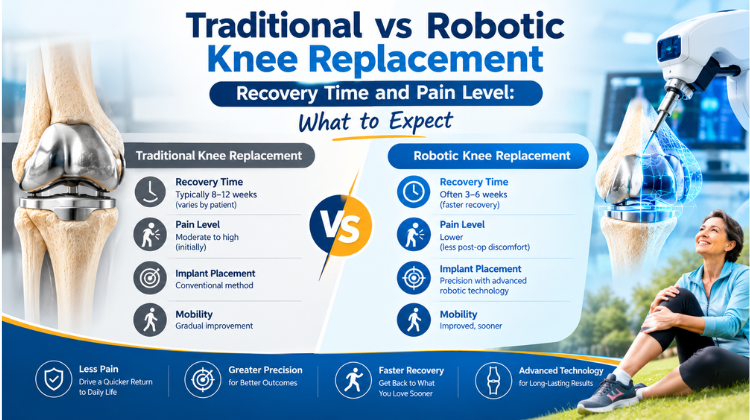
| Post-Op Pain & Swelling | Moderate to high due to tissue manipulation | Reduced soft tissue disruption yields lower pain scores |
| Hospital Stay | 4 to 6 days | 2 to 4 days |
| Return to Activity | 6 to 12 weeks | 3 to 6 weeks |
| Overall Cost Range | ₹2,20,000 – ₹3,80,000 | ₹3,50,000 – ₹6,50,000 |
While conventional manual total hip arthroplasty remains a successful option when performed by a skilled surgeon, choosing Robotic-Assisted Hip Replacement in Gurgaon provides an extra layer of surgical consistency, objective digital verification, and personalized joint alignment.
Evaluating the Cost of Robotic-Assisted Hip Replacement in Gurgaon
Understanding financial requirements helps patients plan effectively. The overall total hip arthroplasty cost when using robotic technology reflects advanced hardware, specialized software licensing, CT imaging protocols, and operating room resources.
+-------------------------------------------------------------------------------+
|                    ROBOTIC HIP SURGERY COST COMPONENTS                        |
+-------------------------------------------------------------------------------+
|  [30-35%] Premium Implants (Ceramic/Polyethylene/Titanium)                    |
|  [25-30%] Surgeon, Anesthesiologist & Robotic Specialist Fees                  |
|  [20-25%] Hospital Room & Robotic OT Facility Usage                           |
|  [10-15%] Pre-op 3D CT Scans, Diagnostics & Post-op Rehab                     |
+-------------------------------------------------------------------------------+
In Gurgaon, the complete financial estimate for a single robotic-assisted hip replacement typically ranges from ₹3,50,000 to ₹6,50,000 ($4,200 to $7,800 USD). Below is an itemized breakdown of standard cost categories:
| Expense Category | Typical Price Range (INR) | Inclusions |
| Pre-Op 3D CT & Imaging | ₹18,000 – ₹35,000 | High-definition pelvic CT mapping, 3D digital templating, blood panels, and cardiac clearance. |
| Robotic System Usage | ₹60,000 – ₹1,20,000 | Software activation, specialized disposable optical arrays, robotic calibration, and system usage fees. |
| Prosthetic Implants | ₹1,000,000 – ₹2,40,000 | High-grade ceramic heads, porous titanium uncemented stems, and cross-linked polyethylene liners. |
| Surgeon & OT Charges | ₹90,000 – ₹1,80,000 | Primary surgeon, assistant surgeon, anesthesiologist, nursing staff, and robotic operating suite time. |
| Inpatient Stay (2–4 Days) | ₹40,000 – ₹90,000 | Room charges (Semi-Private, Private, or Deluxe Suite), clinical nursing, and prescribed inpatient medications. |
| Post-Op Care & Rehab | ₹15,000 – ₹35,000 | In-hospital physiotherapy, mobility devices, home exercise charts, and initial follow-up consultations. |
Key Factors Influencing the Final Price:
-
Implant Material Choice: Premium ceramic-on-ceramic or ceramic-on-polyethylene implants cost more upfront than standard metal-on-polyethylene choices, but offer superior wear resistance.
-
Hospital Category: Inpatient costs vary based on room selection—ranging from shared accommodation to private executive suites in internationally accredited tertiary care hospitals.
-
Medical Complexity: Complex cases involving developmental dysplasia of the hip (DDH), previous surgeries, severe bone loss, or underlying medical conditions require additional operating time and clinical monitoring, altering total expenses.
-
Insurance Coverage: Most health insurance policies cover minimally invasive joint replacement and robotic surgeries when medically necessary. Pre-authorization through the hospital’s Third-Party Administrator (TPA) desk helps clarify out-of-pocket expenses before admission.
Who is the Ideal Candidate for Robotic-Assisted Hip Replacement in Gurgaon?
While robotic technology offers clear technical advantages, it is not required for every single individual. Evaluating candidacy with an experienced orthopedic specialist helps determine the best approach for your specific needs.
                  +-----------------------------------+
                  |   PATIENT CANDIDACY EVALUATION    |
                  +-----------------------------------+
                                    |
     +-------------------+----------+----------+-------------------+
     |                   |                     |                   |
[Young Active Adults] [Complex Anatomy]   [Severe Dysplasia]  [Revision Surgery]
 - High wear risk      - Post-trauma       - DDH cases         - Failed implants
 - Needs precision     - Prior hardware    - Structural shifts - Bone loss repair
Patients who stand to benefit most from Robotic-Assisted Hip Replacement in Gurgaon include:
-
Younger, Active Patients: Individuals under 60 who require maximum joint longevity, fluid natural movement, and long-term durability to support active lifestyles.
-
Patients with Complex Hip Anatomy: Individuals with developmental dysplasia of the hip (DDH), previous pelvic fractures, congenital deformities, or prior surgical hardware benefit from pre-operative 3D modeling and precise haptic guidance.
-
Cases with Significant Leg-Length Differences: Patients presenting with structural short-leg deformities where exact length restoration is critical for balance and spinal alignment.
-
Patients at High Risk for Dislocation: Individuals with spinal stiffness, lumbar fusion history, or altered pelvic tilt benefit from personalized cup positioning tailored to their specific spine-pelvis interactions.
Recovery and Rehabilitation After Robotic-Assisted Hip Replacement in Gurgaon
Because robotic assistance minimizes unnecessary tissue trauma and bone reaming, patients generally experience a smooth, structured recovery path.
Day 1: First Steps & Standing
  └─ Stand and walk with assistance within 12-24 hours post-op; pain managed via oral meds.
Days 2-3: Inpatient Rehab & Stair Climbing
  └─ Practice staircase navigation, transfer techniques, and gait training; hospital discharge.
Weeks 1-3: Rapid Home Recovery
  └─ Transition from walker to cane; independent walking indoors; incision site heals.
Weeks 4-6: Return to Active Living
  └─ Resume unassisted walking, driving, office work, and light recreational activities.
The typical post-operative timeline for Robotic-Assisted Hip Replacement in Gurgaon includes:
-
Day 1 (Immediate Post-Op): Physical therapy begins within 12 to 24 hours after surgery. Guided by physical therapists, patients stand and take their first steps using a walker.
-
Days 2 to 3 (Hospital Discharge): Patients practice walking along corridors, climbing stairs, and managing daily transfers independently. Most are ready for discharge by day 3 or 4.
-
Weeks 1 to 3 (Early Home Rehabilitation): Gait training continues at home. Because soft tissue trauma is minimal, many patients transition from a walker to a single cane within 10 to 14 days.
-
Weeks 4 to 6 (Return to Routine): Driving, office work, and light daily activities resume. Pain is usually minimal, and joint movement feels natural.
Is Robotic-Assisted Hip Replacement in Gurgaon Truly Worth the Hype?
When weighing the advantages, costs, and clinical outcomes, the verdict becomes clear: Robotic-Assisted Hip Replacement in Gurgaon is more than just marketing hype—it represents a meaningful step forward in joint reconstruction technology.
While the surgery carries higher upfront technology costs than conventional manual options, it delivers measurable clinical value:
-
Sub-Millimeter Surgical Precision: Eliminates guesswork in component positioning, cup orientation, and leg length restoration.
-
Safer Bone Preservation: Haptic borders keep bone removal minimal, preserving vital skeletal structure for the future.
-
Faster Functional Recovery: Reduced soft tissue disruption allows patients to return to work, sports, and normal daily living sooner.
-
Long-Term Financial Value: By reducing positioning errors and wear rates, robotic assistance lowers the long-term risk of costly revision surgeries down the line.
Ultimately, the robotic arm is a high-precision tool—and its success depends on the hands guiding it. Choosing a fellowship-trained, experienced orthopedic specialist ensures that modern robotic technology delivers its full potential: a stable, pain-free, long-lasting hip joint.
Facts on Dr. Hemant Sharma
When considering joint replacement, choosing an experienced, highly qualified surgeon is critical. Dr. Hemant Sharma is a leading orthopedic specialist in Gurgaon. Below are key verified facts detailing his professional credentials, surgical leadership, and clinical background:
-
Current Position: Chairman – Orthopedics & Robotic Joint Replacement Surgery, Marengo Asia Robotic Centre for Orthopaedics & Joint Care (MARC) at Marengo Asia Hospital, Gurugram.
-
Total Clinical Experience: Over 26+ years of extensive orthopedic experience across top institutions in India and the United Kingdom.
-
UK NHS Experience: Practiced and completed specialized higher surgical training in the UK National Health Service (NHS) for 11 years before returning to India.
-
Core Qualifications: MBBS (PGIMS Rohtak), DNB in Orthopedic Surgery (St. Stephen’s Hospital, Delhi), MRCS (Royal College of Surgeons of England), and FRCS in Trauma & Orthopedics (Royal College of Surgeons of England, 2010).
-
Fellowship Training: Completed prestigious clinical fellowships in Complex Revision Lower Limb Arthroplasty and Joint Reconstruction at University Hospital Llandough, Cardiff, UK.
-
Surgical Volume: Successfully performed over 9,100+ complex joint reconstructions, robotic arthroplasties, and revision procedures throughout his career.
-
Robotic Experience: Recognized as a first-generation robotic joint surgeon in India, having successfully completed over 500+ robotic-assisted procedures.
-
Honors & Awards: Recipient of the Service Excellence Award in Robotic Orthopaedics Surgery & Joint Replacement at the Times Network India Health Summit (2025) and the Emerging Leader of the Year Award (2019).
-
Disaster Relief Leadership: Led frontline medical and orthopedic relief teams following major emergencies, including the 2001 Gujarat Earthquake and the 1997 Charkhi Dadri air crash.
-
Professional Registrations: Fully registered with the General Medical Council (GMC, UK), Medical Council of India (MCI), Delhi Medical Council, and Haryana Medical Council.
#Robotic Hip Surgery Gurgaon #Total Hip Arthroplasty Cost #Best Orthopedic Surgeon In Gurgaon #Robotic Hip Replacement Benefits #Dr Hemant Sharma Orthopedic #Minimally Invasive Joint Replacement #Hip Implant Longevity #Haptic Robotic Arm Technology #Fast Recovery Hip Replacement #Robotic Joint Replacement India #Ceramic Hip Implant Cost #Marengo Asia Hospital Gurgaon #Uncemented Hip Replacement #Avascular Necrosis Treatment #Direct Anterior Hip Replacement #Hip Dislocation Prevention #Precision Joint Surgery #Computer Navigated Hip Surgery #Leg Length Correction #Hip Replacement Recovery Timeline #Affordable Robotic Surgery #Senior Orthopedic Surgeon Gurgaon #Cashless Medical Insurance #No Cost EMI Hip Surgery #Post Op Physiotherapy Gurgaon #Young Adult Hip Preservation #Joint Reconstruction Specialist #Revision Hip Replacement #3DCT Surgical Planning #Orthopedic Care Gurgaon #Custom Hip Arthroplasty
FAQ
Q1: Is robotic-assisted hip replacement better than standard traditional hip replacement?
Answer: Yes, robotic-assisted hip replacement offers key advantages over traditional manual surgery. By combining pre-operative 3D CT scans with real-time haptic robotic arm guidance, the surgeon can position joint components with sub-millimeter precision. This reduces component misalignment, eliminates leg-length discrepancies, minimizes soft tissue injury, and lowers post-operative dislocation risks. While traditional surgery remains effective, robotic assistance offers higher consistency, more natural joint motion, and faster functional recovery.
Q2: Why should patients choose Dr. Hemant Sharma for robotic hip replacement in Gurgaon?
Answer: Dr. Hemant Sharma is one of India’s most qualified joint replacement specialists, serving as Chairman of Orthopedics & Robotic Joint Replacement at Marengo Asia Hospital, Gurugram. With over 26 years of total experience—including 11 years of practice and fellowship training in the UK—he holds prestigious FRCS (Trauma & Ortho) and MRCS qualifications from the Royal College of Surgeons of England. Having completed over 9,100 surgical cases and more than 500 robotic procedures, he combines global surgical expertise with modern robotic infrastructure.
Q3: What is the total cost of robotic-assisted hip replacement in Gurgaon?
Answer: The average cost for a robotic-assisted hip replacement in Gurgaon ranges between ₹3,50,000 and ₹6,50,000 ($4,200 to $7,800 USD) per hip. This package generally covers pre-operative 3D CT planning scans, robotic software licensing, high-grade ceramic or uncemented titanium implants, surgeon and anesthesiologist fees, operating theater usage, and a 2- to 4-day inpatient hospital stay. Exact pricing depends on the implant brand, room category, and patient medical complexity.
Q4: How long does recovery take after robotic-assisted hip replacement surgery?
Answer: Recovery after robotic hip surgery is noticeably faster than conventional open procedures due to reduced soft tissue disruption. Patients usually stand and take their first assisted steps within 12 to 24 hours after surgery. Most are discharged from the hospital in 2 to 4 days. Patients typically transition from a walker to a single cane within 10 to 14 days and return to unassisted walking, driving, and light office work within 3 to 6 weeks.
Q5: Does health insurance cover robotic-assisted hip replacement in Gurgaon?
Answer: Yes, most major Indian health insurance policies and international medical care plans cover robotic-assisted total hip replacement when recommended for chronic arthritis, joint degeneration, or avascular necrosis. Leading hospitals in Gurgaon feature dedicated Third-Party Administrator (TPA) desks that manage cashless approvals. It is recommended to submit pre-authorization details at least 7 days before surgery to verify policy terms, room rent limits, and implant allowances.