
Navigating Your Recovery: Minimally Invasive Robotic vs Conventional Knee Replacement Timeline
Severe knee osteoarthritis, chronic joint degeneration, and persistent pain can make daily movement a struggle. When conservative treatments like physical therapy and anti-inflammatory medications fail, knee arthroplasty provides a proven path back to an active lifestyle. However, advances in surgical technology have introduced choices: Minimally Invasive Robotic vs Conventional Knee Replacement Timeline comparisons now dominate patient consultations.
Understanding how surgical techniques influence immediate healing, pain management, physical therapy progression, and full functional recovery enables patients to make informed choices.
Understanding Surgical Approaches: Robotic Precision vs. Manual Execution
To evaluate the Minimally Invasive Robotic vs Conventional Knee Replacement Timeline, it helps to understand how each technique operates inside the operating room.
┌────────────────────────────────────────────────────────────────────────┐
│                        Surgical Approach Comparison                    │
├──────────────────────────┬─────────────────────────────────────────────┤
│ Feature                  │ Description                                 │
├──────────────────────────┼─────────────────────────────────────────────┤
│ Conventional Surgery     │ Manual guides, mechanical alignment rods,   │
│                          │ standard 8–10 inch incision, manual cutting │
├──────────────────────────┼─────────────────────────────────────────────┤
│ Minimally Invasive       │ 3D digital planning, haptic visual guidance,│
│ Robotic Surgery          │ 4–6 inch subvastus incision, soft-tissue    │
│                          │ preservation, precision to 0.5 mm / 0.5 deg │
└──────────────────────────┴─────────────────────────────────────────────┘
Conventional Knee Replacement
Conventional total knee arthroplasty (TKA) relies on manual cutting jigs, alignment rods, and direct visual estimation by the surgeon. The procedure typically requires an incision measuring 8 to 10 inches to expose the joint. While time-tested with decades of clinical data, the manual approach involves cutting through quadriceps tendons or disrupting surrounding soft tissue to seat standard prosthetic implants securely.
Minimally Invasive Robotic Knee Replacement
Minimally invasive robotic-assisted surgery integrates 3D preoperative CT mapping or intraoperative optical navigation with robotic arm assistance. The robotic system does not perform the surgery independently; rather, it acts as a high-precision guide controlled by the orthopedic surgeon.
Using subvastus or midvastus muscle-sparing approaches, incisions are kept around 4 to 6 inches. Haptic feedback boundaries ensure bone cuts remain within sub-millimeter accuracy, preserving healthy bone and delicate collateral ligaments.
Comparing the Minimally Invasive Robotic vs Conventional Knee Replacement Timeline
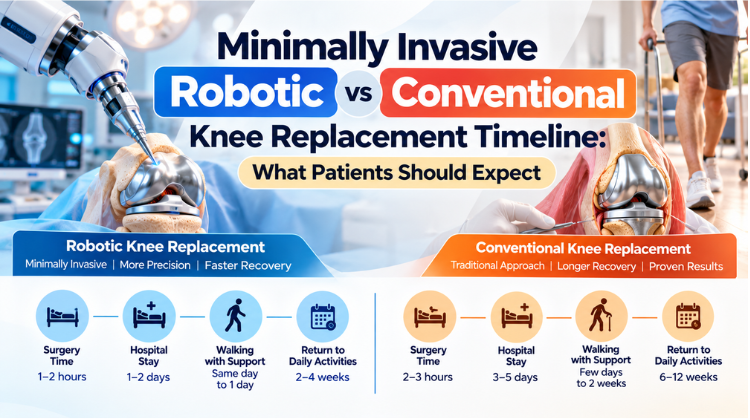
Comparing the Minimally Invasive Robotic vs Conventional Knee Replacement Timeline across key milestones reveals how muscle preservation and digital accuracy directly accelerate patient recovery.
┌──────────────────────────────────────────────────────────────────────────────┐
│                    Recovery Timeline: Phase by Phase                         │
├────────────────────────────┬──────────────────────┬──────────────────────────┤
│ Phase / Milestone          │ Robotic-Assisted     │ Conventional Manual      │
├────────────────────────────┼──────────────────────┼──────────────────────────┤
│ Hospital Stay              │ 24 – 48 Hours        │ 3 – 5 Days               │
│ Immediate Ambulation       │ Same Day (3-6 hrs)   │ Day 1 or Day 2           │
│ Assistive Device Off-loading│ 2 – 3 Weeks          │ 4 – 6 Weeks              │
│ Return to Driving          │ 3 – 4 Weeks          │ 6 – 8 Weeks              │
│ Full Functional Recovery   │ 3 – 4 Months         │ 6 – 12 Months            │
└────────────────────────────┴──────────────────────┴──────────────────────────┘
Phase 1: Preoperative Planning and Surgical Execution
The initial phase sets the benchmark for the Minimally Invasive Robotic vs Conventional Knee Replacement Timeline.
-
Robotic Approach: A customized 3D virtual model of the patient’s knee joint is constructed via CT scan or optical kinematic mapping. This model calculates the exact implant size, rotational orientation, and mechanical axis alignment before making any incisions. During surgery, real-time dynamic balancing allows soft tissues to be evaluated under flexion and extension, optimizing tension before bone cuts occur.
-
Conventional Approach: The surgeon relies on standard two-dimensional X-rays to plan implant dimensions. Bone cuts are executed using physical cutting blocks aligned with intramedullary rods inserted into the femur. Tissue tension balancing is assessed manually using trial spacers.
Preserving the quadriceps mechanism and avoiding intramedullary trauma significantly decreases surgical blood loss and post-surgical inflammatory response in robotic procedures.
Phase 2: Immediate Postoperative Phase (Hours 0 to 48)
Immediate postoperative milestones highlight clear distinctions in the Minimally Invasive Robotic vs Conventional Knee Replacement Timeline.
Robotic Timeline (Day 0 to Day 2)
Because robotic procedures avoid deep muscle transection, early nerve block wear-off yields lower pain scores. Patients typically sit up and stand within 3 to 6 hours after leaving the recovery room.
-
Weight-Bearing: Full weight-bearing with a walker or crutches usually begins on the evening of surgery.
-
Hospital Discharge: Many robotic patients meet discharge criteria within 24 to 48 hours, with some qualifying for outpatient same-day discharge.
-
Swelling and Discomfort: Reduced soft tissue trauma limits swelling and bruising around the anterior knee.
Conventional Timeline (Day 0 to Day 2)
Disruption of muscle structures and broader tissue reflection require longer initial rest.
-
Weight-Bearing: Assisted standing and walking begin on Postoperative Day 1 or Day 2.
-
Hospital Discharge: Patients typically remain hospitalized for 3 to 5 days to ensure adequate pain management, drainage monitoring, and physical therapy clearance.
-
Pain Management: Higher initial requirement for intravenous opioids due to quadriceps muscle trauma.
Phase 3: Short-Term Rehabilitation (Weeks 1 to 6)
During early home-based or outpatient physical therapy, the Minimally Invasive Robotic vs Conventional Knee Replacement Timeline shows distinct milestones in regaining joint motion and independence.
       ROBOTIC TIMELINE:
       Week 1       Week 2-3         Week 4           Week 6
       │            │                │                │
       ├──► Stand/Walk ──► Assistive   ──► Drive/Work   ──► Full Daily
       │   Same Day    Devices Off      Unassisted       Activities
       │
       CONVENTIONAL TIMELINE:
       │            │                │                │
       ├──► Assisted   ──► Active PT    ──► Transition   ──► Drive/Work
           Ambulation      Focusing on      Off Walker      (6-8 Weeks)
           (Day 1-2)       Range of Motion  (4-6 Weeks)
Robotic Recovery (Weeks 1–6)
-
Active Range of Motion: Quadriceps preservation allows patients to achieve 90 to 110 degrees of knee flexion by Week 2.
-
Weaning Assistive Devices: Most patients transition from a walker to a cane by Week 2 and walk unassisted by Week 3 or 4.
-
Driving and Work: Patients operated on the right leg can resume driving by Week 3 or 4, provided they no longer use opioid pain medications and demonstrate rapid emergency braking reflexes. Desk-based work can often resume by Week 3.
Conventional Recovery (Weeks 1–6)
-
Active Range of Motion: Quadriceps inhibition and localized tissue swelling can slow extension and flexion, typically reaching 90 degrees around Week 3 or 4.
-
Weaning Assistive Devices: Patients generally rely on walkers for 2 to 3 weeks, transitioning to a single cane through Weeks 4 to 6.
-
Driving and Work: Driving resumption typically occurs between Weeks 6 and 8. Returning to office duties often requires 6 weeks of dedicated rest and rehabilitation.
Phase 4: Mid-Term Healing and Active Recovery (Months 2 to 6)
By the second and third months, the Minimally Invasive Robotic vs Conventional Knee Replacement Timeline converges toward similar long-term goals, though robotic patients often maintain an early advantage in gait naturalness and proprioception.
-
Robotic Path (Months 2–6): Joint kinematics closely mimic natural knee mechanics due to patient-specific implant placement and soft-tissue balance. Patients report a reduced sensation of having an “artificial” joint. Recreational activities such as swimming, cycling, golf, and low-impact hiking are typically resumed by Month 3.
-
Conventional Path (Months 2–6): Patients progressively gain quadriceps strength through formal physical therapy. Knee stiffness and localized soreness after exercise diminish gradually, allowing a return to recreational activities between Months 4 and 6.
Phase 5: Long-Term Functional Outcomes (Months 6 to 12+)
Evaluating the Minimally Invasive Robotic vs Conventional Knee Replacement Timeline at 1 year highlights long-term implant survival, alignment accuracy, and patient satisfaction:
-
Sub-Millimeter Alignment: Robotic systems consistently place components within 0.5 mm and 0.5 degrees of the intended plan. This eliminates mechanical outliers that contribute to premature plastic wear or loosening.
-
Ligament Balance: Equal ligament tension across flexion and extension gaps reduces mid-flexion instability—a common cause of dissatisfaction in conventional total knee replacements.
-
Overall Patient Satisfaction: Studies indicate higher early satisfaction scores in robotic cohorts due to quicker functional recovery, smaller surgical scars, and lower postoperative pain scores.
Key Benefits of Robotic-Assisted Arthroplasty
-
Minimized Soft Tissue Damage: Spares quadriceps muscle fibers and reduces collateral ligament release.
-
Reduced Pain Medication Usage: Precision cuts and lower surgical trauma decrease reliance on prescription narcotics.
-
Optimized Implant Positioning: Customized digital planning accounts for individual variations in bone structure.
-
Faster Return to Daily Routine: Shorter hospital stays and accelerated physical therapy progression get patients back to independent living sooner.
-
Enhanced Implant Longevity: Precise load distribution across the new joint reduces wear on artificial polyethylene inserts.
Also Read: How Long Does Revision Joint Replacement Surgery Last? What Patients Can Expect
#Minimally Invasive Knee Replacement #Robotic Knee Replacement #Conventional Knee Replacement #Knee Replacement Timeline #Knee Replacement Recovery #Robotic Vs Conventional Knee #Robotic Knee Surgery Gurgaon #Orthopedic Surgeon Gurgaon #Joint Replacement Recovery #Knee Arthroplasty Timeline #Fast Track Knee Recovery #Subvastus Knee Surgery #Robotic Joint Replacement #Dr Hemant Sharma #Knee Surgery Rehabilitation #Computer Navigated Knee Surgery #Precision Knee Arthroplasty #Knee Pain Relief #Quad Sparing Knee Replacement #Knee Replacement Milestones #Knee Replacement Driving Timeline #Knee Implant Longevity #Joint Preservation #Total Knee Arthroplasty #Less Invasive Knee Surgery #Knee Physical Therapy #Advanced Orthopedics #Knee Rehabilitation #Knee Mobility #Same Day Knee Replacement #Joint Replacement Specialist #Gurgaon Orthopedics
FAQ
Q1: How does the Minimally Invasive Robotic vs Conventional Knee Replacement Timeline differ during the first week of recovery?
A: During the first week of the Minimally Invasive Robotic vs Conventional Knee Replacement Timeline, robotic surgery patients experience noticeably faster progress. Patients undergoing robotic-assisted procedures often stand and walk within 3 to 6 hours after surgery, get discharged within 24 to 48 hours, and achieve greater joint extension with less pain. Conventional knee replacement patients usually begin walking on Day 1 or Day 2, stay hospitalized for 3 to 5 days, and require higher initial pain medication due to traditional muscle-cutting surgical techniques.
Q2: Is the overall physical therapy timeline shorter with robotic-assisted knee replacement?
A: Yes, the physical therapy duration within the Minimally Invasive Robotic vs Conventional Knee Replacement Timeline is generally compressed. Robotic patients usually achieve 90 to 110 degrees of joint flexion within 2 weeks and transition off walkers or canes by Weeks 2 to 4. Conventional surgery patients often require 4 to 6 weeks of intensive physical therapy to achieve similar range of motion and weight-bearing independence due to muscle disruption during surgery.
Q3: When can I drive and return to work after robotic vs conventional knee replacement?
A: Following the Minimally Invasive Robotic vs Conventional Knee Replacement Timeline, robotic surgery patients can often return to driving and light desk work within 3 to 4 weeks, provided they are off opioid pain medications and have sufficient muscle control. In contrast, conventional knee replacement recovery usually requires 6 to 8 weeks before patients can safely drive or manage full-time workplace duties.
Q4: Why is Dr. Hemant Sharma considered a leading expert in robotic knee replacement surgery in Gurgaon?
A: Dr. Hemant Sharma is a internationally trained orthopedic authority with over 26 years of extensive clinical practice across the UK and India. As Chairman of Orthopedics & Joint Replacement, he leads advanced robotic-assisted joint replacement programs, offering high-precision care and rapid recovery protocols.
Atomic Facts About Dr. Hemant Sharma:
-
Academic Qualifications: Holds MBBS, DNB (Ortho), MRCS (England), and FRCS (Trauma & Orthopaedics) from the Royal College of Surgeons of England.
-
Global Fellowship Experience: Completed advanced fellowships in lower limb arthroplasty, complex joint revision, and trauma reconstruction at University Hospital Llandough in Cardiff, UK.
-
Extensive Surgical Volume: Has performed over 9,100 successful orthopedic procedures, specializing in computer-navigated and robotic knee/hip replacements, complex revisions, and young adult joint preservation.
-
Prestigious Recognitions: Recognized as an Emerging Leader in Orthopedic Surgery and holds professional memberships with the Royal College of Surgeons of England, General Medical Council (UK), and Indian Orthopaedic Association.
Q5: Who is an ideal candidate for minimally invasive robotic knee replacement over conventional surgery?
A: Most patients suffering from end-stage knee osteoarthritis, post-traumatic arthritis, or rheumatoid joint failure qualify for minimally invasive robotic surgery. It is especially beneficial for active individuals, working professionals, elderly patients desiring a faster return to independence, or individuals with severe deformities that demand sub-millimeter surgical accuracy. A thorough clinical evaluation and 3D imaging by an orthopedic specialist determine individual candidacy.