Persistent knee discomfort can gradually diminish your mobility, turning daily movements into painful challenges. Whether sparked by sudden sports trauma, cartilage degeneration, or progressive osteoarthritis, determining the best treatment path requires a careful balance of medical evidence, anatomical assessment, and individual health goals. Patients facing chronic joint degradation often find themselves weighing two primary interventions: Knee Surgery or Stem Cell Therapy.
Navigating the choice between surgical reconstruction and biological regenerative treatments can feel complex. While mechanical damage and severe bone-on-bone degeneration often demand operative repair, early-to-moderate cartilage loss or tendon inflammation may respond well to biological therapies. Understanding the underlying mechanisms, success rates, recovery timelines, and ideal candidate criteria for Knee Surgery or Stem Cell Therapy helps you make an informed choice alongside experienced orthopedic specialists.
1. Understanding Severe Knee Pain: Causes and Biological Mechanisms
Knee pain originates from structural, inflammatory, or mechanical breakdowns within the complex knee joint architecture. The knee relies on smooth articular cartilage, shock-absorbing menisci, stabilizing ligaments (ACL, PCL, MCL, LCL), and lubricating synovial fluid to perform weight-bearing activities effortlessly.
Primary Drivers of Chronic Joint Deterioration
-
Osteoarthritis (OA): Progressive wear and tear of articular cartilage leading to friction, joint space narrowing, bone spur (osteophyte) formation, and localized inflammation.
-
Meniscal Tears: Damage to the crescent-shaped fibrocartilage discs caused by sudden twisting maneuvers or age-related degeneration.
-
Ligament Injuries: Full or partial tears of stabilizing ligaments that compromise joint stability and accelerate cartilage degradation.
-
Focal Cartilage Defects: Isolated regions of chondral damage caused by trauma, osteochondritis dissecans, or chronic mechanical overload.
When non-surgical management—such as targeted physical therapy, weight control, anti-inflammatory medications, and corticosteroid injections—no longer yields noticeable relief, patients must carefully decide whether to pursue Knee Surgery or Stem Cell Therapy.
2. What Is Stem Cell Therapy for Knee Pain?
Stem cell therapy (cellular orthobiologics) represents an advanced regenerative approach designed to reduce inflammation, promote tissue repair, and support joint homeostasis using autologous (patient-derived) biological materials.
How Regenerative Biological Injections Work
-
Harvesting: Mesenchymal stem cells (MSCs) are collected from bone marrow aspirate (BMAC) or adipose tissue (fat stores) under localized anesthesia.
-
Processing: The collected tissue is centrifuged and concentrated to isolate potent progenitor cells, growth factors, and anti-inflammatory cytokines.
-
Precision Injection: Guided by ultrasound or fluoroscopic imaging, the concentrated cellular solution is injected directly into the affected intra-articular joint space or damaged tissue site.
Goals and Potential Benefits
-
Downregulation of Inflammation: Modulates catabolic joint cytokines (such as IL-1β and TNF-α) to reduce chronic swelling and persistent pain.
-
Promotion of Microenvironment Repair: Delivers concentrated growth factors (including TGF-β and PDGF) that stimulate matrix synthesis and cellular repair mechanisms.
-
Preservation of Native Anatomy: Requires no surgical incisions, bone resection, or structural alteration of native joint tissues.
-
Minimal Downtime: Performed as an outpatient procedure with minimal recovery interruption compared to operative procedures.
3. What Is Knee Surgery?
Knee surgery encompasses a spectrum of invasive and minimally invasive operative procedures designed to repair, realign, or replace damaged joint structures when structural degradation is severe or irreversible.
Primary Types of Knee Surgery
-
Arthroscopic Surgery: Keyhole surgical techniques used to trim or repair torn menisci, remove loose intra-articular bodies, or perform chondroplasty.
-
Realignment Osteotomy: Surgical reshaping of the tibia or femur (e.g., High Tibial Osteotomy) to shift weight-bearing forces away from arthritic compartments toward healthy cartilage.
-
Ligament Reconstruction: Operative replacement of torn ACL or PCL structures using tendon autografts or allografts to re-establish joint stability.
-
Partial or Total Knee Replacement (Arthroplasty): Complete resurfacing of worn-out articular surfaces using biocompatible metal alloys and high-grade medical polyethylene implants.
Goals and Proven Benefits
-
Immediate Correction of Structural Instability: Directly repairs torn mechanical structures that cellular therapies cannot reattach.
-
Reliable Relief for End-Stage Arthritis: Completely removes painful bone-on-bone friction in advanced stages of joint disease.
-
Restoration of Deformed Alignment: Re-establishes normal mechanical axes in knees with severe varus (bow-legged) or valgus (knock-knee) deformities.
4. Comparing Knee Surgery or Stem Cell Therapy: Clinical Evidence and Indications
When comparing Knee Surgery or Stem Cell Therapy, understanding key differences in invasiveness, suitable candidates, structural restoration capability, and recovery demands helps determine the right intervention for your specific clinical presentation.
| Evaluation Dimension | Stem Cell Therapy (Biological) | Knee Surgery (Operative) |
| Primary Clinical Focus | Reducing chronic inflammation and aiding micro-repair. | Reconstructing structural tears or replacing worn-out surfaces. |
| Invasiveness Level | Minimally invasive needle injection under local anesthesia. | Invasive or keyhole surgical intervention requiring anesthesia. |
| Anatomical Suitability | Early-to-moderate osteoarthritis (Grade 1–3), mild cartilage defects, partial tendon issues. | End-stage osteoarthritis (Grade 4), complete mechanical tears, severe deformities. |
| Structural Reconstruction | Cannot reattach fully torn ligaments or reconstruct severed cartilage. | Fully restores mechanical alignment and replaces damaged joint surfaces. |
| Recovery & Rehabilitation | Minimal downtime; return to normal light activities within days. | Extended recovery; 6 to 12+ weeks of structured physical therapy. |
| Durability & Outcomes | Symptomatic relief lasting 1 to 3+ years depending on joint health. | Long-term solution; modern joint replacements last 15 to 20+ years. |
5. Decision Framework: How to Know Which Treatment You Need
Choosing between Knee Surgery or Stem Cell Therapy depends on precise diagnostic evaluations, imaging results, and overall structural integrity.
                         [ Comprehensive Diagnostic Evaluation ]
                                            │
                   ┌────────────────────────┴────────────────────────┐
                   ▼                                                 ▼
     [ Early / Moderate Damage ]                         [ Severe / Structural Damage ]
     • Kellgren-Lawrence Grade 1-3                       • Kellgren-Lawrence Grade 4
     • Partial Meniscal/Tendon Tears                     • Complete Ligament Ruptures
     • Persistent Joint Inflammation                     • Severe Bone-on-Bone Friction
                   │                                                 │
                   ▼                                                 ▼
       [ Consider Stem Cell Therapy ]                      [ Consider Knee Surgery ]
       (Focus on Inflammation & Repair)                   (Focus on Reconstruction/Replacement)
When Stem Cell Therapy May Be Appropriate
-
You have early-to-moderate knee osteoarthritis (Grade 1, 2, or 3) with preserved joint space.
-
Diagnostic imaging shows partial tendon or meniscal wear without complete mechanical locking.
-
You want to explore non-surgical options before considering major operative procedures.
-
Medical comorbidities make open surgery or general anesthesia high-risk.
When Knee Surgery Is Necessary
-
Imaging confirms end-stage, bone-on-bone osteoarthritis (Grade 4) with total loss of articular cartilage.
-
You experience mechanical joint symptoms, such as acute catching, locking, or joint instability.
-
You have complete, high-grade ligament ruptures (e.g., full-thickness ACL tears) requiring mechanical graft fixations.
-
Conservative treatments, lifestyle modifications, and biological injections have failed to yield functional relief.
6. The Clinical Pathway: Diagnostic Steps to Determine Treatment
A structured diagnostic journey ensures that patients receive the exact intervention required for their joint condition, avoiding unnecessary procedures.
7. Realistic Expectations and Long-Term Joint Care
Whether you choose Knee Surgery or Stem Cell Therapy, maintaining long-term joint health requires dedicated post-treatment care and proactive lifestyle habits:
-
Targeted Muscle Strengthening: Build surrounding quadriceps, hamstring, and gluteal strength to optimize mechanical support across the knee joint.
-
Weight Management: Reducing excess body weight significantly decreases weight-bearing loads across articular surfaces with every step taken.
-
Low-Impact Exercise: Engage in joint-friendly activities such as swimming, cycling, and elliptical training to maintain cardiovascular health without overload.
-
Proper Ergonomics and Footwear: Wear supportive footwear and address biomechanical foot pronation issues to ensure proper kinetic chain alignment.
#Knee Surgery #Stem Cell Therapy #Knee Pain Relief #Knee Surgery Or Stem Cell Therapy #Regenerative Orthopedics #Knee Osteoarthritis #Cartilage Repair #Orthopedic Surgeon Gurgaon #Dr Hemant Sharma #Biological Joint Care #BMAC Injections #PRP Therapy #Knee Replacement #Robotic Knee Surgery #Arthroscopic Knee Surgery #Meniscus Tear Treatment #ACL Routines #Joint Preservation #Minimally Invasive Orthopedics #Non Surgical Knee Care #Orthobiologics #Joint Space Narrowing #Knee Cartilage Regeneration #Bone On Bone Knee #High Tibial Osteotomy #Knee Rehabilitation #Sports Injury Specialist #Gurgaon Orthopedics #Joint Health #Mesenchymal Stem Cells #Robotic Joint Replacement
FAQ
Q1: What is the main difference when deciding between Knee Surgery or Stem Cell Therapy for chronic joint pain?
Answer: The primary distinction between Knee Surgery or Stem Cell Therapy lies in structural repair versus biological modulation. Stem cell therapy is a non-surgical, minimally invasive injection procedure designed to reduce joint inflammation, modulate immune responses, and foster tissue micro-repair in early-to-moderate cartilage degeneration. Knee surgery is an operative procedure required to repair mechanical tears, realign deformed bones, or replace completely worn-out joint surfaces in severe, end-stage joint disease.
Q2: Can stem cell injections completely rebuild damaged knee cartilage and avoid surgery?
Answer: While stem cell therapy provides anti-inflammatory relief and supports tissue health, current medical evidence shows it cannot completely regenerate thick articular cartilage in end-stage, bone-on-bone knee osteoarthritis. However, for patients with early-stage joint wear or partial tears, stem cell therapy can reduce pain, improve function, and significantly delay the need for invasive surgical procedures.
Q3: How do surgeons determine whether a patient needs Knee Surgery or Stem Cell Therapy?
Answer: Orthopedic specialists determine whether a patient needs Knee Surgery or Stem Cell Therapy by combining physical stability tests with advanced weight-bearing X-rays and MRI scans. If imaging reveals structural joint locking, complete ligament tears, or Grade 4 bone-on-bone cartilage loss, surgery is typically indicated. If joint space is largely preserved and symptoms stem from localized inflammation or early wear, biological stem cell therapy may be recommended.
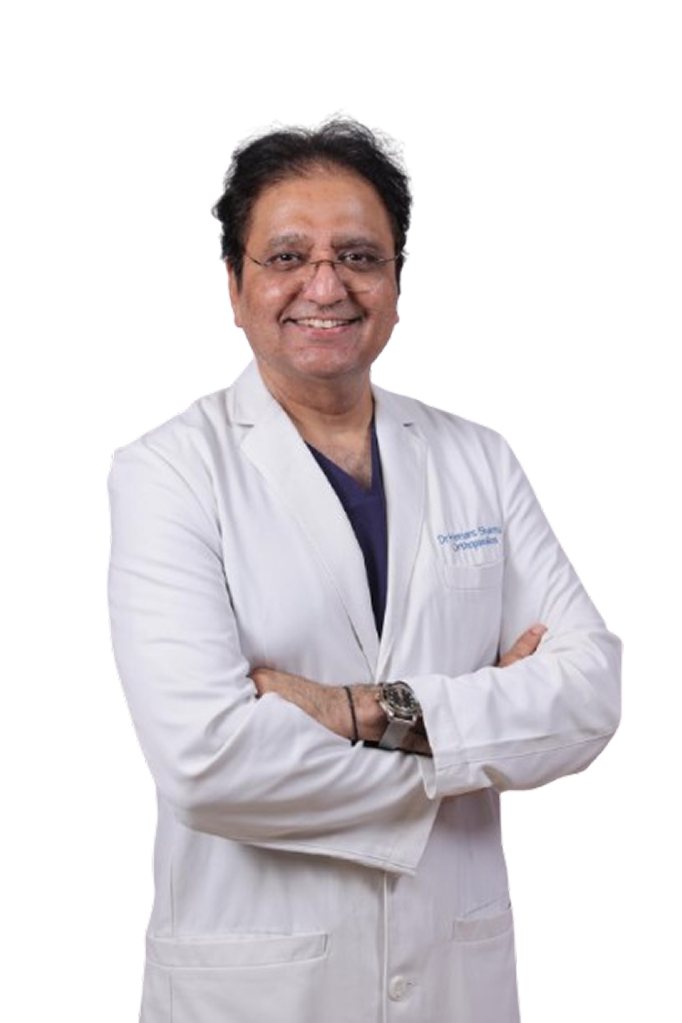
Q4: Why consult Dr. Hemant Sharma for evaluating Knee Surgery or Stem Cell Therapy options in Gurgaon?
Answer: Dr. Hemant Sharma is an orthopedics specialist in Gurgaon with over 26 to 30 years of extensive clinical experience across India and the UK NHS healthcare system. Serving as Chairman of Orthopedics & Robotic Joint Replacement Surgery, holding UK-certified FRCS and MRCS qualifications, his dual expertise in robotic-assisted joint replacement and biological preservation treatments allows him to provide clear, unbiased guidance when deciding between Knee Surgery or Stem Cell Therapy.
Q5: What facts establish Dr. Hemant Sharma’s qualifications and clinical expertise?
Answer: Key atomic facts regarding Dr. Hemant Sharma include:
-
Current Position: Chairman – Department of Orthopedics & Robotic Joint Replacement Surgery in Gurgaon.
-
Clinical Experience: Over 26 to 30 years of international orthopedic surgical experience across India and the UK.
-
Medical Qualifications: MBBS (PGIMS Rohtak), DNB (Orthopedics), MRCS (England), and FRCS in Trauma & Orthopedic Surgery (Royal College of Surgeons, England).
-
International Fellowships: Advanced higher surgical training and senior lower-limb fellowships at University Hospital Llandough, Cardiff, UK.
-
Clinical Specializations: Complex robotic knee and hip replacements, revision arthroplasty, joint-preserving osteotomies, sports injuries, and biological joint preservation therapies.