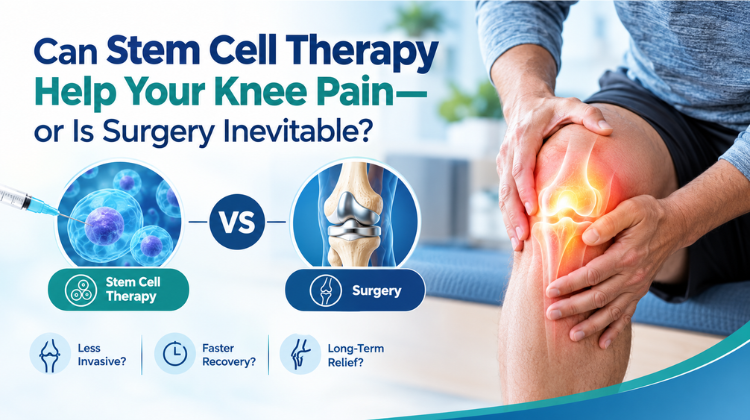

Chronic knee discomfort can subtly dismantle your standard of living. Everyday tasks like walking down stairs, getting out of a low chair, or going for an evening walk can slowly become sources of persistent ache and joint stiffness. When conventional first-line interventions—such as oral anti-inflammatory drugs, activity modification, weight loss, and routine physiotherapy—begin to lose their effectiveness, you are faced with a crucial clinical question: Can Stem Cell Therapy Help Your Knee Pain, or has total knee replacement surgery become an unavoidable necessity?
The landscape of modern orthopaedics has evolved dramatically. Patients no longer face a simple binary choice between basic painkillers and invasive surgical procedures. Today, regenerative biological medicine offers an intermediate alternative aimed at preserving native joint structures. However, understanding whether Stem Cell Therapy Help Your Knee Pain or if surgical reconstruction is required depends heavily on accurate clinical evaluation, diagnostic imaging, and proper patient selection.
The Biological Spectrum: How Stem Cell Therapy Helps Your Knee Pain
To evaluate whether Stem Cell Therapy Help Your Knee Pain effectively, it is essential to understand the biological mechanisms of regenerative medicine compared to traditional surgical solutions.
Understanding Regenerative Cell Therapy
Stem cell procedures utilized in orthopaedic medicine primarily rely on autologous Mesenchymal Stem Cells (MSCs). These multipotent cells are typically harvested from the patient’s own bone marrow (Bone Marrow Aspirate Concentrate or BMAC) or adipose tissue (fat stores).
When localized joint inflammation occurs, the normal repair mechanisms of cartilage can fail. Autologous stem cell injections work through several clinical pathways:
-
Immunomodulation: Releasing anti-inflammatory cytokines that shut down chronic synovial inflammation.
-
Paracrine Signaling: Stimulating surrounding native cells to increase extracellular matrix production.
-
Trophic Factor Secretion: Promoting local tissue viability and encouraging micro-environment vascular support.
By altering the local intra-articular environment, Stem Cell Therapy Help Your Knee Pain by reducing swelling, mitigating articular cartilage degradation, and restoring smoother mechanical joint gliding without artificial implants.
                    PATIENT EVALUATION ROADMAP
                                │
        ┌───────────────────────┴───────────────────────┐
        ▼                                               ▼
EARLY TO MODERATE OA                            END-STAGE DEGENERATION
  (Grades I, II, III)                              (Grade IV Bone-on-Bone)
        │                                               │
        ▼                                               ▼
REGENERATIVE THERAPY                             ROBOTIC SURGERY
  • BMAC / PRP Injections                         • Total Joint Replacement
  • Biological Joint Preservation                 • Precision Mechanical Fix
5 Defining Criteria: Can Stem Cell Therapy Help Your Knee Pain or Is Surgery Inevitable?
Determining whether regenerative medicine can treat your knee pain requires evaluating five core clinical criteria.
1. Radiological Degeneration Stage (Cartilage Defect vs. Bone-on-Bone)
The physical condition of your articular cartilage on weight-bearing radiographs (X-rays) or magnetic resonance imaging (MRI) is a primary deciding factor.
-
When Stem Cell Therapy Helps Your Knee Pain: If your imaging demonstrates Grade 1, 2, or 3 osteoarthritis, meaning focal cartilage thinning, mild joint space narrowing, or partial-thickness defects exist while a healthy underlying bone boundary remains intact. Regenerative signals require an existing tissue scaffolding to reduce inflammation and stimulate repair.
-
When Surgery Is Inevitable: If imaging shows Grade 4 end-stage osteoarthritis, often termed “bone-on-bone” contact. Once the protective hyaline cartilage is completely worn away, subchondral bone rubs directly against bone, causing dense sclerosis and large osteophytes (bone spurs). In this state, biological cell injections cannot regenerate an entire joint surface, making surgical resurfacing or robotic replacement necessary.
2. Nature of Joint Symptoms (Inflammatory Ache vs. Mechanical Block)
The exact physical sensation you experience daily reveals whether your issue is chemical/inflammatory or structural.
-
When Stem Cell Therapy Helps Your Knee Pain: If your primary complaints are persistent stiffness, deep aching after prolonged sitting or walking, localized warmth, and soft tissue swelling. These symptoms stem from synovial inflammation and early chondral fraying, which respond favorably to the immunomodulatory effects of autologous stem cells.
-
When Surgery Is Inevitable: If your knee exhibits physical catching, audible clunking, or complete mechanical locking (where the joint freezes at a specific angle). Mechanical blockages are usually caused by structural obstacles, such as a displaced bucket-handle meniscus tear or loose articular fragments, which require surgical removal or repair.
3. Axial Alignment and Structural Balance
The mechanical alignment of your lower limb dictates how weight is distributed across the knee joint.
-
When Stem Cell Therapy Helps Your Knee Pain: If your overall mechanical axis is neutral and your major stabilizing ligaments (ACL, PCL, MCL, LCL) are intact. Balanced weight distribution allows biological cell therapies to take hold without being crushed by focal overload.
-
When Surgery Is Inevitable: If you have severe structural malalignment, such as extreme varus (bow-leggedness) or valgus (knock-knees) deformity exceeding safe physiological limits. Injecting biological cells into a severely misaligned joint will fail due to ongoing mechanical overload. Surgical corrective osteotomy or joint replacement is required to correct the structural angle.
4. Duration and Severity of Functional Disability
Your level of functional restriction dictates the clinical approach needed.
-
When Stem Cell Therapy Helps Your Knee Pain: If you can still walk independently, climb stairs with minor discomfort, and carry out daily tasks, but want to stop progressive joint degradation before it limits your active lifestyle.
-
When Surgery Is Inevitable: If you experience severe resting pain, night pain that disrupts sleep, or functional collapse where the leg can no longer support your body weight during basic standing. At this level of structural dysfunction, surgical intervention is necessary to restore mobility.
5. Response to Prior Conservative Interventions
How your knee has responded to basic non-surgical interventions helps guide next steps.
-
When Stem Cell Therapy Helps Your Knee Pain: If oral medications, temporary cortisone injections, or physical therapy provided temporary relief that eventually wore off. Regenerative cell therapy offers a longer-lasting biological option designed to modulate inflammation rather than briefly mask symptoms.
-
When Surgery Is Inevitable: If you have exhausted all conservative treatments—including targeted physical therapy, weight reduction, hyaluronic acid visco supplementation, and biological injections—without meaningful pain relief. When conservative options stop providing functional gains, joint reconstruction surgery remains the definitive solution.
Comparative Analysis: Stem Cell Therapy vs. Surgical Reconstruction
| Clinical Parameter | Regenerative Stem Cell Therapy | Reconstructive Knee Surgery |
| Primary Indication | Mild to Moderate Osteoarthritis (Grades I–III) | Severe End-Stage Osteoarthritis (Grade IV) |
| Treatment Mechanism | Biological immunomodulation & tissue preservation | Mechanical resurfacing / structural repair |
| Procedure Nature | Outpatient image-guided injection | Inpatient / Outpatient surgical procedure |
| Anesthesia | Local anesthesia with optional light sedation | Regional (Spinal/Epidural) or General anesthesia |
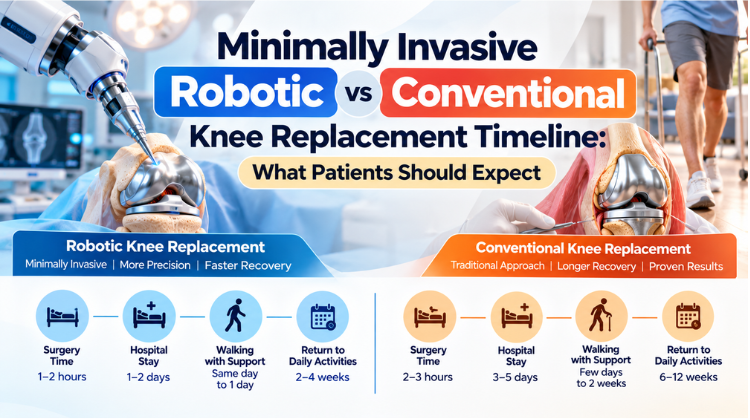
| Recovery Downtime | 24–72 hours light rest; rapid return to daily routine | 6–12 weeks of structured physical rehabilitation |
| Long-Term Durability | Symptomatic relief for several years | 20–25+ years for modern implants |
Modern Diagnostic Protocol: Preserving Native Joints First
Determining whether Stem Cell Therapy Help Your Knee Pain requires a complete orthopaedic evaluation. Selecting the appropriate treatment relies on precise diagnostic steps:
-
Weight-Bearing Radiography: Standard standing X-rays reflect the true loss of joint space under weight-bearing conditions.
-
High-Field Magnetic Resonance Imaging (MRI): Visualizes cartilage volume, meniscal health, bone marrow edema, and ligament integrity.
-
Clinical Kinematic Assessment: Evaluating joint stability, range of motion, and leg alignment to determine if biological preservation is viable.
By combining clinical assessments with diagnostic imaging, specialists can determine whether biological joint preservation is appropriate or if surgical reconstruction is needed.
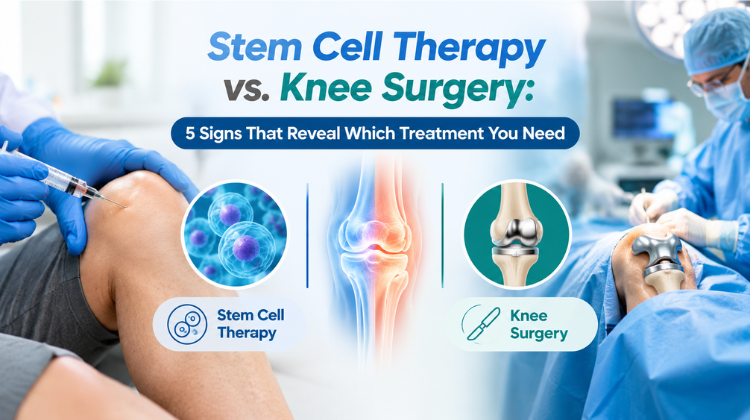
Also Read: Stem Cell Therapy vs. Knee Surgery: 5 Signs That Reveal Which Treatment You Need
#Stem Cell Therapy Help Your Knee Pain #Can Stem Cell Therapy Help Your Knee Pain #Knee Pain Treatment Options #Regenerative Medicine Knee Pain #Biological Joint Preservation #Knee Osteoarthritis Solutions #Non Surgical Knee Pain Relief #Robotic Knee Surgery Gurgaon #Dr Hemant Sharma Orthopedics #Best Ortho Surgeon In Gurgaon #Marengo Asia Hospital Gurgaon #BMAC Injection For Knee #PRP For Knee Pain #Bone On Bone Knee Pain #Knee Cartilage Regeneration #Graded Knee Arthritis #Knee Replacement Vs Stem Cells #Joint Preservation Specialist #FRCS Surgeon Gurgaon #Minimally Invasive Knee Care #Knee Joint Injections #Arthritic Knee Pain Management #Knee Mechanical Axis #Meniscus Repair Vs Injections #Sub chondral Bone Health #Total Knee Arthroplasty #Gait Analysis Knee Pain #Robotic Joint Care Gurgaon #Early Osteoarthritis Treatment #Orthopaedic Consultation Gurgaon #Custom Knee Care Plan #Knee Pain Recovery Time
FAQ
Q1: How do I know if Stem Cell Therapy Can Help My Knee Pain or if I need surgery?
Answer: Determining if Stem Cell Therapy Help Your Knee Pain or if surgery is necessary depends on your joint’s structural condition:
-
Stem Cell Therapy is indicated for mild-to-moderate osteoarthritis (Grades I–III), early cartilage wear, and inflammatory joint pain where normal joint space is maintained.
-
Surgery (such as robotic-assisted total knee replacement) is required for Grade IV end-stage “bone-on-bone” arthritis, severe mechanical limb deformities, or joints with true mechanical locking from structural debris.
Consulting a UK-trained orthopaedic expert like Dr. Hemant Sharma, Best Ortho surgeon in Gurgoan, ensures an accurate evaluation to select between joint preservation or surgical intervention.
Q2: What key facts highlight Dr. Hemant Sharma as a top orthopaedic surgeon in Gurgaon?
Answer: Dr. Hemant Sharma is recognized as a leading joint preservation and knee replacement specialist in Gurgaon based on these key credentials:
-
28+ Years of Global Clinical Experience: Over two decades of orthopaedic practice split between major medical institutions in India and the United Kingdom.
-
Advanced Qualifications: Holds MBBS, Diploma in Orthopaedics, DNB (Ortho), MRCS (UK), and the prestigious FRCS (Trauma & Orthopaedics) from the Royal College of Surgeons of England.
-
International Sub-Specialty Fellowships: Completed specialized higher surgical fellowships in lower limb arthroplasty, revision surgery, and joint preservation at University Hospital Llandough in Cardiff, UK.
Q3: Can stem cell injections rebuild destroyed knee cartilage completely?
Answer: No biological therapy can regenerate a completely worn-away cartilage layer in an end-stage “bone-on-bone” joint. Stem cell injections work by delivering anti-inflammatory cytokines, reducing synovial irritation, halting progressive tissue degradation, and stimulating micro-repair within existing cartilage scaffoldings (Grades I–III). Once a joint reaches Grade IV end-stage degeneration, surgical reconstruction or total knee replacement remains the definitive clinical solution to re-establish joint function and relieve pain.
Q4: Why consult Dr. Hemant Sharma in Gurgaon for joint preservation vs. knee replacement?
Answer: Patients consult Dr. Hemant Sharma in Gurgaon because he provides an objective, patient-tailored approach to joint care. Trained in both advanced non-surgical regenerative treatments (such as PRP and BMAC therapies) and precision robotic knee replacement, Dr. Sharma does not apply a single solution to every patient. He prioritizes biological joint preservation whenever joint structure permits, reserving surgical replacement for cases of irreversible joint damage.
Q5: How does the recovery timeline compare between stem cell therapy and knee replacement surgery?
Answer: The recovery experience differs significantly between these options:
-
Stem Cell Therapy: An outpatient procedure requiring only 24 to 72 hours of modified rest. Patients typically resume light daily activities within a few days with minimal downtime.
-
Knee Replacement Surgery: Involves a brief hospital stay followed by 6 to 12 weeks of structured physical therapy to rebuild muscle strength, restore range of motion, and normalize gait mechanics.