
Living with severe knee or hip osteoarthritis can turn everyday activities—like walking through a shopping mall, negotiating stairs, or getting up from a low chair—into painful struggles. When conservative options like medication, physical therapy, and intra-articular injections fail to deliver lasting relief, joint replacement offers a proven solution.
Medical technology in the National Capital Region has advanced significantly. After Consulting a Robotic Joint Replacement Doctor in Delhi NCR, patients gain access to high-precision surgical protocols designed to minimize soft-tissue trauma and accelerate rehabilitation.
This comprehensive guide details the recovery timeline after Consulting a Robotic Joint Replacement Doctor in Delhi NCR, covering initial clinical evaluations, surgical execution, day-by-day post-operative care, and long-term functional benchmarks.
The Evolutionary Shift: Traditional vs. Robotic-Assisted Joint Replacement
Understanding why robotic technology supports faster recovery requires looking at how it differs from traditional manual surgery.
In conventional joint replacement, the surgeon uses manual jigs, visual estimates, and alignment rods inserted into the bone canal to gauge cutting angles. While highly skilled surgeons achieve reliable results, human eyes cannot match digital precision down to the sub-millimeter level.
+-----------------------------------------------------------------------------------+
|                   ROBOTIC-ASSISTED SURGICAL RECOVERY ENGINE                       |
|                                                                                   |
|  [ 3D DIGITAL CT MAPPING ]  -->  [ REAL-TIME HAPTIC BOUNDARIES ]  --> [ BALANCED TISSUE ]
|  Creates exact virtual model    Prevents accidental cuts to       Ensures natural joint
|  of joint geometry.             ligaments and soft tissue.        kinematics & fast healing.
+-----------------------------------------------------------------------------------+
When Consulting a Robotic Joint Replacement Doctor in Delhi NCR, the surgical workflow incorporates 3D pre-operative CT modeling or intraoperative optical mapping. During surgery, the robotic arm acts as an intelligent assistant guided by real-time haptic boundaries.
The system prevents the cutting tool from moving outside the pre-planned safe boundary, protecting vital collateral ligaments, tendons, and blood vessels. Preserving soft tissue reduces internal swelling, minimizes blood loss, and lessens post-operative pain, establishing the foundation for a faster recovery.
Step 1: What Happens During Your Initial Consultation?
The journey toward pain-free movement begins when Consulting a Robotic Joint Replacement Doctor in Delhi NCR. This comprehensive evaluation lays the groundwork for a personalized surgical plan.
                     +----------------------------------+
                     |    PRE-OPERATIVE CLINICAL AUDIT  |
                     +----------------------------------+
                                      |
         +----------------------------+----------------------------+
         |                            |                            |
         v                            v                            v
+------------------+        +------------------+        +------------------+
| 3D Digital Scan  |        | Soft-Tissue Map  |        | Medical Clear    |
| Captures exact   |        | Assesses joint   |        | Cardiac, renal & |
| bone anatomy     |        | laxity & angles  |        | glycemic checks  |
+------------------+        +------------------+        +------------------+
Key Clinical Assessments:
-
High-Resolution 3D Anatomic Mapping: Advanced imaging generates a 3D digital model of your affected joint, allowing your surgeon to select the precise implant size, orientation, and alignment before entering the operating room.
-
Dynamic Soft-Tissue Assessment: Real-time software evaluates ligament tension across your joint’s full range of motion. This ensures balanced tension in both flexion and extension.
-
Medical & Anesthetic Clearance: Comprehensive blood panels, cardiac assessments, and glycemic reviews ensure you are physically prepared for surgery and rapid post-operative rehabilitation.
Step 2: The Day of Surgery – Surgical Precision in Action
On the day of surgery, advanced technology and refined clinical protocols work together to protect healthy tissue and support early recovery.
+-----------------------------------------------------------------------------------+
|                        INTRAOPERATIVE SURGICAL MILESTONES                         |
|                                                                                   |
|  +------------------------+  +------------------------+  +---------------------+  |
|  | Sub-Millimeter Cuts    |  | Haptic Safety Shield   |  | Multimodal Block    |  |
|  | Accurately prepares    |  | Protects surrounding   |  | Target nerve blocks |  |
|  | bone surfaces          |  | ligaments and vessels  |  | for pain-free waking|  |
|  +------------------------+  +------------------------+  +---------------------+  |
+-----------------------------------------------------------------------------------+
-
Targeted Regional Anesthesia: Modern regional nerve blocks numb the surgical site without causing systemic grogginess, allowing you to wake up comfortably without severe pain or nausea.
-
Preserving Healthy Bone & Soft Tissue: The robotic arm guides bone cuts with sub-millimeter precision, removing only damaged cartilage and bone while leaving healthy surrounding tissue intact.
-
Real-Time Dynamic Balancing: Before finalizing implant placement, digital sensors evaluate joint stability, making fine micro-adjustments to ensure the artificial joint feels natural.
Step 3: Day-by-Day Post-Operative Recovery Timeline
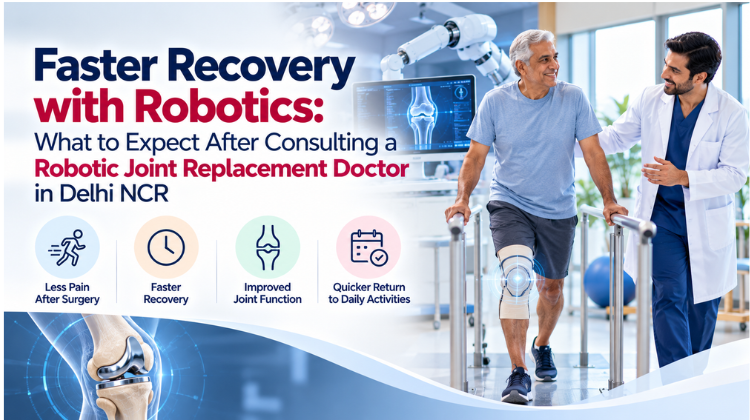
Recovery after Consulting a Robotic Joint Replacement Doctor in Delhi NCR follows a structured, accelerated rehabilitation pathway.
+-----------------------------------------------------------------------------------+
|                        POST-OPERATIVE RECOVERY TIMELINE                           |
|                                                                                   |
|  [ DAY 1: FIRST STEPS ]    -->  [ WEEK 2-3: STITCH REMOVAL ] --> [ WEEK 4-6: FULL FREEDOM ]
|  Standing & walking with        Unassisted indoor walking,       Driving, climbing stairs,
|  walker within 4-6 hours.       stair climbing initiated.        and active daily routine.
+-----------------------------------------------------------------------------------+
Day 1: Early Mobilization and First Steps
-
Within 4 to 6 Hours: Under the guidance of physical therapists, patients stand and take their first steps using a walker. Early weight-bearing stimulates circulation and prevents deep vein thrombosis (DVT).
-
Pain Management: Multimodal analgesia—combining local infiltration, targeted medications, and cold therapy—keeps pain levels low.
Days 2 to 3: Hospital Discharge
-
Functional Independence: You will practice walking down hospital corridors, navigating a short flight of stairs, and sitting or standing independently.
-
Discharge Readiness: Most patients are discharged within 48 to 72 hours, equipped with a home exercise plan, blood thinners, and wound-care instructions.
Weeks 2 to 3: Indoor Independence
-
Suture Removal: Incisions heal cleanly due to smaller surgical openings and reduced tissue tension.
-
Transitioning Off Walkers: Many patients transition from a walker to a simple elbow crutch or walking stick, achieving independent indoor mobility.
Weeks 4 to 6: Returning to Active Living
-
Driving & Work: Patients who have undergone robotic surgery often resume driving, return to office work, and manage light daily errands without discomfort.
-
Full Range of Motion: Targeted exercises help achieve 120 degrees or more of knee flexion, allowing for comfortable sitting, squatting, and fluid walking.
Comparative Overview: Traditional vs. Robotic Recovery Pathways
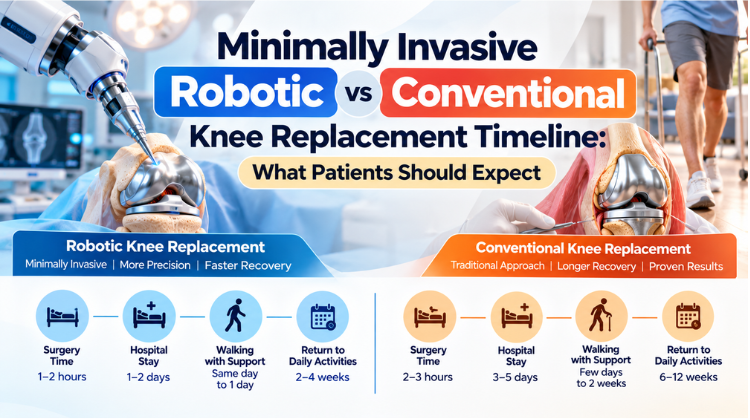
A side-by-side comparison highlights why so many patients opt for robotic surgery after Consulting a Robotic Joint Replacement Doctor in Delhi NCR:
| Recovery Metric | Traditional Joint Replacement | Robotic-Assisted Joint Replacement |
| Surgical Precision | Manual alignment within standard human visual limits. | Sub-millimeter and sub-degree placement accuracy. |
| Soft-Tissue Trauma | Higher tissue retraction required for visual exposure. | Minimal tissue disruption due to haptic safety boundaries. |
| Post-Op Pain & Swelling | Moderate to high early pain; prolonged swelling. | Reduced early pain and minimal tissue swelling. |
| First Mobilization | Walking usually starts 24 to 48 hours after surgery. | Walking starts within 4 to 6 hours on Day 1. |
| Average Hospital Stay | 4 to 6 days in the hospital. | 2 to 3 days in the hospital. |
| Return to Normal Activity | Typically 8 to 12 weeks for full functional recovery. | Typically 3 to 6 weeks for active daily living. |
Spotlight on Clinical Leadership: Dr. Hemant Sharma – Orthopedic & Joint Specialist
When choosing a specialist after Consulting a Robotic Joint Replacement Doctor in Delhi NCR, a surgeon’s background, international credentials, and clinical experience are essential considerations.
Dr. Hemant Sharma is a leading Orthopedic and Joint Replacement Surgeon practicing in Gurugram, Delhi NCR. With over 26 years of clinical experience across India and the United Kingdom.
Facts About Dr. Hemant Sharma:
-
26+ Years of Experience: Possesses over 26 years of surgical experience in complex orthopedics, joint reconstruction, trauma, and revision arthroplasty across India and the UK.
-
Advanced International Qualifications: Completed his MBBS from PGIMS Rohtak (1994) and DNB in Orthopedics (2000), followed by earning prestigious memberships and fellowships from the Royal College of Surgeons, England—holding both MRCS (2004) and FRCS (Trauma & Orthopedics, 2010).
-
UK NHS NHS Experience & Fellowship: Spent 11 years practicing in the UK’s National Health Service (NHS), completing a Senior Fellowship in Revision Lower Limb Arthroplasty at University Hospital Llandough, Cardiff, Wales.
-
Robotic Surgical Expertise: Recognized as a first-generation robotic surgeon in India, having completed over 500 robotic joint replacements and more than 9,000 total surgical procedures.
-
Industry Recognition: Honored with the Service Excellence Award in Robotic Orthopaedics Surgery & Joint Replacement at the Times Network India Health Summit (2025) and recognized as Emerging Leader of the Year (2019).
His Clinical Approach to Patient Recovery
Dr. Hemant Sharma combines international clinical standards (FRCS UK) with advanced robotic precision. His approach focuses on preserving bone stock, minimizing soft-tissue disruption, and ensuring dynamic joint alignment, helping patients achieve quick, comfortable recoveries and long-lasting mobility.
Summary Recommendation
Choosing to undergo joint replacement is a major step toward restoring your quality of life. By Consulting a Robotic Joint Replacement Doctor in Delhi NCR, you can take advantage of state-of-the-art robotic precision, custom surgical planning, and tissue-sparing techniques that support a faster, smoother recovery.
With more than 26 years of global clinical expertise, advanced UK fellowships, and leadership in robotic joint replacement, Dr. Hemant Sharma offers high-precision care designed to help you regain mobility, eliminate pain, and return to an active lifestyle with confidence.
#Consulting A Robotic Joint Replacement Doctor In Delhi NCR #Dr Hemant Sharma #Best Orthopedic Surgeon Gurgaon #Robotic Knee Replacement Delhi #Robotic Hip Replacement Gurgaon #FRCS Orthopedic Surgeon #Fast Recovery Knee Surgery #Sub Millimeter Precision #Joint Replacement Specialist #Knee Osteoarthritis Treatment #Hip Arthroplasty Delhi #Revision Joint Replacement #Computer Navigated Knee Surgery #Minimally Invasive Joint Surgery #Knee Pain Treatment Gurgaon #Advanced Orthopedics Delhi NCR #Robotic Surgery Cost India #Joint Preservation Surgery #Complex Trauma Surgeon #PRP Therapy Knee #Total Knee Arthroplasty #Total Hip Arthroplasty #Orthopedic Consultation Gurgaon #Mako Robotic Surgery #Top Joint Surgeon Delhi #Cartilage Repair Surgery #Gurgaon Orthopedic Clinic #Joint Health India #Rapid Rehabilitation Protocol
FAQ
Q1: What makes recovery faster after Consulting a Robotic Joint Replacement Doctor in Delhi NCR?
Answer: Recovery is significantly faster because robotic-assisted joint replacement relies on sub-millimeter surgical accuracy and haptic safety boundaries. These features prevent accidental damage to surrounding collateral ligaments, tendons, and blood vessels. Less tissue disruption leads to minimal bleeding, reduced swelling, lower post-operative pain, and early mobilization within 4 to 6 hours of surgery.
Q2: Why is Dr. Hemant Sharma considered a top choice for robotic joint replacement in Gurgaon?
Answer: Dr. Hemant Sharma brings over 26 years of surgical experience, including 11 years of practice and advanced fellowship training in the UK NHS. He holds FRCS (Trauma & Orthopedics, UK) credentials and has performed over 500 robotic joint replacements. His focus on precision mapping, muscle-sparing approaches, and rapid rehabilitation makes him a preferred specialist in Delhi NCR.
Q3: How soon can I walk after robotic knee replacement surgery?
Answer: Most patients stand and walk using a walker within 4 to 6 hours of completing surgery on Day 1. Thanks to localized nerve blocks and soft-tissue-preserving robotic techniques, early movement is comfortable and helps prevent blood clots, promoting a fast recovery.
Q4: Will I need extended physical therapy after robotic joint replacement?
Answer: Because robotic assistance ensures precise implant alignment and dynamic soft-tissue balance, post-operative stiffness is greatly reduced. Most patients require only 2 to 3 weeks of light physical therapy to regain independence, compared to 6 to 8 weeks often needed after traditional manual joint surgery.
Q5: Is robotic joint replacement covered by health insurance policies in Delhi NCR?
Answer: Yes, major health insurance companies and third-party administrator (TPA) networks in India cover robotic-assisted joint replacement procedures when recommended by an orthopedic surgeon for end-stage osteoarthritis or joint damage. It is advisable to review your policy details with the hospital’s insurance desk prior to admission.