Dr. Hemant Sharma
FRCS (England) MRCS (England) DNB
Specialist in Revision Lower Limb ArthroPlasty
Complex Hip, Knee and Sports Injury

Knee pain caused by localized osteoarthritis can make everyday movements—like walking down stairs, kneeling, or rising from a chair—feel like an uphill battle. When non-surgical treatments no longer provide relief, many patients worry that a total knee replacement is their only option. Fortunately, modern orthopedics offers a precise, bone-preserving alternative. Opting for robotic partial knee surgery in Gurugram allows surgeons to target only the damaged compartment of your knee while leaving healthy bone, cartilage, and ligaments completely intact.
Unlike a traditional total knee replacement where the entire joint surface is resurfaced, partial knee resurfacing (uncompartmental knee arthroplasty) replaces only the diseased compartment—medial, lateral, or patellofemoral.
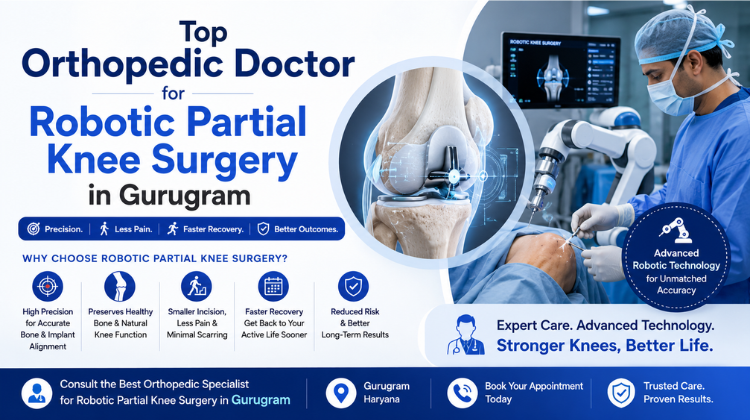
When performed using robotic assistance, the procedure reaches sub-millimeter precision. Advanced 3D modeling generates a personalized virtual blueprint of your joint anatomy. Guided by this real-time feedback, the surgeon uses a robotic arm to sculpt and remove damaged tissue with extreme accuracy. Choosing robotic partial knee surgery in Gurugram ensures that soft tissues and natural knee ligaments (like the ACL and PCL) are fully preserved, leading to a much more natural feeling knee.
Embracing robotic technology for partial joint resurfacing provides clear clinical advantages over traditional manual methods:
Maximum Bone and Ligament Preservation: Only the damaged portion of the joint is removed. Your natural ligaments remain untouched, preserving natural joint mechanics.
Sub-Millimeter Surgical Accuracy: Robotic navigation ensures exact implant positioning, balancing, and alignment, which minimizes post-operative wear and tear.
Smaller Incisions & Minimal Tissue Trauma: Keyhole access means less blood loss, less swelling, and minimal scarring.
Faster Recovery and Reduced Hospital Stay: Most patients begin walking within hours after surgery and return home within 24 to 48 hours.
Less Post-Operative Pain: Preserving surrounding healthy tissue significantly lowers pain levels during rehabilitation.
Consulting an expert for robotic partial knee surgery in Gurugram ensures you experience all these benefits through custom-tailored surgical execution.
Unicondylar knee resurfacing is specifically designed for patients with early-to-moderate, localized joint degeneration. You should evaluate robotic partial knee surgery in Gurugram if you experience:
Pain confined primarily to one side of the knee (usually the inner/medial side).
Preserved range of motion without severe stiffness or joint deformity.
Intact cruciate ligaments (ACL/PCL) offering joint stability.
Ineffective results from physical therapy, injections, or anti-inflammatory medications.
Seeking a specialist for robotic partial knee surgery in Gurugram helps confirm whether your joint damage is unicompartmental or widespread.
From your initial scan to full recovery, the journey through robotic partial knee surgery in Gurugram follows a seamless, structured care pathway:
Pre-Operative 3D Mapping: A CT scan or optical mapping creates a high-definition 3D digital model of your knee joint.
Intra-Operative Robotic Guidance: The surgeon utilizes robotic-arm guidance to execute the digital plan, making micro-adjustments to optimize soft-tissue balancing.
Immediate Post-Op Mobilization: Physical therapy begins almost immediately, helping you regain strength and movement safely.
By trusting a leading team for robotic partial knee surgery in Gurugram, you ensure your procedure is backed by top-tier infrastructure and modern joint reconstruction protocols.
Living with chronic knee pain does not mean giving up your active lifestyle or undergoing full joint replacement. Advanced robotic partial knee surgery in Gurugram delivers targeted, minimally invasive treatment that restores smooth mobility while preserving your natural knee. Schedule a consultation today with a recognized knee specialist to take the first step toward pain-free movement.
Current Leadership Role: Chairman – Marengo Asia Robotic Centre for Orthopaedics & Joint Care (MARC) at Marengo Asia Hospitals, Gurugram.
Extensive Clinical Experience: Over 25 to 29 years of global clinical experience across the United Kingdom (NHS) and India specializing in joint replacement, complex trauma, and robotic surgery.
Educational Background & Credentials: MBBS (PGIMS, Rohtak), DNB in Orthopedic Surgery (St. Stephen’s Hospital, Delhi), MRCS, and FRCS in Trauma & Orthopaedics (Royal College of Surgeons of England).
Specialized Expertise: Renowned orthopaedics specialist in Gurgaon specializing in robotic-assisted partial and total knee replacement, revision lower limb arthroplasty, joint preservation, and complex sports injuries.
#robotic partial knee surgery in gurugram #best knee replacement doctor #gurgaon #unicompartmental #knee arthroplasty #robotic unicondylar #knee replacement #partial knee resurfacing #minimally invasive knee surgery #robotic joint replacement #specialist #cartilage sparing #knee surgery #knee preservation doctor #gurugram #robotic arm assisted #knee surgery #top orthopedic surgeon #gurgaon
A: A total knee replacement replaces all three compartments of the knee joint with artificial implants. In contrast, a robotic partial knee replacement replaces only the single damaged compartment (medial, lateral, or patellofemoral) while preserving all healthy bone, cartilage, and natural ligaments like the ACL and PCL.
A: Robotic assistance utilizes 3D computer modeling and real-time haptic feedback to help the surgeon sculpt the bone and place the implant with sub-millimeter precision. This ensures optimal soft-tissue balance, eliminates alignment errors, reduces post-operative pain, and extends the long-term lifespan of the implant.
A: Dr. Hemant Sharma, orthopaedics specialist in Gurgaon, brings over 25 years of international experience trained in the UK (FRCS England). As Chairman of the Marengo Asia Robotic Centre for Orthopaedics & Joint Care, he combines international surgical standards with cutting-edge robotic navigation technology to deliver accurate, bone-sparing joint resurfacing with rapid recovery timelines.
A: Recovery after robotic partial knee surgery is significantly faster than traditional surgery. Most patients stand and walk with support within hours of surgery, return home in 24 to 48 hours, drive within 2 to 3 weeks, and return to active daily routines and light sports within 4 to 6 weeks.
A: No, robotic partial knee surgery is ideal for patients with localized, unicompartmental osteoarthritis whose ligaments (ACL/PCL) are intact and healthy. Patients with widespread severe arthritis across multiple compartments or severe joint deformities are generally better candidates for robotic total knee replacement.