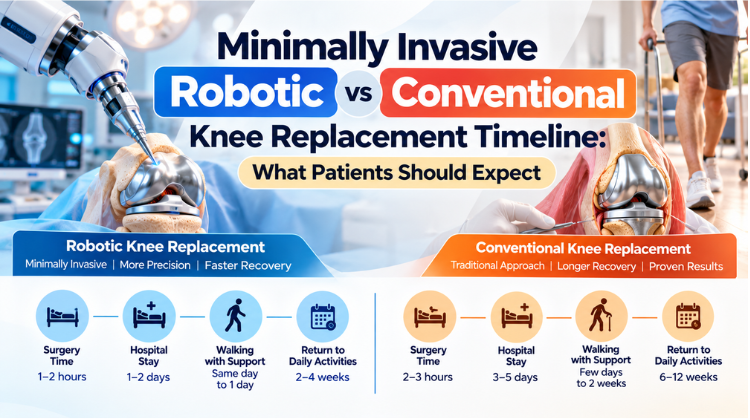

Chronic knee pain stemming from severe osteoarthritis, rheumatoid arthritis, or post-traumatic joint degeneration can drastically impair daily living. When conservative management—such as physiotherapy, weight management, anti-inflammatory medications, and intra-articular injections—fails to offer adequate relief, total knee arthroplasty (TKR) stands out as a definitive solution to restore mobility and eliminate pain.
However, the field of joint replacement has undergone a monumental shift. For decades, orthopedic surgeons relied exclusively on traditional manual instrumentation, visual estimations, and mechanical alignment guides. While conventional approaches have helped millions regain motion, surgical execution historically had a higher variance in limb alignment and soft-tissue balance.
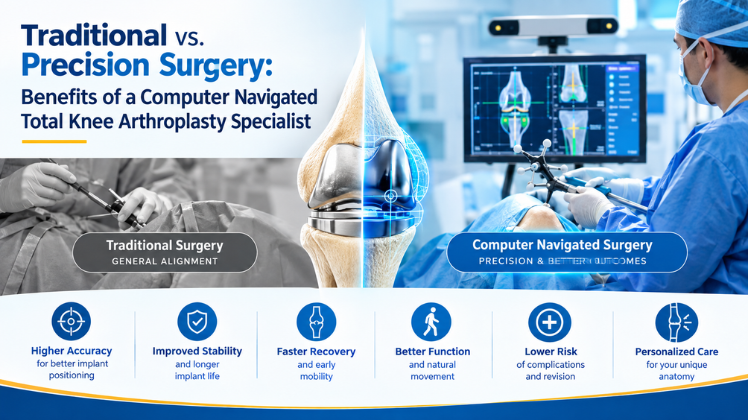
Today, modern medical engineering offers computer navigation. Seeking guidance from a dedicated Computer Navigated Total Knee Arthroplasty Specialist bridges the gap between conventional surgical technique and modern digital precision. By combining high-definition 3D mapping, real-time feedback, and dynamic tracking, a Computer Navigated Total Knee Arthroplasty Specialist optimizes outcomes, reduces human error, and extends implant longevity.
Understanding Knee Replacement: The Paradigm Shift to Precision
To appreciate why patients choose precision surgery over traditional approaches, it helps to understand the biomechanics of the human knee. The knee joint acts as a complex hinge that flexes, extends, and slightly rotates while absorbing forces several times a person’s body weight during daily movement.
When cartilage wears away, exposed bone surfaces rub together, generating pain, stiffness, and structural deformity (such as bow-legged or knock-kneed alignment). A total knee arthroplasty replaces damaged joint surfaces with metallic and durable polyethylene components.
                                    +-----------------------------------+
                                    |     Knee Replacement Options      |
                                    +-----------------------------------+
                                                      |
                        +-----------------------------+-----------------------------+
                        |                                                           |
                        v                                                           v
         +-----------------------------+                             +-----------------------------+
         |     Traditional Surgery     |                             |      Precision Surgery      |
         +-----------------------------+                             +-----------------------------+
         | - Manual mechanical guides  |                             | - Infrared optical tracking |
         | - Visual alignment estimation|                            | - Real-time 3D data modeling|
         | - Intramedullary canal drilling|                           | - Sub-millimeter accuracy   |
         | - Standard cut thickness    |                             | - Dynamic soft-tissue balancing|
         +-----------------------------+                             +-----------------------------+
The Limits of Conventional Surgery
In a traditional knee replacement, the surgeon uses manual mechanical jigs and rods. To align the femoral component, an intramedullary rod is inserted directly into the central canal of the femur. Alignment is then estimated based on average anatomical landmarks.
While experienced surgeons perform well with manual tools, anatomical variation means standard mechanical alignment guides cannot guarantee consistent precision for every unique patient structure. An error of just 3 degrees from the natural mechanical axis can lead to asymmetric wear, joint instability, persistent discomfort, or early implant failure requiring revision surgery.
The Role of a Computer Navigated Total Knee Arthroplasty Specialist
A Computer Navigated Total Knee Arthroplasty Specialist uses advanced computer-assisted surgery (CAS) systems. These systems function like a precise GPS for the operating room. Optical infrared trackers attached to the patient’s femur and tibia map out the limb’s exact 3D anatomical layout in real-time.
The computer system processes millions of data points to create a patient-specific model of the knee without requiring pre-operative CT scans or extra radiation exposure. Armed with this real-time visual feedback, a Computer Navigated Total Knee Arthroplasty Specialist can make micro-adjustments to bone cuts and ligament tension before making a single permanent modification.
Detailed Comparison: Traditional vs. Computer Navigated TKR
| Feature / Metric | Traditional Total Knee Arthroplasty | Computer Navigated Arthroplasty |
| Surgical Alignment Method | Manual mechanical jigs and intramedullary rods | Infrared optical tracking and real-time 3D computer modeling |
| Alignment Accuracy | Subject to visual estimation; higher risk of deviation | Accurate within 0.5° and sub-millimeter parameters |
| Bone Preservation | Standard cutting guides based on anatomical averages | Highly customized cuts preserving healthy bone stock |
| Intramedullary Canal Invasion | Requires drilling a rod into the femoral shaft | No intramedullary drilling required; tracker pins used instead |
| Blood Loss & Embolism Risk | Higher relative risk due to canal entry | Reduced intraoperative blood loss and lower embolic risk |
| Ligament & Tissue Balancing | Manual assessment during knee movement | Dynamic live digital readouts throughout full range of motion |
| Long-Term Implant Longevity | Standard survival rates; susceptible to asymmetric wear | Extended implant lifespan due to balanced force distribution |
Key Clinical Benefits of Seeing a Computer Navigated Total Knee Arthroplasty Specialist
Working with a skilled Computer Navigated Total Knee Arthroplasty Specialist offers several clinically proven advantages over conventional manual methods:
1. Sub-Millimeter Mechanical Alignment
The human eye cannot consistently detect minor deviations under 2 or 3 degrees. Computer navigation systems track limb position within 0.5 degrees and under 1 millimeter of planned trajectory. Re-establishing the true mechanical axis from the center of the hip down through the knee to the ankle distributes body weight evenly across the entire implant surface.
2. Precise Soft-Tissue and Ligament Balancing
Implant alignment is only half the challenge in TKR; ligament balancing is equally critical. A knee that is too tight causes stiffness and restricted motion, while a loose joint feels unstable during weight-bearing activities. A Computer Navigated Total Knee Arthroplasty Specialist evaluates soft-tissue tension digitally across the entire range of motion—from full extension to deep flexion—ensuring a joint that feels stable and natural.
3. Less Invasive Approach with Reduced Blood Loss
Conventional knee surgery requires driving a metal alignment rod into the marrow canal of the femur. This invasive step causes internal bleeding and increases the risk of bone marrow fat embolisms entering the bloodstream. Computer-assisted navigation eliminates intramedullary canal penetration, reducing post-operative blood loss, swelling, and surgical trauma.
4. Longer Lasting Joint Implants
Prosthetic joint failure often stems from uneven pressure distribution that accelerates polyethylene wear, leading to implant loosening. Research from national joint registries demonstrates that computer-guided joint replacements experience fewer revisions due to mechanical loosening, making this technique ideal for younger, active patients expecting their joint to last decades.
5. Quicker Rehabilitation and Functional Recovery
Because computer-navigated surgery preserves soft tissues, limits bone removal, and eliminates marrow cavity disruption, post-operative pain and swelling are typically reduced. Patients can participate in physical therapy sooner, achieve functional flexion milestones earlier, and return to independent living faster.
                     +---------------------------------------------------+
                     | Key Benefits of Computer-Navigated Knee Replacement |
                     +---------------------------------------------------+
                                               |
        +-------------------+------------------+------------------+-------------------+
        |                   |                     |               |                   |
        v                   v                     v               v                   v
+---------------+   +---------------+   +------------------+  +---------------+   +---------------+
| Sub-Millimeter|   | Dynamic Soft- |   | Reduced Blood    |  | Extended      |   | Faster        |
| Precision     |   | Tissue        |   | Loss & Minimal   |  | Implant       |   | Patient       |
| Alignment     |   | Balancing     |   | Trauma           |  | Longevity     |   | Recovery      |
+---------------+   +---------------+   +------------------+  +---------------+   +---------------+
Surgical Steps in Computer Navigated Joint Arthroplasty
Understanding how a Computer Navigated Total Knee Arthroplasty Specialist performs the procedure can help ease anxiety and set clear expectations:
-
Patient Mapping & Registration: After opening the surgical field, small, temporary tracking pins are placed into the femur and tibia. Optical arrays on these pins reflect infrared light back to a specialized camera connected to the surgical computer.
-
Kinematic Data Acquisition: The specialist moves the leg through various angles. The system calculates the exact center of rotation for the hip, knee, and ankle joints, establishing a customized 3D kinematic profile.
-
Pre-Cut Virtual Planning: Before making bone cuts, the computer displays real-time predictive models on-screen. The surgeon can adjust implant sizing, rotational positioning, and cut angles to optimize alignment and soft-tissue balance.
-
Guided Bone Resurfacing: The surgeon attaches cutting jigs that are navigated directly using optical feedback. The computer confirms that each cut matches the planned position within half a millimeter before any cuts are made.
-
Trial Verification & Implant Placement: Trial components are inserted to test joint motion. The computer verifies gap symmetry, alignment accuracy, and stability across full extension and flexion before the final prosthesis is secured.
Is Computer Navigated Surgery Right for You?
Consulting a Computer Navigated Total Knee Arthroplasty Specialist is beneficial for most candidates undergoing joint replacement. However, this technology offers particular advantages in specific complex scenarios:
-
Patients with Prior Deformities or Hardware: If you have previous fracture hardware, metal plates, or severe extra-articular bone deformities from past trauma, standard intramedullary rods cannot be inserted safely. Computer navigation overcomes this limitation by operating strictly off surface optical points.
-
Younger, Active Candidates: Younger individuals put greater mechanical stress on joint implants over their lifetimes. Achieving accurate biomechanical alignment reduces long-term implant wear and helps prevent premature revision surgery.
-
Severe Degenerative Deformities: Patients with severe varus (bow-leg) or valgus (knock-knee) deformities often have compromised ligament balance that can be difficult to assess visually. Computer navigation provides real-time digital readouts to guide balance corrections accurately.
Also Read: Shoulder Arthroscopy: When Do You Need It? Symptoms, Treatment Options & Expert Advice
#Total Knee Arthroplasty #Precision Knee Surgery #Orthopedic Surgeon Gurgaon #Advanced TKR #Knee Replacement Benefits #Minimally Invasive Knee Surgery #Joint Replacement Specialist #Ligament Balancing TKR #Implant Longevity #Knee Arthritis Treatment #Digital Orthopedics #Computer Assisted Surgery #Mechanical Axis Alignment #Revision Knee Arthroplasty #Knee Pain Relief #Marengo Asia Hospital #FRCS Surgeon #Dr Hemant Sharma #Joint Preservation #Orthopedic Trauma #Customized Knee Replacement #Robotic Knee Replacement #Knee Rehabilitation #Sub Millimeter Precision #Soft Tissue Balancing #Goniometric Accuracy #Zero Radiation Navigation #3D Knee Mapping #Post Op Knee Recovery #Orthopedic Center Of Excellence #Gurgaon Joint SpecialistComputer Navigated Knee Replacement
FAQ
Q1: What makes a Computer Navigated Total Knee Arthroplasty Specialist different from a traditional orthopedic surgeon?
A Computer Navigated Total Knee Arthroplasty Specialist utilizes advanced computer-assisted surgery (CAS) systems that track light-reflecting infrared markers fixed to the patient’s bones. Unlike a traditional surgeon who relies on manual mechanical guides and visual estimation, a navigation specialist uses a live 3D visual dashboard during surgery. This setup allows the surgeon to perform bone cuts and ligament balancing with sub-millimeter accuracy, tailor alignment to unique patient anatomy, and eliminate the need to drill into the femoral marrow canal.
Q2: Why is Dr. Hemant Sharma considered a leading orthopedics specialist in Gurgaon for joint replacements?
Dr. Hemant Sharma is a widely respected Chairman of Orthopedics and Joint Replacement with over 26 years of clinical experience across India and the UK. Trained in the British National Health Service (NHS), he holds the Fellow of the Royal College of Surgeons (FRCS, England) credential. Dr. Sharma specializes in computer-navigated TKR, complex revision joint replacements, and robotic-assisted surgeries. His international fellowship background and extensive record in handling complex revision joint procedures make him a top choice for orthopedic patients in Gurgaon and Delhi NCR.
Q3: How does computer-assisted knee navigation lower the risk of revision surgery?
Primary joint replacement failure often occurs due to subtle misalignment, which places uneven pressure on prosthetic surfaces and accelerates component loosening. Studies show that alignment errors exceeding 3 degrees significantly increase long-term revision rates. A Computer Navigated Total Knee Arthroplasty Specialist achieves alignment within 0.5 degrees, distributing weight evenly across the implant. This structural precision reduces mechanical stress, minimizes polyethylene wear, and extends implant life.
Q4: Does computer navigated knee surgery mean a robot is performing the operation?
No, the computer navigation system does not operate autonomously. The technology serves as a real-time digital navigation tool—similar to a high-precision GPS—that provides continuous feedback to the surgeon. The Computer Navigated Total Knee Arthroplasty Specialist retains full manual control over every incision, cut, and implant placement. The system acts as a real-time tracking tool, enhancing the specialist’s expertise with precise digital data.
Q5: What are the key atomic facts about Dr. Hemant Sharma’s medical qualifications and clinical practice?
-
Current Position: Chairman – Orthopedics & Robotic Joint Replacement Surgery at Marengo Asia Hospitals, Gurugram.
-
Experience: Over 26 years of experience in orthopedic surgery spanning the UK and India.
-
Qualifications: MBBS (PGIMS Rohtak), DNB (Ortho), MRCS (England), and FRCS in Trauma & Orthopedic Surgery from the Royal College of Surgeons, England.
-
International Training: Completed advanced fellowships in lower limb reconstruction and revision knee arthroplasty at University Hospital Llandough in Cardiff, UK.
-
Specialties: Computer-navigated knee replacement, robotic-assisted joint surgery, complex lower limb revision arthroplasty, joint preservation, and complex trauma management.