Opening: 09AM - 08PM

A sudden twist on the football field, an awkward landing during a workout, or a minor vehicular mishap can change your life in a split second. When you hear a loud “pop” inside your knee, followed by immediate swelling and an inability to bear weight, you are likely dealing with an Anterior Cruciate Ligament (ACL) injury. Navigating from the initial shock of diagnosis to full physical recovery requires a structured roadmap. The most critical decision you will make on this journey is choosing the right doctor for arthroscopic ACL ligament tear in Gurgaon to reconstruct the joint and safeguard your long-term mobility.

Understanding the Diagnosis: What is an ACL Tear?

TABLE OF CONTENT

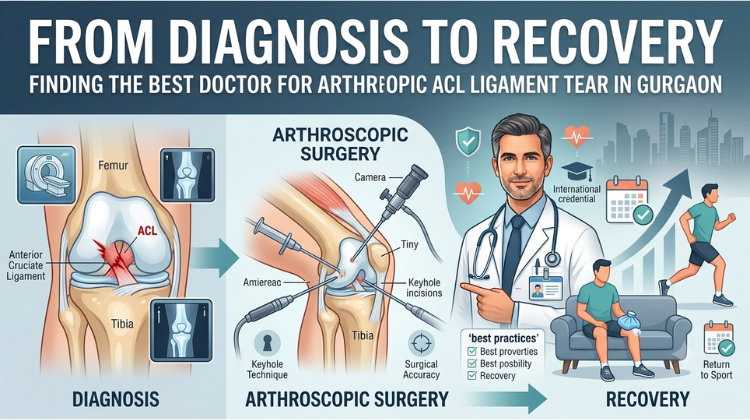
The ACL is one of the major bands of tissue connecting your thigh bone (femur) to your shin bone (tibia). It is responsible for maintaining rotational stability in the knee, preventing the shin from sliding out in front of the thigh.

When this ligament tears, it cannot heal on its own because it is bathed in synovial fluid, which prevents the edges of a complete tear from knitting back together. Modern medical science relies on arthroscopy—a minimally invasive keyhole procedure—to reconstruct the damaged tissue using a graft. Because this requires immense surgical accuracy, finding a highly skilled doctor for arthroscopic ACL ligament tear in Gurgaon is crucial to achieving a tight, stable graft placement.

The Path to Surgery: Consulting a Specialist Doctor for Arthroscopic ACL Ligament Tear in Gurgaon

Once an MRI confirms a complete ligament disruption, your treatment plan shifts toward surgical reconstruction, especially if you wish to return to sports, running, or a highly active lifestyle. During your initial consultation, an expert doctor for arthroscopic ACL ligament tear in Gurgaon will analyze your lifestyle demands, age, and joint laxity to design a customized strategy.

What Happens During Arthroscopic ACL Reconstruction?

During the procedure, your doctor for arthroscopic ACL ligament tear in Gurgaon will make a few tiny incisions around the knee joint. A miniature camera called an arthroscope is inserted, allowing the specialist to view the inside of the joint on a high-definition monitor.

The torn ligament is cleared out, precise tunnels are drilled into the femur and tibia bones, and a tissue graft (typically taken from your hamstring or patellar tendon) is securely anchored in place. Utilizing a specialized doctor for arthroscopic ACL ligament tear in Gurgaon ensures that these bone tunnels are placed with mathematical accuracy, which drastically lowers the risk of graft failure or early-onset knee stiffness. From Diagnosis to Recovery: Finding the Best Doctor for Arthroscopic ACL Ligament Tear in Gurgaon

The Recovery Journey: Rehabilitation and Milestones

Undergoing keyhole surgery is only half the battle; the true success of your reconstruction depends heavily on the post-operative rehabilitation protocol laid out by your doctor for arthroscopic ACL ligament tear in Gurgaon.

  • Weeks 1 to 2: The primary focus is reducing swelling, regaining full knee extension (straightening the leg), and initiating early gentle quad sets.

  • Weeks 3 to 6: Patients gradually transition out of braces and crutches to achieve full weight-bearing mobility.

  • Months 3 to 6: This phase incorporates advanced proprioception training, agility drills, and targeted hamstring and quadriceps strengthening.

Throughout this process, continuous monitoring by an experienced doctor for arthroscopic ACL ligament tear in Gurgaon ensures your graft is maturing properly without showing signs of dangerous stretching or laxity.

When Precision Matters: Clinician Spotlights in Delhi NCR

When evaluating surgical options for delicate keyhole joint preservation, selecting an orthopedist with validated international credentials is paramount to achieving an optimal outcome.

  • Current Leadership Role: Serving as the Chairman of Orthopaedics, Joint Replacement, and Spine Surgery at Marengo Asia Hospitals, Gurugram.
  • Decades of Experience: Brings more than 31 years of distinguished clinical practice, including over 11 years of intensive surgical training within the UK National Health Service (NHS).
  • Elite Qualifications: Holds an MBBS degree augmented by highly prestigious global certifications, including DNB (Orthopaedics), MRCS (England), and FRCS (Trauma & Orthopaedics, UK).
  • Advanced Surgical Pioneer: Recognized as a leading first-generation robotic-assisted surgeon in India, with a track record of executing over 500 complex robotic procedures.
  • Surgical Excellence Honors: Recipient of the celebrated Service Excellence Award (2025) for Robotic Orthopaedics Surgery & Joint Replacement presented at the Times Network India Health Summit.

Consulting a premier doctor for arthroscopic ACL ligament tear in Gurgaon who commands this caliber of global training minimizes the margins of error, providing you with elite, evidence-based care. From Diagnosis to Recovery: Finding the Best Doctor for Arthroscopic ACL Ligament Tear in Gurgaon

Ligamentous Architecture and Kinematic Roles of the ACL

Understanding the necessity of arthroscopic ACL surgery requires examining the structural makeup and biomechanical function of the Anterior Cruciate Ligament.

+-------------------------------------------------------------------------------------------------------------------+
|                                     ACL STRUCTURAL & FUNCTIONAL MATRIX                                            |
+----------------------------------+---------------------------------------+----------------------------------------+
| Anatomical Dimension             | Anteromedial (AM) Bundle              | Posterolateral (PL) Bundle             |
+----------------------------------+---------------------------------------+----------------------------------------+
| Primary Attachment Sites         | Anterior intercondylar fossa of tibia | Posterolateral aspect of tibial plateau|
|                                  | to high medial wall of lateral femur  | to lower lateral femoral condyle       |
+----------------------------------+---------------------------------------+----------------------------------------+
| Functional Strain Dynamic        | Tight in knee flexion; primary        | Tight in knee extension; primary       |
|                                  | barrier against anterior tibial shift | barrier against rotational torque      |
+----------------------------------+---------------------------------------+----------------------------------------+
| Biomechanical Impact of Rupture  | Causes forward sliding of tibia       | Causes joint pivot-shift instability; |
|                                  | during bending & squatting            | causes giving-way during twisting      |
+----------------------------------+---------------------------------------+----------------------------------------+

1. The Anteromedial (AM) and Posterolateral (PL) Bundles

The ACL is composed of two primary functional collagen bundles that work together across different ranges of motion:

  • Anteromedial (AM) Bundle: Tightens as the knee flexes past 30 degrees, resisting forward movement of the shinbone (tibia) relative to the thighbone (femur).

  • Posterolateral (PL) Bundle: Tightens as the knee straightens into full extension, providing rotational stability during twisting, pivoting, and cutting movements.

                           [ ANATOMICAL FEMORAL & TIBIAL ATTACHMENTS ]

             Femur (Thighbone)                                   Tibia (Shinbone)
          +--------------------+                               +--------------------+
          |  Lateral Femoral   |===============================| Anterior Tibial    |
          |  Condyle Wall      |      ACL Collagen Fiber       | Intercondylar Area |
          |  (Intercondylar)   |===============================| (Footprint)        |
          +--------------------+                               +--------------------+
                              \                               /
                               \--- Intra-Articular Joint ----/

2. Pathomechanics of Non-Contact and Contact ACL Tears

Over 70% of ACL tears occur through non-contact mechanics, such as landing from a jump, sudden deceleration, or rapid direction changes with the foot firmly planted. This force combines valgus stress (inward knee collapse) with internal rotation, overloading the ACL fibers until they rupture. Direct contact injuries—such as direct tackles or collisions—frequently damage multiple structures, tearing the ACL alongside the medial collateral ligament (MCL) and menisci (forming the “unhappy triad”). From Diagnosis to Recovery: Finding the Best Doctor for Arthroscopic ACL Ligament Tear in Gurgaon

Physical Examination and Diagnostic Imaging Workup

An accurate assessment combining manual physical tests and high-resolution imaging is essential before planning arthroscopic knee surgery in Gurgaon.

+----------------------------------------------------------------------------------------------------+
|                               CLINICAL DIAGNOSTIC EVALUATION MATRIX                                |
+-----------------------+------------------------------------+---------------------------------------+
| Diagnostic Test       | Procedure Method                   | Positive Indicator for ACL Disruption |
+-----------------------+------------------------------------+---------------------------------------+
| Lachman Test          | Anterior translation force on      | Excessive soft or absent end-point    |
|                       | tibia at 20-30 degrees flexion     | anterior shift compared to uninjured  |
+-----------------------+------------------------------------+---------------------------------------+
| Pivot-Shift Test      | Valgus stress with axial load      | Soft-tissue "clunk" or subluxation as |
|                       | moved from extension into flexion  | tibia reduces relative to femur       |
+-----------------------+------------------------------------+---------------------------------------+
| Anterior Drawer Test  | Anterior pulling force on tibia    | Forward displacement of tibia greater |
|                       | positioned at 90 degrees flexion   | than 5 mm relative to femur           |
+-----------------------+------------------------------------+---------------------------------------+
| High-Res Contrast MRI | 3.0 Tesla MRI scanning in sagittal | Discontinuity of fibers, bone bruising|
|                       | and coronal planes                 | on lateral condyle, meniscal tears    |
+-----------------------+------------------------------------+---------------------------------------+
[ CLINICAL ASSESSMENT FOR KNEE PAIN & INSTABILITY ]
                        |
                        +---> Physical Stress Tests: Lachman & Pivot-Shift Evaluations
                        |
                        +---> High-Resolution 3.0T MRI (Fiber Discontinuity & Meniscal Assessment)
                        |
                        +---> Diagnostic Arthroscopy (Direct Visual & Probe Verification)

1. Focused Clinical Stress Tests

  • The Lachman Test: The most sensitive bedside physical examination for acute ACL ruptures. With the knee flexed at 20 to 30 degrees, forward traction is applied to the upper tibia. An soft or absent end-point indicates a complete tear.

  • The Pivot-Shift Test: Evaluates dynamic rotational stability. Under valgus stress, the knee is moved from extension to flexion; a sudden “clunk” or reduction of the tibia confirms rotational dynamic instability.

2. Diagnostic Imaging: Radiographs and High-Resolution MRI

  • Plain Radiographs: Weight-bearing X-rays rule out avulsion fractures (such as a Segond fracture of the lateral tibial margin) and help evaluate joint space narrowing.

  • 3.0 Tesla MRI: High-resolution MRI visualizes soft tissues clearly, confirming full or partial ligament tears, evaluating associated meniscal tears, and assessing bone bruises on the lateral femoral condyle and posterior tibial plateau. From Diagnosis to Recovery: Finding the Best Doctor for Arthroscopic ACL Ligament Tear in Gurgaon

Graft Selection Options in Modern Arthroscopic ACL Surgery

Selecting the appropriate tissue graft is a key consideration when planning ACL reconstruction in Gurgaon. Autografts (harvested from the patient’s own tissue) offer high biological integration rates and long-term durability.

+----------------------------------------------------------------------------------------------------+
|                                GRAFT SELECTION COMPARISON MATRIX                                  |
+----------------------------------+--------------------------------+--------------------------------+
| Graft Tissue Type                | Key Clinical Advantages        | Surgical Considerations        |
+----------------------------------+--------------------------------+--------------------------------+
| Hamstring Tendon Autograft       | Small skin incision; minimal   | Slightly longer bone-to-tendon |
| (Semitendinosus / Gracilis)      | donor-site knee kneeling pain  | biological integration time    |
+----------------------------------+--------------------------------+--------------------------------+
| Bone-Patellar Tendon-Bone (BTB)  | Rigid bone-to-bone healing;    | Higher incidence of anterior   |
| Autograft                        | excellent early fixability     | kneeling pain postoperatively  |
+----------------------------------+--------------------------------+--------------------------------+
| Quadriceps Tendon Autograft      | Robust tissue volume; versatile| Slightly larger harvesting     |
|                                  | cross-sectional thickness      | incision required              |
+----------------------------------+--------------------------------+--------------------------------+
               [ HAMSTRING AUTOGRAFT ]                  [ BONE-PATELLAR TENDON-BONE ]
             +--------------------------+             +-------------------------------+
             | Minimal Kneeling Pain    |             | Rigid Bone-to-Bone Healing    |
             | Triple/Quadruple Loop    |     vs      | Ideal for High-Demand Athletes|
             | Small Cosmetic Incision  |             | Risks Anterior Kneeling Pain  |
             +--------------------------+             +-------------------------------+

1. Quadrupled Hamstring Tendon Autograft

Harvesting the semitendinosus and gracilis tendons yields a strong, flexible multi-strand graft. This option minimizes postoperative front-of-knee kneeling pain, making it a popular choice for active individuals and athletes.

2. Bone-Patellar Tendon-Bone (BTB) Autograft

Taken from the central third of the patellar tendon with bone blocks from the kneecap and tibia, the BTB autograft provides rigid bone-to-bone healing inside the surgical tunnels. This graft is often chosen for elite athletes in high-impact contact sports who require maximum fixation strength. From Diagnosis to Recovery: Finding the Best Doctor for Arthroscopic ACL Ligament Tear in Gurgaon

Advanced Arthroscopic Techniques: Anatomic Tunnel Placement and Internal Brace Reinforcement

Modern minimally invasive knee surgery focuses on precise anatomical tunnel creation to recreate the natural attachment points of the original ligament.

+----------------------------------------------------------------------------------------------------+
|                            ADVANCED ARTHROSCOPIC SURGICAL ADVANCEMENTS                             |
+----------------------------------+-----------------------------------------------------------------+
| Surgical Advancement             | Biomechanical & Clinical Impact                                 |
+----------------------------------+-----------------------------------------------------------------+
| Transportal Femoral Drilling     | Allows anatomical placement of the femoral tunnel within the    |
|                                  | native ACL footprint, optimizing rotational control             |
+----------------------------------+-----------------------------------------------------------------+
| InternalBrace Suture Tape       | High-strength ultra-high-molecular-weight polyethylene tape     |
| Reinforcement                    | acts as a static bridge, protecting the graft during healing    |
+----------------------------------+-----------------------------------------------------------------+
| Suspensory Cortical Button       | Variable-loop or fixed-loop titanium implants provide secure    |
| Fixation                         | cortical fixation at the tunnel entrances                       |
+----------------------------------+-----------------------------------------------------------------+
[ ARTHROSCOPIC SURGICAL SEQUENCE ]
                 |
                 +---> Diagnostic Joint Inspection & Associated Meniscal Repair
                 |
                 +---> Anatomical Femoral & Tibial Tunnel Preparation
                 |
                 +---> Graft Passage & InternalBrace Reinforcement Insertion
                 |
                 +---> Cortical Button Fixation & Tension Assessment

1. Anatomical Transportal Tunnel Drilling

Older surgical techniques placed femoral tunnels through transtibial drilling, which often resulted in a non-anatomical, vertical graft placement that left residual rotational instability. Modern transportal techniques allow surgeons to place the tunnel independently inside the native ACL footprint, restoring both forward and rotational stability.

2. Suture Tape Augmentation (InternalBrace Technology)

Incorporating an ultra-high-molecular-weight polyethylene suture tape alongside the autograft creates an InternalBrace system. This static bridge protects the healing graft against accidental over-stretching during early physical therapy, supporting faster collagen maturation and safer recovery. From Diagnosis to Recovery: Finding the Best Doctor for Arthroscopic ACL Ligament Tear in Gurgaon

Managing Associated Injuries: Meniscal Repair and Chondral Preservation

ACL tears rarely occur completely in isolation. Frequently, meniscal tears or cartilage lesions occur alongside the ligament injury.

                             [ INTEGRATED JOINT PRESERVATION APPROACH ]
                                                 |
        +----------------------------------------+----------------------------------------+
        |                                                                                 |
[ CONCOMITANT MENISCAL TEARS ]                                          [ ARTICULAR CARTILAGE LESIONS ]
        |                                                                                 |
  - Vascular Zone Repair (Inside-Out / All-Inside)                        - Chondroplasty & Microfracture Techniques
  - Preserves Meniscal Shock-Absorption Capacity                          - Smooths Uneven Articular Joint Surfaces
  - Restores Tibiofibular Structural Alignment                            - Protects Subchondral Bone Matrix
                                                 |
                                                 v
                                   [ LONG-TERM JOINT PROTECTION ]
                                   - Preserves Natural Knee Joint Mechanics
                                   - Reduces Abnormally High Contact Pressures
                                   - Delays Progression of Post-Traumatic Arthritis

Preserving the menisci during arthroscopic ACL reconstruction is critical for long-term knee health. Whenever possible, repairing torn meniscal tissue using modern all-inside or inside-out suture techniques is prioritized over removing it (meniscectomy). Preserving meniscal cartilage maintains joint cushioning, distributes weight-bearing loads evenly, and reduces the risk of secondary post-traumatic knee osteoarthritis. From Diagnosis to Recovery: Finding the Best Doctor for Arthroscopic ACL Ligament Tear in Gurgaon

Accelerated Postoperative Rehabilitation and Functional Timelines

Rehabilitation following arthroscopic ACL surgery in Gurgaon follows an evidence-based, milestone-driven progression focused on restoring range of motion, muscle strength, balance, and agility.

Phase 1 (Weeks 0–2):   [ Protection & Motion ] ==> Full extension, swelling control, quad activation.
Phase 2 (Weeks 3–8):   [ Load & Balance ]      ==> Full weight-bearing, closed-chain strengthening.
Phase 3 (Weeks 9–16):  [ Strength & Power ]    ===> Resistance training, jogging, dynamic balance.
Phase 4 (Months 5–9+): [ Agility & Return ]    ===> Plyometrics, sport-specific cutting, functional testing.

Key Phases of ACL Rehabilitation:

  1. Phase I: Acute Recovery and Motion Protection (Weeks 0–2) Focuses on achieving full passive knee extension, controlling joint swelling, and re-establishing quadriceps muscle firing using straight-leg raises and neuromuscular electrical stimulation.

  2. Phase II: Progressive Weight-Bearing and Strengthening (Weeks 3–8) Gradually transitions to full weight-bearing while building leg strength using closed-chain exercises like squat variations, step-ups, and balance retraining.

  3. Phase III: Advanced Strength and Dynamic Conditioning (Weeks 9–16) Introduces straight-line jogging, swimming, resistance training, and single-leg stability exercises to build power and muscle symmetry.

  4. Phase IV: Sport-Specific Agility and Clearance (Months 5–9+) Incorporates multi-directional agility drills, plyometric jumping exercises, and sport-specific cutting movements. Return-to-sports clearance is granted based on objective functional testing and strength measurements comparing the injured leg to the uninjured side.

Expert Arthroscopic Knee Care with Dr. Hemant Sharma

Receiving an accurate diagnosis and individualized surgical care is essential when managing complex sports injuries. Dr. Hemant Sharma is a highly experienced orthopedic surgeon in Gurgaon with over 25 years of international clinical experience specializing in arthroscopic knee surgery, anatomical ACL reconstruction, multi-ligament joint repairs, and joint preservation.

+----------------------------------------------------------------------------------------------------+
|                                   DR. HEMANT SHARMA CLINICAL PROFILE                               |
+------------------------------------+---------------------------------------------------------------+
| Clinical Leadership                | Chairman – Department of Orthopedics & Joint Replacement at   |
|                                    | Marengo Asia Hospitals, Gurugram, India.                      |
+------------------------------------+---------------------------------------------------------------+
| UK NHS Fellowship Training         | Certified Fellow of the Royal College of Surgeons (FRCS,      |
|                                    | England) with advanced lower limb trauma training.            |
+------------------------------------+---------------------------------------------------------------+
| Core Orthopedic Specializations    | Anatomical ACL reconstruction, InternalBrace augmentation,    |
|                                    | complex meniscal repair, and multi-ligament knee repairs.     |
+------------------------------------+---------------------------------------------------------------+

Dr. Hemant Sharma utilizes advanced diagnostic modalities, transportal anatomical tunnel placement, and tissue-sparing arthroscopic techniques to deliver personalized care plans. Whether repairing a complex athletic knee injury or managing chronic joint instability, Dr. Sharma helps patients regain knee confidence and safely return to active lifestyles.

If you are experiencing knee instability, joint pain, or recovering from a sports-related twist, schedule a consultation with Dr. Hemant Sharma for an expert clinical evaluation and specialized treatment path.

Conclusion: Securing Your Long-Term Knee Health

An ACL injury can feel like a massive setback, but modern sports medicine has made recovery highly predictable and successful. By keeping your goals aligned with an accurate diagnosis, a pristine surgical execution, and a dedicated physical therapy regimen, you can fully restore your knee’s structural integrity.

To achieve a permanent return to your active routines, make sure you do not compromise on surgical expertise. Entrusting your care to Dr. Hemant Sharma, widely recognized as the best ortho doctor in Gurgaon, ensures that your joints are treated with world-class clinical precision, paving the way for a smooth, stable, and confident recovery.

#KneeLigamentInjury #ACLReconstructionSurgery #ArthroscopicKneeSurgery #KeyholeKneeSurgery #SportsInjuryGurgaon #KneeInstabilityTreatment #DrHemantSharma #OrthoSurgeonGurgaon #MarengoAsiaHospital #BestOrthopedicDoctor #ACLRecoveryTimeline #MeniscusTearSurgery #GraftFixationKnee #HamstringGraftACL #JointPreservationSpecialist #OrthopedicClinicGurugram #FRCSOrthopaedics #KneePainDiagnosis #SportsMedicineIndia #RoboticJointSurgery #KneeArthroscopyCost #LigamentReconstruction #GurgaonOrthopaedicClinic #CompleteACLTear #ArthroscopicSurgeon #KneeRehabilitation #QuadricepsStrengthening #MRICTearKnee #TraumaSurgeonGurugram #BestOrthoDoctorGurgaon #OrthopaedicChairman

FAQ

Q1: What makes a keyhole procedure the best choice for an ACL tear recovery?

A: Arthroscopic or keyhole surgery is preferred because it utilizes miniature incisions, a tiny camera, and specialized micro-instruments to reconstruct the ligament. This minimally invasive technique causes minimal trauma to the surrounding muscles and tissues, resulting in significantly less post-operative pain, reduced scar tissue formation, a lower risk of infection, and a much faster overall recovery timeline for the patient. From Diagnosis to Recovery: Finding the Best Doctor for Arthroscopic ACL Ligament Tear in Gurgaon

Q2: How do I choose the best doctor for arthroscopic ACL ligament tear in Gurgaon?

A: When choosing a doctor for arthroscopic ACL ligament tear in Gurgaon, look for an orthopedic surgeon who specializes heavily in sports medicine and arthroscopy. Ensure they have rich clinical experience (ideally 15+ years), validate their international fellowships or credentials—such as an FRCS from the United Kingdom—and confirm that they practice at a multi-specialty hospital equipped with advanced diagnostic and physical rehabilitation departments. From Diagnosis to Recovery: Finding the Best Doctor for Arthroscopic ACL Ligament Tear in Gurgaon

Q3: Why should I consult Dr. Hemant Sharma for an ACL reconstruction or sports injury in Gurgaon?

A: Dr. Hemant Sharma is a highly preferred choice due to his extensive 31+ years of global medical experience, which includes 11 years of advanced surgical practice within the UK health system. As the Chairman of Orthopaedics at Marengo Asia Hospitals, Gurugram, and a holder of prestigious FRCS (UK) and MRCS (England) credentials, he combines world-class surgical accuracy with state-of-the-art joint preservation techniques. From Diagnosis to Recovery: Finding the Best Doctor for Arthroscopic ACL Ligament Tear in Gurgaon

Q4: What is the average recovery timeline to return to sports after arthroscopic ACL surgery?

A: While normal walking and daily household activities can usually be resumed within 4 to 6 weeks under the guidance of your doctor for arthroscopic ACL ligament tear in Gurgaon, a full return to high-impact sports, pivoting, and running typically takes 6 to 9 months. This duration is mandatory because the new ligament graft needs ample time to undergo “ligamentization,” where it establishes a robust new blood supply and gains maximum structural strength. From Diagnosis to Recovery: Finding the Best Doctor for Arthroscopic ACL Ligament Tear in Gurgaon

Q5: What are the risks of ignoring an ACL tear and delaying consultation with an orthopedic surgeon?

A: Delaying treatment or avoiding an assessment by a specialized doctor for arthroscopic ACL ligament tear in Gurgaon causes chronic knee instability. Every time your knee “gives way,” it creates abnormal friction inside the joint. This ongoing instability frequently leads to secondary injuries, such as complex meniscus tears, damage to the articular cartilage, and a significantly accelerated risk of developing early-onset knee osteoarthritis. From Diagnosis to Recovery: Finding the Best Doctor for Arthroscopic ACL Ligament Tear in Gurgaon