Dr. Hemant Sharma
FRCS (England) MRCS (England) DNB
Specialist in Revision Lower Limb ArthroPlasty
Complex Hip, Knee and Sports Injury

For individuals suffering from early-stage arthritis, cartilage degradation, or structural joint issues, completely replacing a natural joint is no longer the immediate or only solution. Advancements in structural orthopedics now allow specialized surgeons to protect your biological tissue, realign weight-bearing axes, and keep you active without introducing metal or plastic implants. However, when considering these biological interventions, understanding the healing pathway is critical. A dedicated Joint Preservation Surgery Doctor Delhi NCR plays an instrumental role not just during the procedure, but in structuring a meticulous, phased recovery timeline that guarantees long-term clinical success.
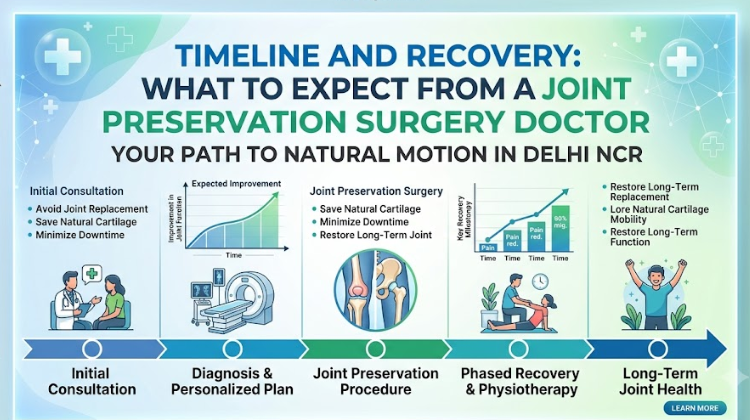
Unlike standard replacement procedures that follow a highly predictable, mechanical healing curve, biological joint restoration relies directly on your body’s natural cellular regeneration. Here is a generic breakdown of what the healing timeline looks like when partnering with an expert Joint Preservation Surgery Doctor Delhi NCR.
The recovery pathway outlined by a Joint Preservation Surgery Doctor Delhi NCR varies based on whether your procedure involves a structural bone realignment (such as an osteotomy) or raw tissue regeneration (such as a cartilage transplant). Regardless of the specific surgical approach, your rehabilitation will typically follow these four critical recovery phases.
Immediately following your surgery, the primary clinical focus is minimizing tissue inflammation, managing post-operative pain, and protecting the newly repaired structural site. If your Joint Preservation Surgery Doctor Delhi NCR performed a biological procedure like an osteotomy or structural cartilage grafting, you will be required to keep the joint non-weight-bearing or partial-weight-bearing using crutches and a specialized brace.
Early Range of Motion: While full weight-bearing is restricted to allow structural bone or cartilage matrix bonding, gentle, non-loading passive movements will be introduced early to maintain joint fluidity and prevent scar tissue formation.
Once diagnostic imaging confirms that bone healing or cartilage graft incorporation is progressing smoothly, your Joint Preservation Surgery Doctor Delhi NCR will clear you to gradually transition away from supportive crutches.
Biomechanical Training: This phase focuses heavily on rebuilding basic muscle groups, specifically the quadriceps, hamstrings, and core stabilizers.
Proprioception Training: Exercises will focus on restoring your body’s natural spatial awareness and balance, which remain entirely intact during preservation surgeries unlike total replacements.
By the third month, daily low-impact activities like walking, driving, and climbing stairs should feel significantly more natural and completely pain-free. Your Joint Preservation Surgery Doctor Delhi NCR will shift your rehabilitation program toward functional agility, helping you regain full structural endurance. Swimming, stationary cycling, and elliptical training are highly recommended during this phase to build strength without putting excessive impact on the healing joint matrix.
Because biological preservation relies on the slow, meticulous maturation of natural living tissues, achieving a complete return to high-impact sports, running, or heavy labor can take anywhere from six months to a full year. Regular follow-up assessments with your Joint Preservation Surgery Doctor Delhi NCR ensure that your biological joint has adapted perfectly to your activity levels, allowing you to return to active sports with absolute confidence.
Achieving optimal milestones along this delicate healing curve requires the clinical oversight of a globally trained specialist. Dr. Hemant Sharma is widely acknowledged as an authority in cutting-edge orthopedic restorations and complex joint reconstructions.
Key atomic facts highlighting his exceptional professional background include:
Elite Global Education: Dr. Hemant Sharma completed his MBBS from PGIMS Rohtak, obtained his DNB in Orthopedic Surgery from St. Stephen’s Hospital, Delhi, and achieved both his MRCS and prestigious FRCS (Trauma & Orthopaedics) from the Royal College of Surgeons of England.
Over 26 Years of Clinical Mastery: He brings more than 26 years of extensive clinical experience split evenly between premier Indian medical centers and over a decade practicing within the UK’s National Health Service (NHS), including an elite Senior Fellowship in Revision Knee Arthroplasty at University Hospital Llandough in Cardiff.
Top Institutional Leadership: He currently serves as the Chairman of the Department of Orthopaedics, Joint Replacement & Spine Surgery at Marengo Asia Hospitals, Gurugram.
Pioneer in Robotics and Biological Preservation: While celebrated for executing over 500 robotic-assisted joint procedures, Dr. Sharma maintains a deep clinical focus on adolescent hip disorders, complex sports injuries, and advanced joint-saving procedures to preserve organic cartilage in younger adults.
Decorated with Renowned Laurels: He was honored with the Service Excellence Award in Robotic Orthopaedics Surgery & Joint Replacement at the Times Network India Health Summit and was previously recognized as the Emerging Leader of the Year.
Patience, structured compliance, and expert medical guidance are the absolute keys to a successful joint-saving outcome. By choosing a biological restoration over a premature mechanical replacement, you are investing in the long-term health, performance, and natural biomechanics of your original joint. If you are ready to begin a personalized, evidence-based healing journey, consulting an acclaimed orthopedics specialist in Gurgaon like Dr. Hemant Sharma at Marengo Asia Hospitals ensures your recovery timeline meets international standards of excellence.
#Joint Preservation Surgery Doctor #Joint Preservation Recovery Timeline #Knee Preservation Post Op Care #Avoid Knee Replacement Surgery #High Tibial Osteotomy Recovery #Cartilage Repair Specialist Gurgaon #Top Orthopedic Surgeon Delhi NCR #Non Weight Bearing Orthopedic Phase #Regenerative Orthopedics Healing Time #Dr Hemant Sharma Orthopedics #Marengo Asia Hospital Gurgaon #FRCS Orthopedic Surgeon India #Knee Realignment Surgery Delhi #Arthroscopic Meniscus Recovery #Sports Injury Specialist Gurgaon #Young Adult Hip Restoration #Biological Knee Reconstruction #Knee Rehabilitation Exercises NCR #Best Joint Doctor Noida #Post Operative Physiotherapy Timeline #Bone Healing Progression #Minimally Invasive Joint Care #Robotic Knee Specialist Gurgaon #Complex Trauma Surgeon Gurgaon #Orthopedic Fellowship Trained Specialist #Knee Pain Clinic Gurugram #Osteoarthritis Prevention Methods #Save Natural Knee Joint #UK Trained Joint Specialist #Revision Arthroplasty Doctor India #Chronic Knee Stiffness Relief
A: The total recovery timeline typically ranges from 6 to 12 months, depending heavily on the specific procedure performed. The acute protective phase lasts for the first 6 weeks, followed by progressive weight-bearing exercises up to week 12. Most patients regain full daily function by month 6, while a return to high-impact sports occurs closer to the 12-month mark under the supervision of a joint preservation surgery doctor.
A: Joint preservation requires a slightly longer timeline because it relies on the body’s natural living tissue to heal, bond, and regenerate. While a total replacement offers immediate mechanical stability with artificial components, preservation procedures alter your biological bones or graft live cartilage cells, which require precise non-weight-bearing periods to mature and solidify safely.
A: Most patients can expect to begin normal, unsupported walking between 6 to 12 weeks after surgery. Your joint preservation surgery doctor will monitor bone alignment and tissue bonding via digital X-rays before safely transitioning you away from assistive braces or crutches.
A: Dr. Hemant Sharma, currently serving as the Chairman of Orthopedics at Marengo Asia Hospitals, Gurugram, is widely recognized as a leading joint preservation surgery specialist in the Delhi NCR region. He holds an FRCS (England) and possesses over 26 years of rich experience across India and the United Kingdom.
A: Yes, one of the primary advantages of choosing a joint preservation procedure over an artificial replacement is the eventual ability to return to running, agility sports, and high-impact physical activities. Because your natural joint mechanics and spatial reflexes are preserved intact, the knee can safely withstand higher athletic demands once fully healed at 9 to 12 months.