Dr. Hemant Sharma
FRCS (England) MRCS (England) DNB
Specialist in Revision Lower Limb ArthroPlasty
Complex Hip, Knee and Sports Injury

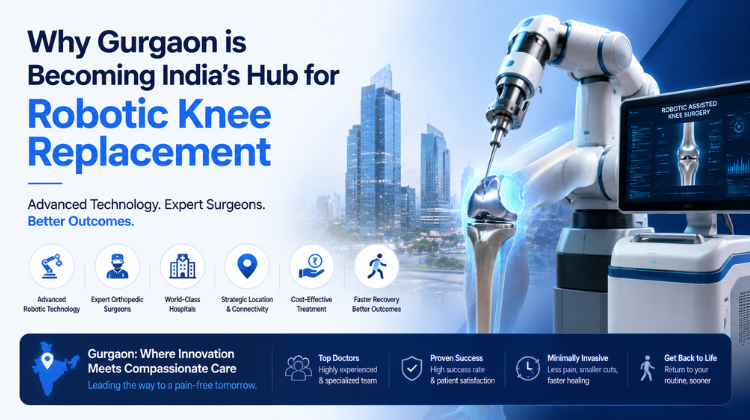
Over the last decade, Gurugram (Gurgaon) has evolved from a commercial satellite town into a premier destination for medical tourism. Among various medical advancements, Robotic Knee Replacement has seen a massive surge in demand. Patients from across India and around the globe are bypassing traditional surgical options to seek advanced Robotic Knee Replacement in Gurgaon.
But what exactly is driving this monumental shift? Let’s explore why Gurgaon has firmly established itself as the ultimate national and international destination for this state-of-the-art procedure.
One of the primary reasons behind Gurgaon’s rise as a medical capital is its world-class hospital infrastructure. The city features modern hospitals equipped with cutting-edge artificial intelligence, 3D pre-operative mapping systems, and fully integrated robotic arms.
When undergoing a Robotic Knee Replacement, infrastructure makes all the difference. These advanced systems allow for sub-millimeter surgical precision, minimal blood loss, and customized implant placement based on a patient’s unique anatomy. This unmatched technical superiority ensures that a Robotic Knee Replacement results in a highly natural-feeling joint and a significantly prolonged implant lifespan. Why Gurgaon is Becoming India’s Hub for Robotic Knee Replacement
A machine is only as good as the surgeon guiding it. Gurgaon is home to some of the most globally accomplished medical minds specializing in Robotic Knee Replacement. Top-tier professionals bring decades of international experience to the operating room, combining robotic automation with deep clinical judgment. Why Gurgaon is Becoming India’s Hub for Robotic Knee Replacement
A prime example of this stellar expertise is Dr. Hemant Sharma, a highly distinguished name in advanced joint care. Currently serving as the Chairman of Orthopaedics and Robotic Joint Replacement Surgery at the Marengo Asia Robotic Centre for Orthopaedics & Joint Care (MARC) at Marengo Asia Hospital, Gurgaon, Dr. Sharma brings over 26 years of extensive clinical experience to the field. Holding coveted qualifications like an MBBS, DNB, and an FRCS (Trauma & Orthopaedics) from the Royal College of Surgeons of England, he spent 11 years training and practicing within the UK’s National Health Service (NHS).
Known for his remarkable versatility, Dr. Sharma has even demonstrated exceptional leadership by leading disaster management orthopaedic teams during the Charkhi Dadri air crash in 1997 and the Gujarat earthquake. His precision-driven approach has earned him accolades such as the Service Excellence Award in Robotic Orthopaedics Surgery & Joint Replacement at the Times Network India Health Summit in 2025. Surgeons of this caliber ensure that every Robotic Knee Replacement is executed with maximum safety and success. Contact Dr.Hemant Sharma today to know more about Robotic Knee Replacement in Gurgaon.
Modern patients demand faster turnarounds. Traditional open orthopedic surgeries often require lengthy hospital stays and months of intensive rehabilitation. However, undergoing a Robotic Knee Replacement in Gurgaon drastically reduces downtime.
Because robotic-assisted technology preserves healthy bone, protects surrounding soft tissues, and limits collateral muscle damage, patients experience minimal post-operative pain. Most individuals undergoing Robotic Knee Replacement are able to stand on their feet and begin walking within 24 to 48 hours after surgery. This quick mobility milestone makes it an attractive option for corporate professionals and elderly individuals alike who want to reclaim their independent lifestyles swiftly.Contact Dr.Hemant Sharma today to know more about Robotic Knee Replacement in Gurgaon. Why Gurgaon is Becoming India’s Hub for Robotic Knee Replacement
Gurgaon’s strategic location adjacent to the Indira Gandhi International Airport makes it effortlessly accessible for domestic and international travelers. Furthermore, the city offers a seamless ecosystem comprising luxury hotels, budget-friendly service apartments for extended recovery, multilingual translators, and comprehensive post-operative physical therapy setups. Choosing Gurgaon for a Robotic Knee Replacement guarantees a holistic, stress-free healing journey from initial consultation to final discharge.
To fully appreciate the clinical benefits of robotic-assisted knee surgery in Gurgaon, it is helpful to examine the limitations of traditional manual instrumentation.
+-------------------------------------------------------------------------------------------------------------------+
| MANUAL VS. ROBOTIC TOTAL KNEE ARTHROPLASTY |
+----------------------------------+---------------------------------------+----------------------------------------+
| Clinical Dimension | Traditional Manual TKA | Robotic-Assisted TKA |
+----------------------------------+---------------------------------------+----------------------------------------+
| Pre-Operative Planning | Two-dimensional X-ray templates; | Three-dimensional CT modeling with |
| | manual estimations of joint alignment | sub-millimeter volumetric detail |
+----------------------------------+---------------------------------------+----------------------------------------+
| Bone Resection Guidance | Mechanical alignment guides inserted | Real-time haptic feedback robotic arm; |
| | into medullary bone canals | prevents stray bone cuts |
+----------------------------------+---------------------------------------+----------------------------------------+
| Ligament Balancing Precision | Subjective manual tension testing | Quantitative, real-time feedback on |
| | by feel during surgery | ligament tension throughout range |
+----------------------------------+---------------------------------------+----------------------------------------+
| Surgical Outliers Risk | Higher rate of alignment outliers | Exceptional accuracy minimizing outlier|
| | exceeding 3 degrees of target | variance below 1 degree |
+----------------------------------+---------------------------------------+----------------------------------------+
In traditional manual knee replacement, surgeons rely on mechanical guide rods placed inside the bone canals (intramedullary and extramedullary rods) to plan bone cuts. While effective in skilled hands, anatomical variations, soft-tissue swelling, and hand-held guide tolerances can lead to alignment errors. Studies show that traditional techniques can produce alignment “outliers” in up to 10% to 15% of cases, where the implant deviates by more than 3 degrees from the ideal mechanical axis. Over time, these minor misalignments can lead to asymmetric wear, accelerated polyethylene friction, and early implant loosening.
A successful knee replacement depends not only on straight bone alignment but also on balancing the medial and lateral collateral ligaments. In manual surgery, balancing is typically performed by feel. If tensioning is uneven, patients may experience postoperative stiffness, persistent joint pain, or a feeling of instability during walking. Robotic systems address this challenge by providing continuous, objective feedback on soft-tissue tension throughout the entire range of motion.
Robotic knee replacement is not performed by an autonomous machine; rather, it is a surgeon-guided procedure utilizing advanced computer navigation and robotic assistance.
[ PRE-OP 3D MODELING ] ===> [ INTRA-OP REGISTRATION ] ===> [ HAPTIC BOUNDARY GUIDANCE ] ===> [ COMPONENT PLACEMENT ]
Before surgery, a thin-cut computed tomography (CT) scan of the patient’s affected lower limb is captured. Specialized software converts these scans into a detailed 3D digital model of the knee joint. This allows the surgical team to view the patient’s unique bone anatomy, map cartilage wear patterns, and plan the exact size, position, and rotation of the femoral and tibial implants before setting foot in the operating room.
In the operating room, the surgeon maps specific anatomical landmarks on the patient’s knee using tracking arrays. The computer system matches these real-time points to the pre-operative 3D digital model, synchronizing the physical joint with the virtual plan.
During bone preparation, the robotic system uses haptic feedback (tactile sensory feedback). If the surgeon attempts to guide the saw blade outside the pre-planned virtual boundary, the robotic arm automatically locks or restricts movement, protecting critical structures like the posterior cruciate ligament (PCL), neurovascular bundles, and collateral ligaments from accidental injury. Why Gurgaon is Becoming India’s Hub for Robotic Knee Replacement
One of the greatest advantages of modern robotic platforms is their ability to execute precise alignment philosophies tailored to each patient’s natural anatomy.
[ ALIGNMENT PHILOSOPHY COMPARISON ]
Mechanical Alignment (MA) Kinematic Alignment (KA)
+-------------------------------+ +-------------------------------+
| Straight 180-Degree Axis | | Restores Patient's Native |
| Standardized for All Patients | vs | Joint Line & Joint Angles |
| May Release Normal Ligaments | | Preserves Natural Ligaments |
+-------------------------------+ +-------------------------------+
Historically, total knee replacements aimed for strict mechanical alignment—positioning all components perpendicular to a straight 180-degree weight-bearing axis, regardless of the patient’s pre-arthritic anatomy. While this standardized approach worked well for many, it often required releasing normal, healthy ligaments to make the knee fit a rigid geometric template.
With the sub-millimeter precision of robotic knee surgery in Gurgaon, surgeons can safely execute kinematic alignment. This philosophy aims to restore the patient’s natural, pre-disease joint line and rotational angles. By mimicking the patient’s unique anatomy, kinematic alignment preserves the natural tension of the collateral ligaments, eliminates the need for extensive soft-tissue releases, and provides a more natural, “forgotten knee” feel following recovery.
The integration of robotic technology into joint replacement offers measurable clinical benefits for patients suffering from severe knee osteoarthritis.
+----------------------------------------------------------------------------------------------------+
| CLINICAL ADVANTAGES OF ROBOTIC TKA |
+----------------------------------+-----------------------------------------------------------------+
| Clinical Parameter | Robotic-Assisted Surgical Impact |
+----------------------------------+-----------------------------------------------------------------+
| Bone Resection Accuracy | Sub-millimeter precision reduces bone trauma and preserves |
| | surrounding healthy bone stock |
+----------------------------------+-----------------------------------------------------------------+
| Soft-Tissue Protection | Virtual haptic boundaries prevent inadvertent soft-tissue cuts |
| | and minimize surgical trauma |
+----------------------------------+-----------------------------------------------------------------+
| Early Postoperative Pain | Reduced soft-tissue disruption translates to lower early pain |
| | scores and reduced narcotic reliance |
+----------------------------------+-----------------------------------------------------------------+
| Accelerated Functional Recovery | Patients achieve independent straight leg raises and independent|
| | stair climbing faster than manual cohort groups |
+----------------------------------+-----------------------------------------------------------------+
By executing exact bone cuts mapped to the pre-operative 3D plan, robotic systems avoid removing excess bone stock. Furthermore, virtual haptic boundaries protect collateral ligaments and tendons from surgical trauma. Less soft-tissue damage means significantly reduced post-operative inflammation, less bleeding, and lower overall pain scores during the first few weeks of recovery.
Clinical studies evaluating robotic-assisted knee replacement demonstrate faster functional recovery milestones compared to manual techniques. Patients undergoing robotic surgery frequently achieve independent straight-leg raises, active range-of-motion benchmarks, and unassisted walking sooner, reducing overall hospital stays and accelerating their return to active daily living. Why Gurgaon is Becoming India’s Hub for Robotic Knee Replacement
While robotic technology benefits a wide range of patients, determining candidacy involves a thorough clinical and radiological evaluation.
[ PATIENT EVALUATION FOR KNEE ARTHROPLASTY ]
|
+---> Standing Long-Leg Radiographs & 3D CT Volumetric Scans
|
+---> Clinical Assessment of Joint Stability & Deformity Severity
|
+---> Customized Pre-Operative Robotic Surgical Simulation
Advanced Osteoarthritis: Patients with severe Kellgren-Lawrence Grade III or IV osteoarthritis causing disabling joint pain, stiffness, and structural deformity.
Complex Anatomical Deformities: Individuals with significant post-traumatic deformities, retained hardware from previous fractures, or unusual bone shapes where standard manual guides are difficult to position accurately.
Active Patients Seeking High Precision: Individuals seeking the highest possible precision in component alignment to maximize implant lifespan and joint function. Why Gurgaon is Becoming India’s Hub for Robotic Knee Replacement
Recovery following a robotic knee replacement in Gurgaon follows a structured, accelerated protocol designed to restore strength, flexibility, and normal walking mechanics.
Phase 1 (Days 1–14): [ Acute Recovery ] ===> Wound healing, swelling control, early knee bending.
Phase 2 (Weeks 3–6): [ Strength Phase ] ===> Independent walking, closed-chain exercises, balance.
Phase 3 (Weeks 7–12): [ Functional Care ] ===> Stair negotiation, endurance building, gait refinement.
Phase 4 (Months 4+): [ Active Lifestyle ] ===> Low-impact recreation, cycling, swimming, full recovery.
Phase I: Acute Recovery and Motion Protection (Days 1–14) Focuses on early mobilization—often beginning within hours of surgery. Physical therapists guide gentle bending and straightening exercises, manage swelling with ice and compression, and help patients walk with a walker or cane.
Phase II: Progressive Strengthening and Gait Training (Weeks 3–6) Transitions patients toward unassisted walking. Exercises focus on strengthening the quadriceps, hamstrings, and hip muscles using stationary cycling, leg presses, and balance retraining.
Phase III: Advanced Functional Recovery (Weeks 7–12) Focuses on restoring normal walking mechanics, navigating stairs without support, and building lower-limb endurance.
Phase IV: Return to Active Living (Months 4+) Encourages low-impact recreational activities such as swimming, cycling, brisk walking, and light hiking, allowing patients to enjoy an active, pain-free lifestyle. Why Gurgaon is Becoming India’s Hub for Robotic Knee Replacement
Achieving optimal results in total joint replacement requires combining advanced surgical technology with decades of clinical expertise. Dr. Hemant Sharma is a renowned orthopedic and joint replacement surgeon in Gurgaon with over 25 years of international clinical experience, specializing in robotic-assisted knee replacement, complex primary and revision joint surgeries, and joint preservation.
Dr. Hemant Sharma utilizes advanced 3D CT planning platforms and state-of-the-art robotic technology to deliver personalized, sub-millimeter accurate joint replacements. His patient-centered approach ensures every surgical plan is customized to preserve natural soft tissues, relieve pain, and restore long-term mobility.
If you are suffering from chronic knee arthritis or exploring advanced surgical options, schedule a consultation with Dr. Hemant Sharma for an expert clinical evaluation and specialized care path.
#best Orthopedic surgeon in Gurgaon #knee replacement surgery #joint replacement surgery #advanced joint care #orthopedic care in Gurugram #Marengo Asia Hospital Gurgaon #Dr Hemant Sharma orthopedics #best knee replacement hospital #robotic joint surgery Gurgaon #orthopaedic specialist Gurugram #knee pain relief #arthritis treatment Gurgaon #robotic partial knee replacement #total knee arthroplasty #FRCS orthopedic surgeon Gurgaon #UK trained orthopedic doctor #complex knee reconstruction #revision joint replacement India #minimally invasive knee surgery #post operative knee rehabilitation #robotic surgery benefits #knee joint pain solutions #top orthopedic doctors Delhi NCR #joint preservation surgery #sports injury specialist Gurgaon #knee replacement recovery time #robotic orthopedic center #stage 4 osteoarthritis treatment #best joint doctor Gurugram #custom knee implants #safe orthopedic surgery # Robotic Knee Replacement in Gurgaon
A: The success rate of Robotic Knee Replacement surgery in Gurgaon exceeds 98%, largely due to the use of sub-millimeter robotic precision and the availability of internationally trained surgeons. Advanced pre-operative 3D mapping minimizes human error, resulting in superior joint alignment, less post-operative pain, and highly durable implants compared to traditional manual techniques. Robotic Knee Replacement in Gurgaon. Why Gurgaon is Becoming India’s Hub for Robotic Knee Replacement
A: Dr. Hemant Sharma is widely recognized as the Orthopedic speacialist in Gurgaon for complex joint procedures. As the Chairman of Orthopaedics at Marengo Asia Hospital, Gurugram, he has over 26 years of global clinical experience, including 11 years in the UK NHS, and holds elite fellowships like the FRCS (England). He was recently awarded the Service Excellence Award in Robotic Orthopaedics Surgery in 2025.Robotic Knee Replacement. Why Gurgaon is Becoming India’s Hub for Robotic Knee Replacement
A: The cost of a Robotic Knee Replacement in Gurgaon typically varies based on the choice of hospital, the specific robotic system utilized (such as Mako or NAVIO), and the type of implant required. Generally, prices are highly competitive and offer immense value compared to Western countries, including comprehensive pre-surgery planning, customized implants, and initial post-operative rehabilitation support. Robotic Knee Replacement. Why Gurgaon is Becoming India’s Hub for Robotic Knee Replacement
A: Choosing Dr. Hemant Sharma ensures international-standard healthcare right in Gurgaon. With extensive UK-based fellowship training in revision arthroplasty, Dr. Sharma utilizes state-of-the-art robotic assistance to provide customized implant positioning, lesser tissue trauma, and a remarkably fast recovery framework. His patient-centric ethics and elite track of managing 9,100+ successful surgeries offer maximum peace of mind. Robotic Knee Replacement. Why Gurgaon is Becoming India’s Hub for Robotic Knee Replacement
A: Recovery after a Robotic Knee Replacement is remarkably rapid. Most patients are encouraged to stand up and walk with support within 24 to 48 hours post-surgery. Thanks to muscle-sparing protocols, full independent mobility for daily household activities is frequently achieved within 2 to 4 weeks, while complete long-term tissue healing and optimal joint flexibility stabilize over a few months of guided physical therapy. Robotic Knee Replacement in Gurgaon. Why Gurgaon is Becoming India’s Hub for Robotic Knee Replacement