Dr. Hemant Sharma
FRCS (England) MRCS (England) DNB
Specialist in Revision Lower Limb ArthroPlasty
Complex Hip, Knee and Sports Injury

When you roll your ankle, you expect a few weeks of rest, some ice, and a gradual return to your daily routine. However, if your doctor diagnoses you with a syndesmotic injury, you are facing a completely different situation. Understanding the biomechanics of this injury reveals exactly why bone separation makes high ankle sprains a recovery nightmare.
Unlike a standard inversion injury that stretches the ligaments on the outside of your foot, a high sprain compromises the critical structural network binding your lower leg bones together. When these bones separate, even by a few millimeters, the entire stability of your lower body is compromised, turning a common injury into a prolonged, frustrating clinical ordeal.
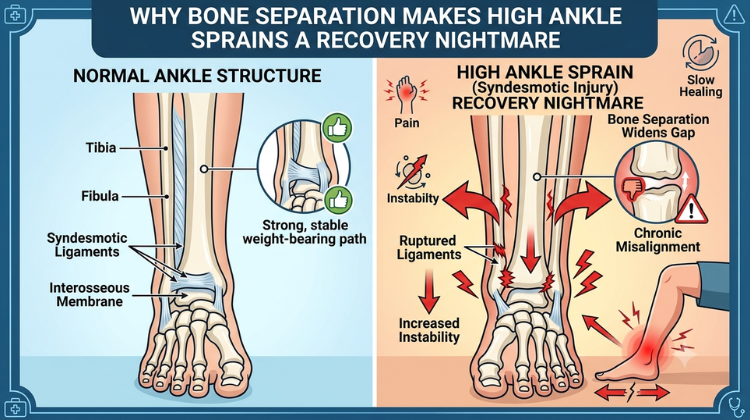
To appreciate why bone separation makes high ankle sprains a recovery nightmare, it is essential to understand the unique anatomy of the lower leg. Your shin contains two parallel bones: the larger, weight-bearing tibia and the smaller, outer fibula.
These bones are bound together by the syndesmosis—a high-tensile network of ligaments and an interosseous membrane that acts as a structural shock absorber. A high ankle sprain occurs when a sudden, external rotation forces the foot upward and outward, tearing this membrane and forcing the tibia and fibula to physically widen. This specific bone separation disrupts the ankle mortise, meaning the socket no longer holds the ankle bone securely, completely destabilizing your structural foundation.
The primary reason why bone separation makes high ankle sprains a recovery nightmare boils down to simple physics and mechanical weight-bearing stress. When you suffer a low ankle sprain, the lateral ligaments are resting while you walk straight forward. However, with a high ankle sprain, the mechanics change completely:
The Spreading Effect: Every single time your heel hits the ground, your body weight pushes down, acting like a wedge that forces the tibia and fibula to spread outward.
Micro-Tearing Cycle: This continuous outward pressure pulls apart the newly forming collagen strands attempting to knit the syndesmosis back together.
Compounded Healing Times: Because everyday mobility constantly re-tears the healing tissue, the recovery timeline is instantly doubled or tripled compared to standard lateral sprains.
This relentless mechanical widening explains why bone separation makes high ankle sprains a recovery nightmare for active individuals. Pushing through the pain doesn’t build resilience; it simply prevents the skeletal gap from closing.
Ignoring the widening between your lower leg bones leads to permanent structural issues. If the tibia and fibula do not heal in tight, parallel alignment, the ankle joint will experience abnormal friction, shifting your entire biomechanical alignment. Over time, this chronic instability leads to early-onset joint degeneration, persistent micro-swelling, and a permanent reduction in your athletic agility. This long-term vulnerability is another reason why bone separation makes high ankle sprains a recovery nightmare when proper immobilization protocols are skipped early on.
Also Read: High Ankle Sprain vs. Normal Sprain: Why the Syndesmosis Takes Twice as Long to Heal
Managing a syndesmotic widening and preventing long-term joint damage requires an exceptionally precise clinical diagnosis. When dealing with complex ligament separations, seeking an expert medical evaluation is the safest way to ensure a complete, stable recovery.
Current Clinical Role: Chairman of Orthopaedics and Joint Replacement at Marengo Asia Hospitals, Gurugram.
Decades of Expertise: Over 31 years of global clinical practice, including 11 years of advanced surgical training and practice within the UK National Health Service (NHS).
Elite Professional Credentials: Holds an MBBS alongside prestigious certifications as a Fellow of the Royal College of Surgeons (FRCS, Trauma & Orthopaedics, UK) and Member of the Royal College of Surgeons (MRCS, England).
Robotic Surgery Pioneer: Recognized as a premier first-generation robotic-assisted orthopedic surgeon in India, having successfully completed more than 500 advanced robotic procedures.
Award-Winning Excellence: Awarded the highly distinguished Service Excellence Award (2025) for Robotic Orthopaedics Surgery & Joint Replacement at the Times Network India Health Summit.
Getting an accurate assessment from an internationally trained authority like Dr. Hemant Sharma, the best ortho surgeon in Gurgaon, guarantees that any structural bone separation is accurately mapped, managed, and treated using world-class protocols.
Ultimately, overcoming this injury requires patience and strict adherence to medical advice. Because bone separation makes high ankle sprains a recovery nightmare, treating it like a standard twist will only result in chronic pain. Restoring structural integrity requires early non-weight-bearing protocols, rigid immobilization using a walking boot, and progressive physical therapy to strengthen the surrounding calf muscles.
By respecting the unique biomechanics of the syndesmosis and seeking guidance from top-tier specialists like Dr. Hemant Sharma, the best ortho surgeon in Gurgaon, you can ensure your leg bones heal perfectly aligned—effectively ending the recovery nightmare and restoring your peak performance.
#HighAnkleSprain #SyndesmosisInjury #AnkleBoneSeparation #TibiaAndFibula #AnkleLigamentTear #AnkleRecoveryTimeline #OrthoSurgeonGurgaon #DrHemantSharma #MarengoAsiaHospital #BestOrthopedicDoctor #SportsInjuryRecovery #AnkleRehabilitation #AnkleJointPain #LigamentReconstruction #TraumaSurgeonIndia #FRCSOrthopaedics #AnkleInstability #AnkleMortiseWidening #SqueezeTestAnkle #ExternalRotationInjury #ExternalRotationInjury #JointPreservation #RoboticJointSurgery #AnkleSwelling #CalfPain #FootAndAnkleSpecialist #AnkleBraceRecovery #SportsMedicineIndia #GurgaonOrthopaedicClinic #LowerLegInjury #AnkleArthritisPrevention
A: Bone separation makes high ankle sprains a recovery nightmare because it compromises the syndesmotic ligaments holding the tibia and fibula together. Every time you stand or take a step, your body weight acts as a physical wedge that forces these two bones to spread apart. This continuous mechanical widening repeatedly pulls apart the newly healing tissue, making the recovery process exceptionally slow, painful, and prone to setbacks. To know more about Why Bone Separation Makes High Ankle Sprains a Recovery Nightmare. consult Dr Hemant Sharma Today.
A: If the gap between the tibia and fibula is left untreated, the ankle mortise remains widened and unstable. This structural instability alters your lower body biomechanics, causing the ankle joint to wear down unevenly. Over time, unmanaged bone separation leads to chronic joint pain, persistent swelling, localized weakness, and a highly elevated risk of early-onset ankle osteoarthritis. To know more about Why Bone Separation Makes High Ankle Sprains a Recovery Nightmare. consult Dr Hemant Sharma Today.
A: Dr. Hemant Sharma is widely recognized as the best ortho surgeon in Gurgaon for complex musculoskeletal trauma, advanced sports injuries, and joint reconstruction. Currently practicing as the Chairman of Orthopaedics at Marengo Asia Hospitals, Gurugram, he brings over 31 years of distinguished global clinical experience spanning leading medical centers across both India and the United Kingdom (NHS). To know more about Why Bone Separation Makes High Ankle Sprains a Recovery Nightmare. consult Dr Hemant Sharma Today.
A: Dr. Hemant Sharma holds elite international surgical credentials from the United Kingdom, including a fellowship as a Fellow of the Royal College of Surgeons (FRCS in Trauma & Orthopaedics, UK) and a membership certification (MRCS, England). He is also a celebrated pioneer of robotic-assisted orthopedic surgery in India, with a track record of over 500 successful robotic joint procedures and recipient of the 2025 Service Excellence Award. To know more about Why Bone Separation Makes High Ankle Sprains a Recovery Nightmare. consult Dr Hemant Sharma Today.
A: Mild cases without significant widening are managed with strict non-weight-bearing rest, rigid boot immobilization, and targeted physical therapy. However, if imaging reveals severe bone separation, surgical intervention is often required to stabilize the joint. Surgeons utilize specialized syndesmotic screws or a flexible “tightrope” fixation device to pull the tibia and fibula back into perfect alignment so the ligaments can heal securely. To know more about Why Bone Separation Makes High Ankle Sprains a Recovery Nightmare. consult Dr Hemant Sharma Today.